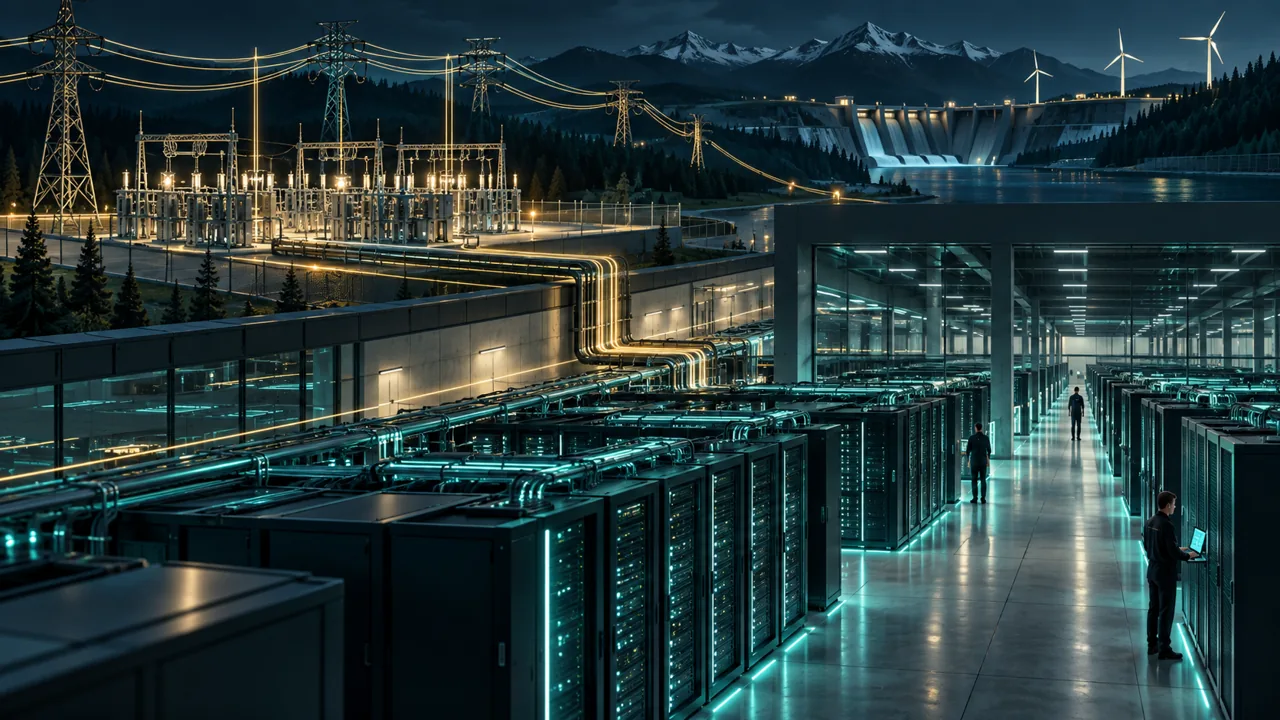
A data-centre announcement can describe a site, a financing plan, a grid connection request or a facility that is actually operating. Headlines often flatten these stages into one story about limitless AI growth. The International Energy Agency instead offers scenarios with assumptions: its 2026 analysis projects global data-centre electricity demand rising from roughly 485 TWh in 2025 to about 950 TWh in 2030.
That is a projection, not a meter reading from the future. Grid constraints, efficiency improvements and the pace of AI adoption can push the outcome away from the central case. For Canadian readers, the next questions involve electricity supply, network connectivity, public resources and who benefits from the capacity built here.
How large is the demand—and how uncertain?
The IEA says data-centre electricity use grew in 2025, with AI-focused sites growing faster. Its updated projection points to roughly a doubling by 2030 and about 3% of global electricity demand. Global totals matter, but electricity infrastructure is local: a project needs a suitable site, connection, cooling, transmission and a source of power at the time it is needed.
Power demand also varies with how systems are used. Training a large model is not the same pattern as serving millions of small requests. More efficient chips and software can reduce energy per task while lower prices stimulate more use. That is why a straight line from one model release to one power-plant requirement is usually unreliable.
Related sources: IEA: Key Questions on Energy and AI ↗
Canada’s sovereign-compute plans are a starting line
The federal Canadian Sovereign AI Compute Strategy describes support for domestic commercial capacity, public supercomputing infrastructure and access to compute resources. Its aim is to give Canadian researchers and companies more capacity under Canadian governance. A strategy document or application round is not proof that a machine is already online or that every small firm can afford it.
Track the milestones separately: announced support, signed agreements, a construction start, electricity and network connections, commissioning, available capacity and actual customers. The location of a server alone does not settle the questions of software control, hardware supply chains or data access. “Sovereign” has to be explained in operational terms.
Related sources: Canadian Sovereign AI Compute Strategy ↗
Is this an AI bubble? Follow use and returns
“Bubble” is a question about the relationship between investment and future value, not a technical measurement. A building can be necessary infrastructure and still be financed on overly optimistic assumptions. Conversely, a setback on one project does not prove all AI demand is imaginary. Evaluate contracts, occupancy, operating costs and whether customers repeatedly pay for applications that solve real problems.
Readers should also separate a government investment ceiling from money already disbursed. Project announcements frequently use future-tense language. Check dates, funding status and whether the underlying service is commercially available before repeating a capacity claim.
Where internet performance enters the picture
Data centres exchange large amounts of information with storage systems, partners and end users. Network routes and latency matter for interactive tools, while moving datasets can place more emphasis on sustained throughput. A person with a fast home plan may still experience a slow AI app if its provider is distant, busy or constrained elsewhere in the path.
AI Speed measures the route from your browser to this site’s endpoint. It is useful for understanding your connection, but it is not a measurement of a specific AI data centre. If an application matters to your organization, measure that application from the Canadian locations and devices where people actually use it.
Sources and editorial method
We use the linked original statements and reports to distinguish documented facts from our analysis. Company announcements describe their authors’ plans and claims; they are not independent verification of future outcomes. This article is dated and will be revised if material evidence changes.
- IEA: Key Questions on Energy and AI ↗ — Updated 2026 electricity observations and scenarios.
- Canadian Sovereign AI Compute Strategy ↗ — Federal description of intended compute investments and access.