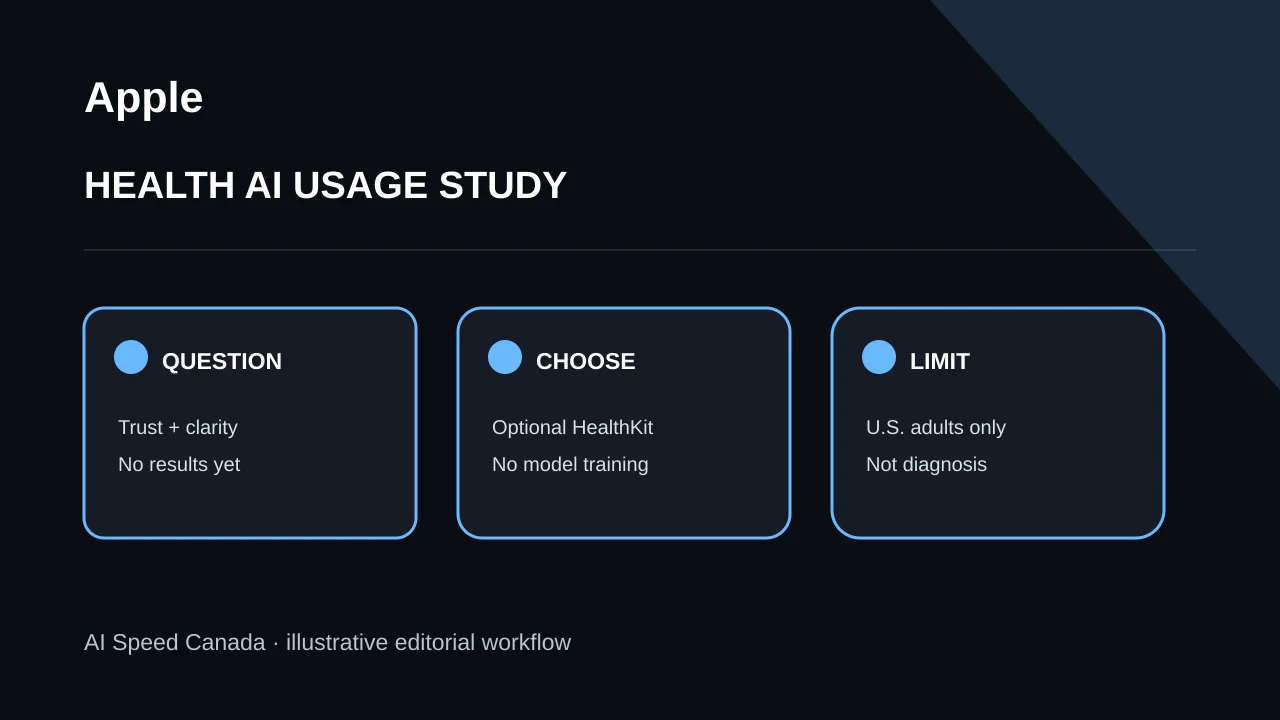
Apple announced the Apple Health AI Usage Study on November 15, 2026 in collaboration with OpenEvidence. The virtual U.S. study and its associated app are designed to examine how people use conversational health AI, including trust, comprehension, response quality and health-related actions. Launching recruitment is a completed event; no study findings have yet been reported.
The study tests interaction with health AI, not a new treatment
Participants can ask everyday health questions, read responses linked to peer-reviewed clinical citations and prepare for visits with clinicians. Apple says the OpenEvidence system draws on established medical sources. That description does not establish that every response will be complete or correct; Apple’s own announcement says large-language-model health answers can be incomplete or unclear.
The app is not intended to diagnose or treat a condition or replace professional advice. A useful future evaluation will need to explain how trust, comprehension and behaviour are measured, which questions participants ask, how errors are classified and whether outcomes differ across groups. The planned enrolment ceiling alone is not evidence of clinical benefit.
Related sources: Apple: Apple Health AI Usage Study announcement ↗
HealthKit sharing is optional, and training use is expressly excluded
Participants may choose whether to share HealthKit data such as resting heart rate, activity, sleep or laboratory results and whether to share survey responses. Apple says study data will not be used to train AI models, and describes security measures, confidentiality protections and guardrails intended to direct certain concerning questions toward a provider or other resources.
Those are study-design claims, not an independent privacy audit. Prospective participants should read the consent materials, identify what Apple and OpenEvidence each receive, understand withdrawal and deletion procedures, and avoid assuming that an optional data connection is necessary. Researchers should eventually report withdrawals, missing data and safety escalations alongside positive findings.
Related sources: Apple: Apple Health AI Usage Study announcement ↗
Canadians cannot enrol in the announced study
Apple says enrolment is limited to up to 200,000 eligible U.S. participants aged 21 or older. Participants need an Apple Intelligence-enabled iPhone—iPhone 15 Pro or later—running iOS 26 or later. The November 15 announcement does not offer Canadian enrolment or a Canadian launch date.
The restriction matters because U.S. recruitment cannot automatically answer questions about Canadian care pathways, languages, population diversity or provincial privacy and health systems. Canadian clinicians and policymakers can learn from a rigorously reported study, but should wait for methods and results rather than treating an Apple product announcement as general evidence. Any Canadian deployment would require its own dated availability, consent and governance details.
Sources and editorial method
We use the linked original statements and reports to distinguish documented facts from our analysis. Company announcements describe their authors’ plans and claims; they are not independent verification of future outcomes. This article is dated and will be revised if material evidence changes. Read our editorial standards and corrections process.
- Apple: Apple Health AI Usage Study announcement ↗ — Official November 15, 2026 announcement; study purpose, partner, participant experience, privacy claims, eligibility and U.S.-only availability.