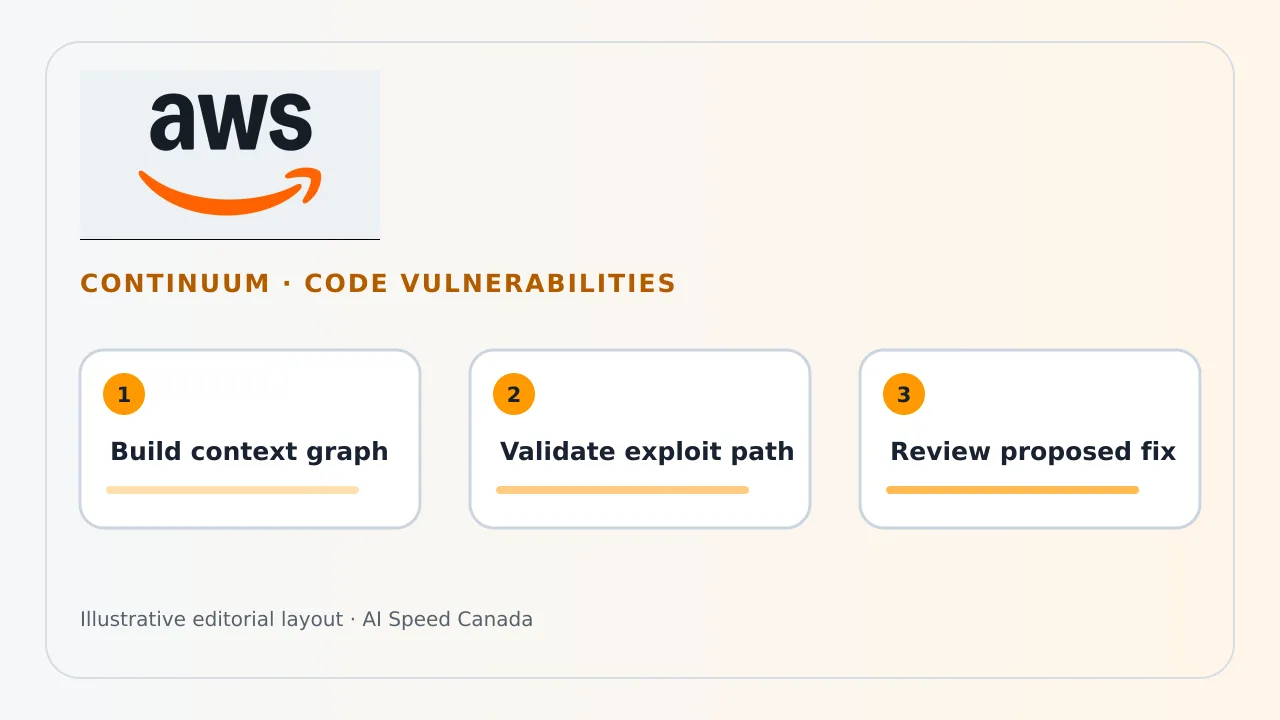
Amazon Web Services announced general availability of AWS Continuum for code vulnerabilities on October 22, 2026. The service connects source code with selected AWS environment context, validates whether findings are exploitable, prioritizes them by business impact and proposes patches or pull requests. AWS says every current remediation begins with a person approving the change before it ships. Future guardrail-based autonomous actions are described as planned capability, not the present approval model.
Prioritization depends on a graph of code and infrastructure
Continuum can ingest code through a GitHub integration or Amazon S3. An optional collector gathers AWS Config resources and network information from the account and Region where the application runs. AWS says the resulting context graph links systems, ownership, dependencies and data so an issue near a critical authentication or payment service can be ranked differently from an isolated development utility.
That context is useful only if it is complete and current. Missing accounts, private repositories, non-AWS infrastructure or stale ownership data can distort an attack path. Canadian teams should document what the collector can read, where the context is processed and retained, and which repositories or accounts are outside the graph.
Related sources: AWS News Blog: Continuum for code vulnerabilities GA ↗ · AWS Continuum User Guide: service overview ↗
Validation evidence still needs security review
For some findings, AWS says Continuum can establish an evidence level through static analysis. When it can reproduce an exploit, the service runs it in an isolated sandbox and attaches proof-of-concept code and reproduction steps. It can also assess whether existing defenses would detect or stop the path. These are product capabilities described by AWS, not an independent measure of false-positive or false-negative rates.
Proof-of-concept material is sensitive. Limit access, keep it out of ordinary chat or ticket systems, and make sure a test cannot reach production data or networks. A finding that the service cannot reproduce is not automatically safe, while a successful reproduction still requires a reviewer to confirm scope and business impact.
Related sources: AWS News Blog: Continuum for code vulnerabilities GA ↗
A generated pull request is not a completed remediation
Continuum can draft a source patch, dependency upgrade or configuration change and deliver it as a pull request. The console explicitly says the issue is not fixed until the organization reviews and merges the change. Tests, security checks, ownership and rollback remain the customer’s responsibility.
AWS describes future autonomous remediation for classes that meet confidence gates such as test coverage, bounded scope and historical success. Those controls are not equivalent to current general availability. Before enabling any later automation, teams should define prohibited systems, parameter limits, multi-party approval for critical assets and evidence that rollback restores the full environment.
Related sources: AWS News Blog: Continuum for code vulnerabilities GA ↗ · AWS Continuum User Guide: service overview ↗
Canadian users need to account for the launch-region boundary
At announcement, AWS lists availability only in US East (N. Virginia) and US West (Oregon). Canadian organizations should verify current regional support and contractual data handling before sending proprietary code or infrastructure context across regions. A Canadian AWS workload does not imply that this security service processes everything in Canada.
A bounded evaluation should seed known vulnerable and safe cases, compare findings with expert review, record missed attack paths and measure reviewer time. Track accepted patches, regressions and time to verified closure rather than the number of generated fixes. General availability describes service status, not proven effectiveness in a particular environment.
Related sources: AWS News Blog: Continuum for code vulnerabilities GA ↗ · AWS Continuum User Guide: service overview ↗
Sources and editorial method
We use the linked original statements and reports to distinguish documented facts from our analysis. Company announcements describe their authors’ plans and claims; they are not independent verification of future outcomes. This article is dated and will be revised if material evidence changes. Read our editorial standards and corrections process.
- AWS News Blog: Continuum for code vulnerabilities GA ↗ — Official October 22 announcement; workflow, evidence, remediation approval and launch Regions.
- AWS Continuum User Guide: service overview ↗ — Official documentation describing code integrations, validation and remediation scope.