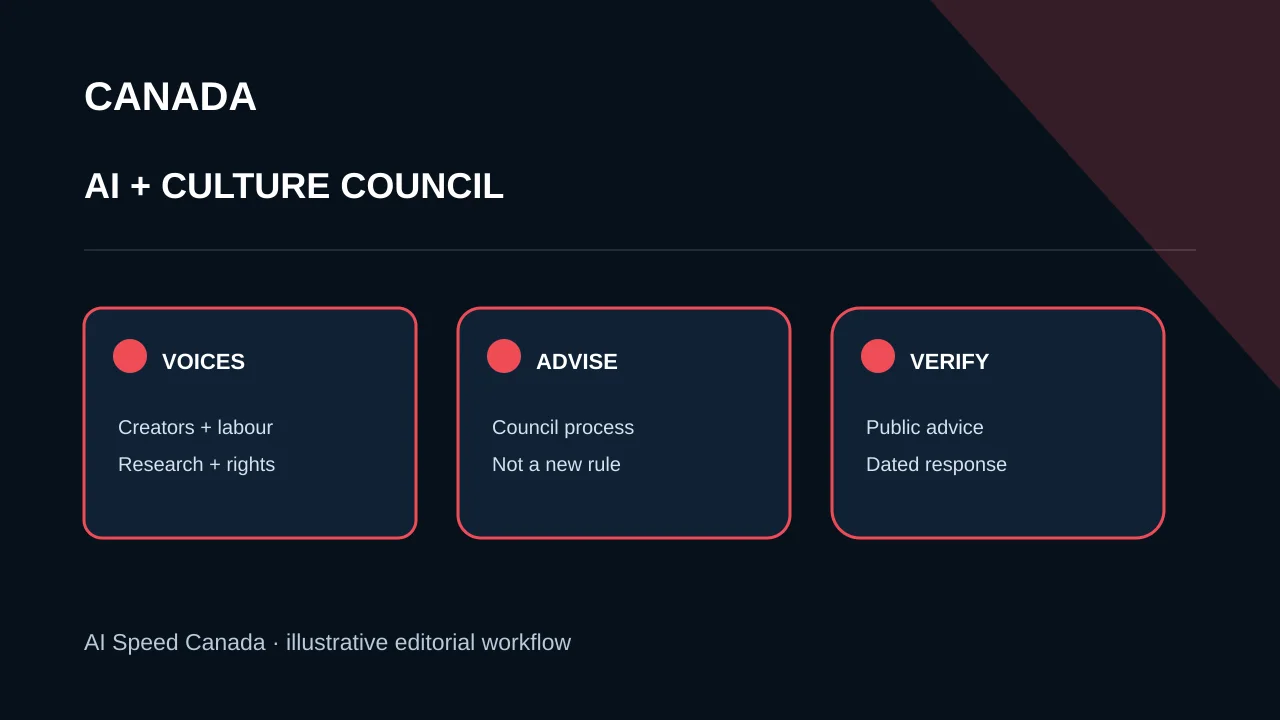
Canadian Heritage announced on November 19, 2026 that the federal government has appointed 12 members to a new Advisory Council on Artificial Intelligence and Culture and convened its inaugural meeting. The council is intended to advise government and the cultural sector as Canada implements its national AI strategy. Its creation establishes an advisory forum; it does not itself create regulation, resolve copyright disputes or distribute program funding.
The membership spans creative, technical and public-interest organizations
The initial members come from film and television, universities, First Nations data governance, publishing, game development, independent production, cultural workforce organizations, music publishing, minority-language media, AI music, machine-learning research and a university creative-AI hub. The government says membership will rotate over time to bring in additional expertise as issues evolve.
A broad list of affiliations does not guarantee that every creator, region, language, disability community or cultural practice is represented. The council should publish how it selects priorities, handles conflicts of interest and incorporates submissions from people outside the appointed group.
Related sources: Canadian Heritage: Advisory Council on Artificial Intelligence and Culture ↗
The mandate is advice, not independent decision-making authority
According to the release, the council will provide ongoing advice and insight related to Canada's National AI Strategy, with attention to the cultural sector's risks and opportunities. That could include adoption, skills, compensation, data governance, provenance and the treatment of Canadian cultural expression, but the announcement does not assign the council regulatory or adjudicative powers.
Readers should distinguish a recommendation, a government response, proposed legislation, a funded program and an implemented rule. Those are separate milestones. Future coverage should link the council's actual published advice rather than infer positions from an individual member's affiliation.
Related sources: Canadian Heritage: Advisory Council on Artificial Intelligence and Culture ↗ · Canada: National Artificial Intelligence Strategy — AI for All ↗
The council follows the March 2026 Banff summit
The government connects the council to Canada's first National Summit on Artificial Intelligence and Culture, held in Banff from March 15 to 17, 2026. That summit brought together cultural, government, technology, academic and civil-society participants. The November announcement identifies the new council as a continuing channel after that event.
Canada's AI for All strategy includes a stated $50-million Creative Technology Program. The release mentions that program as wider policy context; it does not announce applications, recipients or spending through the council. A budget commitment, program design and money delivered to an organization should not be reported as the same outcome.
Related sources: Canadian Heritage: Advisory Council on Artificial Intelligence and Culture ↗ · Canada: National Artificial Intelligence Strategy — AI for All ↗
Useful accountability begins with public work products
The most valuable next evidence would be a published mandate, meeting summaries, consultation process, recommendations, government responses and implementation dates. Advice should identify whose evidence was considered and separate consensus from unresolved disagreement.
Canadian creators and technology organizations should watch for concrete treatment of licensing, attribution, Indigenous data governance, official languages, competition, labour effects and access for smaller organizations. Until work products appear, the defensible conclusion is that a representative advisory process has begun—not that Canada has completed an AI-and-culture policy framework.
Sources and editorial method
We use the linked original statements and reports to distinguish documented facts from our analysis. Company announcements describe their authors’ plans and claims; they are not independent verification of future outcomes. This article is dated and will be revised if material evidence changes. Read our editorial standards and corrections process.
- Canadian Heritage: Advisory Council on Artificial Intelligence and Culture ↗ — Official November 19, 2026 release; membership, inaugural meeting, mandate and summit context.
- Canada: National Artificial Intelligence Strategy — AI for All ↗ — Official national-strategy context and program framework.