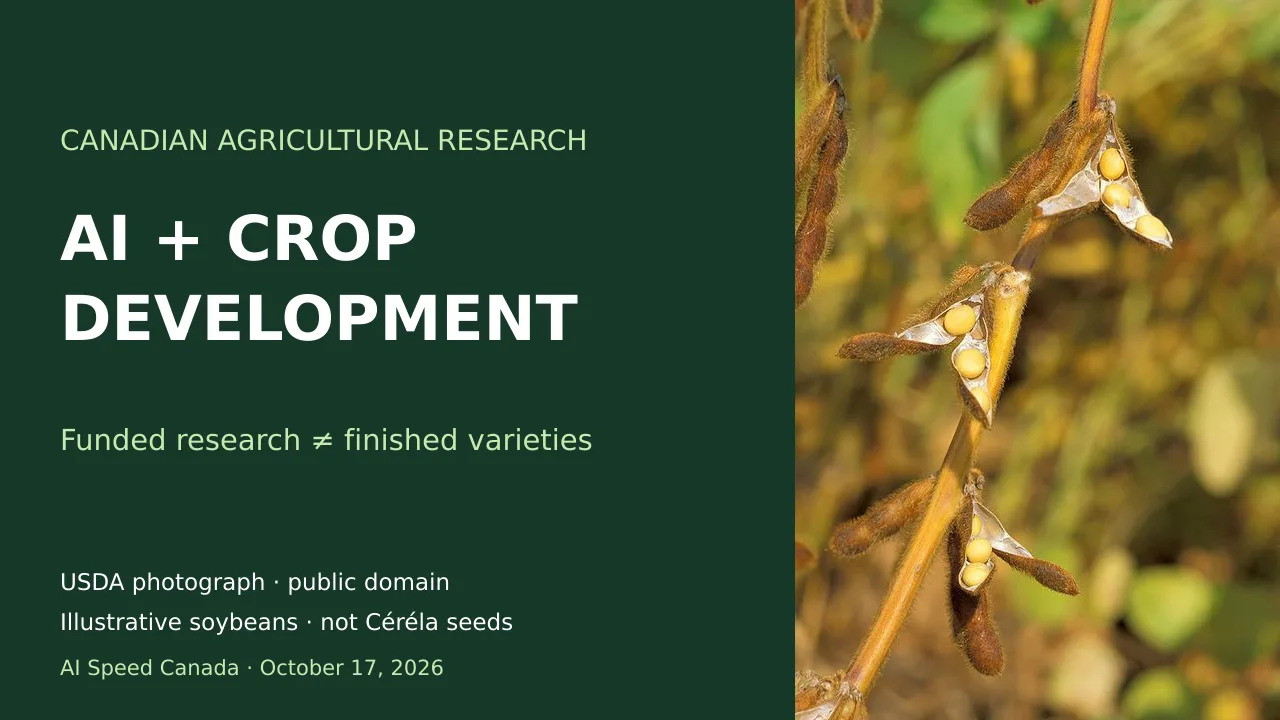
Agriculture and Agri-Food Canada announced on October 15, 2026 that Quebec-based Céréla Inc. will receive up to CAD $571,521 over three years for AI-assisted crop research. The stated targets are soybean and barley varieties suited to Eastern Canadian conditions. The announcement funds development; it does not establish that a new variety is ready to buy or that an AI method has already improved farm yields.
Two breeding goals, not a general-purpose farm chatbot
The release identifies barley with resistance to Fusarium head blight and soybeans without anti-trypsin factors as research goals. It describes AI as a way to shorten variety development. Those are specific intended traits, but the release does not publish a model evaluation, field-trial dataset or measured time saving for this project.
AI Speed’s assessment is that progress should be judged at several stages: whether candidate selection improves, whether the desired traits persist, and whether the resulting plants perform under relevant growing conditions. A promising prediction is an input to that process, not the final agricultural result.
Related sources: AAFC: Céréla AI crop-research funding announcement ↗
What the funding mechanism tells readers
The award comes through the AgriScience Program’s Projects component under the Sustainable Canadian Agricultural Partnership. The program supports pre-commercial applied research rather than guaranteeing commercial outcomes. Its published guidance distinguishes industry research contributions from collaborative research performed by federal scientists.
For non-repayable contributions, the program describes an agreement covering activities, shared costs and reporting, including expenses eligible for reimbursement. Consequently, an announced maximum should not be described as money already spent. The release does not provide a disbursement schedule or the project’s complete financing agreement.
Related sources: AAFC: Céréla AI crop-research funding announcement ↗ · AAFC: AgriScience Projects program guidance ↗
What Eastern Canadian growers should watch next
Useful follow-up would identify trial locations, comparison varieties, growing seasons and the conditions under which a trait was measured. Yield, disease response and suitability for a particular end use are different questions. Results from one controlled setting should not be promoted as a universal farm recommendation.
Seed buyers can ask for the variety name, locally relevant trial evidence and an actual availability date before changing a purchasing plan. Researchers can make later reporting stronger by publishing the baseline breeding process, the AI-assisted step and the validation method. These are evaluation questions from AI Speed, not results supplied by the announcement.
Sources and editorial method
We use the linked original statements and reports to distinguish documented facts from our analysis. Company announcements describe their authors’ plans and claims; they are not independent verification of future outcomes. This article is dated and will be revised if material evidence changes. Read our editorial standards and corrections process.
- AAFC: Céréla AI crop-research funding announcement ↗ — October 15, 2026 primary release; maximum funding, duration and intended traits.
- AAFC: AgriScience Projects program guidance ↗ — Program purpose, funding mechanisms and contribution-agreement reporting; checked October 17, 2026.