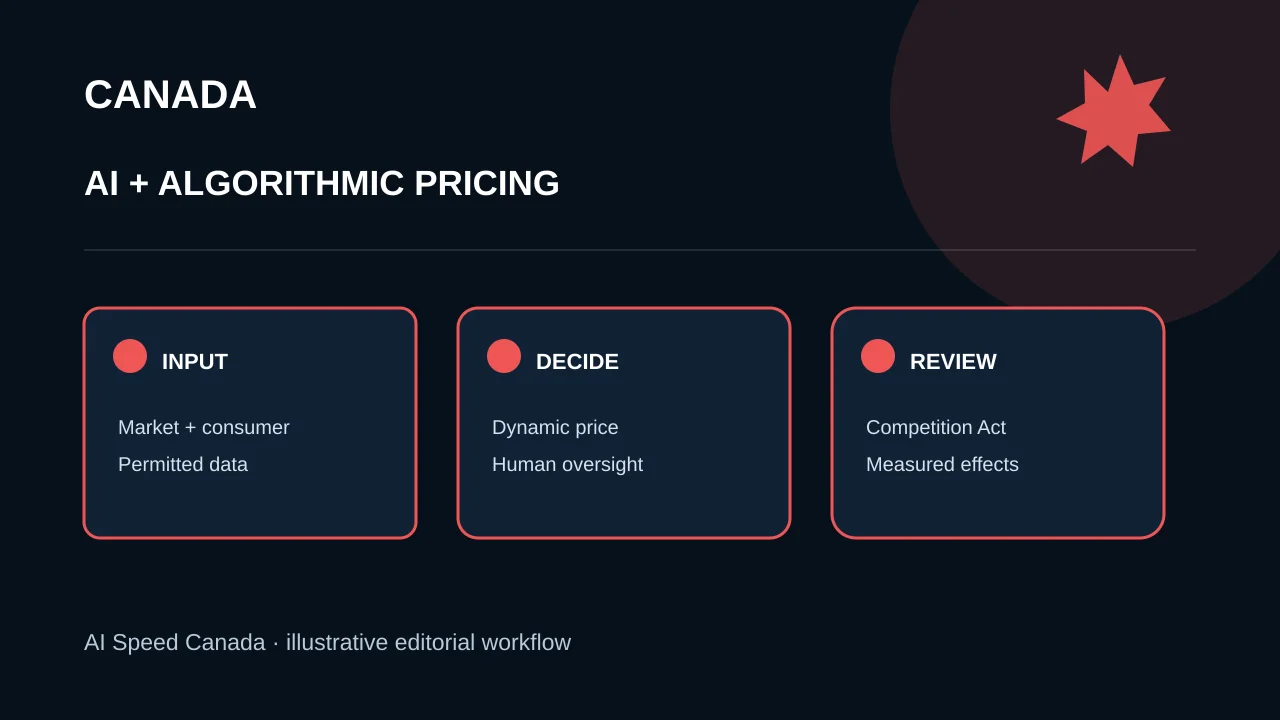
Canada’s Competition Bureau told a House of Commons committee on November 23, 2026 that algorithmic pricing is not inherently contrary to the Competition Act. Acting Deputy Commissioner Mike Hollingworth said the Bureau focuses on how firms use pricing tools and their effects on competition, including price-fixing, exclusionary conduct, abuse of market power and deceptive marketing. The statement explains an enforcement position; it is not a new statute, a finding that a named business broke the law or a government-set rule for what a product should cost.
The legal question is conduct and effect, not whether software uses AI
Businesses may use algorithms to respond to supply and demand, manage inventory, reduce costs or help a smaller entrant compete. The Bureau also identifies risks when competing firms rely on common tools or pooled data, when software helps sustain coordinated pricing, or when a dominant firm uses data and automation to exclude rivals.
The Bureau is an independent law-enforcement agency, not a price regulator. It does not decide the correct price for a hotel room, ticket, rental unit or product. Its role is to enforce the Competition Act and protect the competitive process, while Parliament and governments decide whether additional legislation or sector rules are needed.
Related sources: Competition Bureau: Algorithmic pricing and the Competition Act ↗ · Competition Bureau: Algorithmic pricing and competition discussion paper ↗
Two earlier matters show why the facts of each market matter
The Bureau investigated RealPage Canada and Yardi Canada revenue-management software used in rental housing. It did not find sufficient evidence at that time of dominance or anti-competitive collaboration causing substantial harm in Canada, partly because adoption was not widespread enough. The Bureau nevertheless published compliance guidance and said certain features could still raise concerns.
The Bureau also reached a consent agreement with Kalibrate over a fuel-data product. These outcomes are not interchangeable: one investigation closed without a civil contravention finding, while the other produced agreed remedies. They demonstrate why a product category alone cannot establish legality or harm.
Related sources: Competition Bureau: Algorithmic pricing and the Competition Act ↗ · Competition Bureau: RealPage and Yardi position statement ↗
Pricing inputs and representations deserve their own audit trail
The Bureau’s earlier discussion paper says third-party services may pool industry information and sell recommendations to several competitors. That structure can create coordination risks depending on the data, market and conduct. Personalized pricing can also depend on consumer information whose collection, sharing or use was not clearly represented.
A Canadian business should document the source and permitted use of every input, who receives competitor-sensitive data, whether staff can reject recommendations, and how the system affects prices over time. Customer-facing statements about collection, retention, deletion and control must be accurate. A vendor label such as “optimization” or “AI” does not answer those questions.
Related sources: Competition Bureau: Algorithmic pricing and competition discussion paper ↗
A practical review separates efficiency claims from measured outcomes
Before deployment, test whether the system produces sustained price convergence, retaliatory discounts, discriminatory outcomes or unexplained volatility. Compare results with a control process, retain decision logs needed for lawful review and give compliance staff authority to stop use. Seek legal advice for the actual market and arrangement rather than treating a general speech as a safe harbour.
For consumers, a changing price is not by itself evidence of collusion or deception. Preserve dated screenshots and receipts when a displayed or promised price differs from the checkout amount, and report substantiated concerns through the appropriate competition, consumer-protection or privacy channel. The next policy evidence to watch is any investigation, court decision, formal guidance or legislative amendment—not speculation about what an algorithm might be doing.
Sources and editorial method
We use the linked original statements and reports to distinguish documented facts from our analysis. Company announcements describe their authors’ plans and claims; they are not independent verification of future outcomes. This article is dated and will be revised if material evidence changes. Read our editorial standards and corrections process.
- Competition Bureau: Algorithmic pricing and the Competition Act ↗ — November 23, 2026 committee statement; Bureau mandate, benefits, enforcement concerns and limits.
- Competition Bureau: Algorithmic pricing and competition discussion paper ↗ — Official explanation of pricing systems, data flows and potential Competition Act issues.
- Competition Bureau: RealPage and Yardi position statement ↗ — Official investigation outcome and compliance guidance for Canadian rental pricing software.