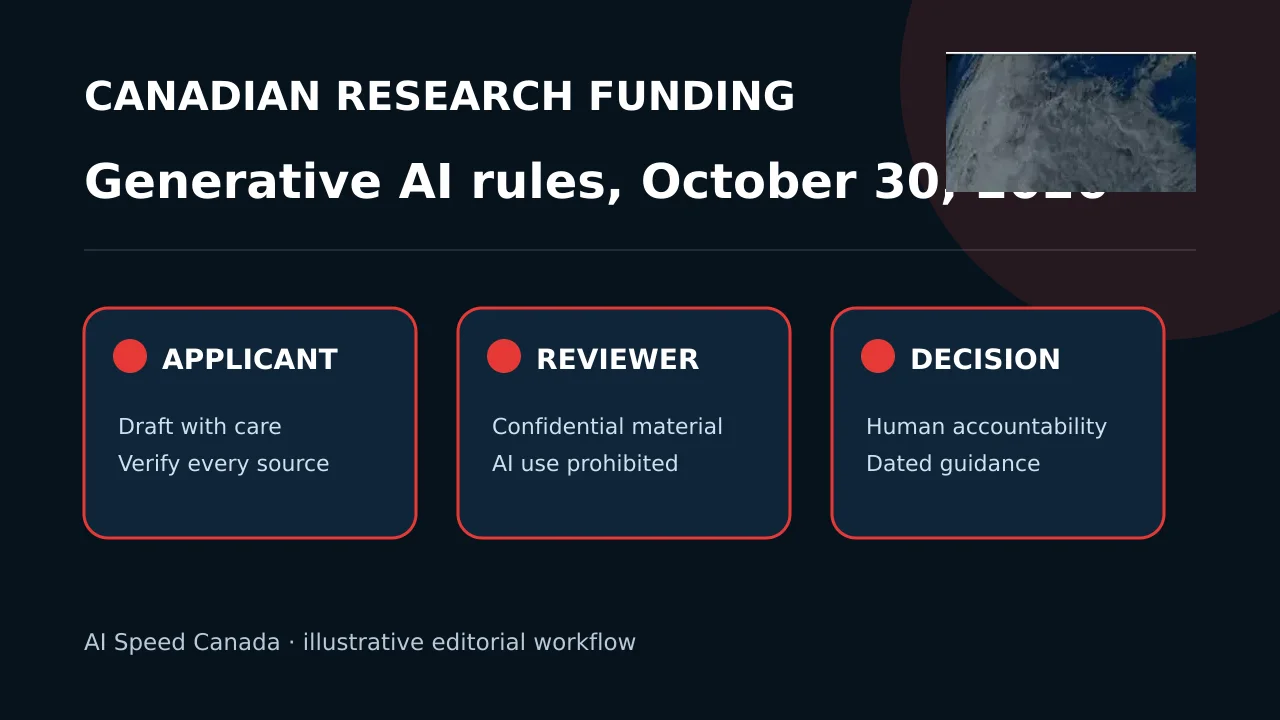
Four Canadian research funders updated their guidance on generative AI in funding applications and peer review on October 30, 2026. The Canadian Institutes of Health Research, Natural Sciences and Engineering Research Council, Social Sciences and Humanities Research Council and Canada Foundation for Innovation permit applicants to use generative AI in limited ways, while making the applicant responsible for the final submission. Reviewers face a stricter rule: they must not use public or institutionally deployed generative-AI tools to carry out their review responsibilities.
Applicants may draft, summarize or translate—but accountability does not move to the tool
The updated FAQ says applicants may use generative AI to draft or summarize application sections and may use it for translation between English and French. It does not require applicants to disclose generative-AI use. Applicants must still verify accuracy, completeness and relevance, confirm citations against authoritative records and acknowledge original sources that materially inform the application.
This is permission under the agencies’ application guidance, not proof that every institution, discipline or competition accepts every workflow. Researchers should also check the specific funding opportunity, university policy and agreements with collaborators before uploading text. A fluent draft cannot establish that a method, citation, budget or claimed result is correct.
Related sources: Canada research funders: updated generative-AI guidance ↗ · Canada research funders: applicant and reviewer FAQ ↗
The reviewer prohibition includes institutionally procured tools
Reviewers may not upload application material to an online generative-AI system. The October update explicitly extends that prohibition to tools procured and deployed by a reviewer’s institution. The agencies say they do not independently verify each institution’s security and privacy controls, so institutional deployment does not create an exception.
The boundary also covers draft reviews, notes and feedback even when application text is not pasted directly. Those materials can reveal unpublished ideas, methods and personal or proprietary information. Reviewers remain bound by the agencies’ conflict-of-interest and confidentiality agreement.
Related sources: Canada research funders: updated generative-AI guidance ↗ · Canada research funders: applicant and reviewer FAQ ↗
Applicants still need a data decision before using a tool
The guidance warns that a generative-AI service may not protect application material. Applicants are advised to examine privacy terms, retention, reuse and security controls, and not assume that co-applicants or partners consent to uploading information about them. A secure enterprise label is not a substitute for reading the actual configuration and agreement.
A practical workflow is to classify the material first: public background, unpublished methods, personal information, partner confidential information and security-sensitive data should not be treated alike. Keep a human-owned source list and compare every generated citation with the cited work rather than trusting a plausible title.
Related sources: Canada research funders: applicant and reviewer FAQ ↗
This is a policy update, not a finding about AI quality
The agencies do not claim that AI-written applications are better or that reviewers could never use a future approved system. They say the guidance will be reviewed as tools and research practices evolve. The precise current result is a differentiated rule: applicant assistance is allowed with responsibility and verification, while generative-AI use in peer review is strictly prohibited.
Canadian researchers should retain the dated guidance used for a submission and check for later updates before the next competition. Institutions can support applicants with approved handling practices, but they should not imply that a local licence overrides the federal reviewer restriction.
Sources and editorial method
We use the linked original statements and reports to distinguish documented facts from our analysis. Company announcements describe their authors’ plans and claims; they are not independent verification of future outcomes. This article is dated and will be revised if material evidence changes. Read our editorial standards and corrections process.
- Canada research funders: updated generative-AI guidance ↗ — Official guidance modified October 30, 2026; accountability, confidentiality and the reviewer prohibition.
- Canada research funders: applicant and reviewer FAQ ↗ — Official FAQ modified October 30, 2026; permitted applicant uses, no disclosure requirement, verification practices and prohibited reviewer uses.