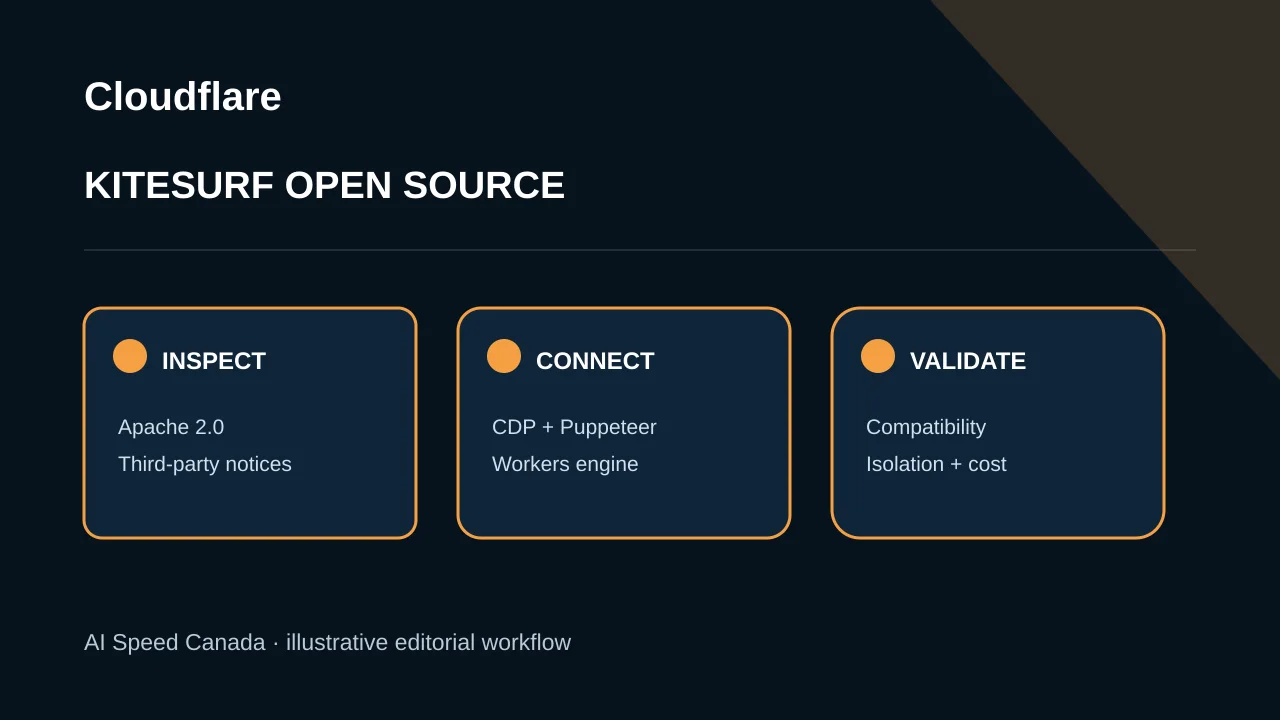
Cloudflare announced on November 13, 2026 that Kitesurf is open source under the Apache 2.0 licence. The experimental browser engine runs on Cloudflare Workers and is designed for AI agents rather than as a replacement for a person’s desktop browser. Publishing the repository is a completed release; broad web compatibility, reliability and efficiency remain active development goals.
Kitesurf implements browser functions without a Chromium container
Cloudflare says Kitesurf parses HTML, applies CSS, executes JavaScript and renders screenshots on Workers. It exposes the Chrome DevTools Protocol, allowing tools such as Puppeteer or an agent harness to connect through a familiar interface. Its components include an engine for sessions and client connections, page execution code and a renderer.
The implementation uses Rust and WebAssembly projects for layout, styling, JavaScript and graphics. Those components retain their own licences, while the Kitesurf repository carries third-party notices. Teams should review the dependency tree and notices rather than assuming the repository’s top-level licence governs every included component.
Related sources: Cloudflare: Kitesurf is now open source ↗
Self-deployment changes control, not the underlying service dependencies
Developers can build Kitesurf locally, connect through CDP and deploy a modified engine to their own Cloudflare account. Cloudflare says the hosted deployment requires a Workers Paid plan because pages are isolated with Dynamic Workers. This is not a cost-free local browser or proof that page data stays on a single device.
Canadian teams evaluating the engine should map where URLs, page content, screenshots, credentials and logs travel. Use test accounts, restrict network destinations and avoid production secrets until isolation, cleanup and audit behaviour are verified. A browser controlled by an agent can still click destructive controls, submit forms or expose data when the surrounding permissions are too broad.
Related sources: Cloudflare: Kitesurf is now open source ↗
Compatibility needs page-level evidence
Cloudflare explicitly describes Kitesurf as under heavy development. Build a representative suite covering authentication, redirects, modern JavaScript, forms, downloads, accessibility trees and screenshot fidelity. Compare successful task completion and failure visibility with the browser engine currently used by the agent.
Open source makes inspection and contribution possible; it does not establish security, standards compliance or production support. Pin a tested revision, review updates and keep a fallback for sites that require unsupported browser behaviour. For public websites, respect access controls, robots guidance and service terms rather than treating automation capability as permission.
Sources and editorial method
We use the linked original statements and reports to distinguish documented facts from our analysis. Company announcements describe their authors’ plans and claims; they are not independent verification of future outcomes. This article is dated and will be revised if material evidence changes. Read our editorial standards and corrections process.
- Cloudflare: Kitesurf is now open source ↗ — Official November 13, 2026 release; licence, Workers architecture, CDP support, deployment requirement and development status.