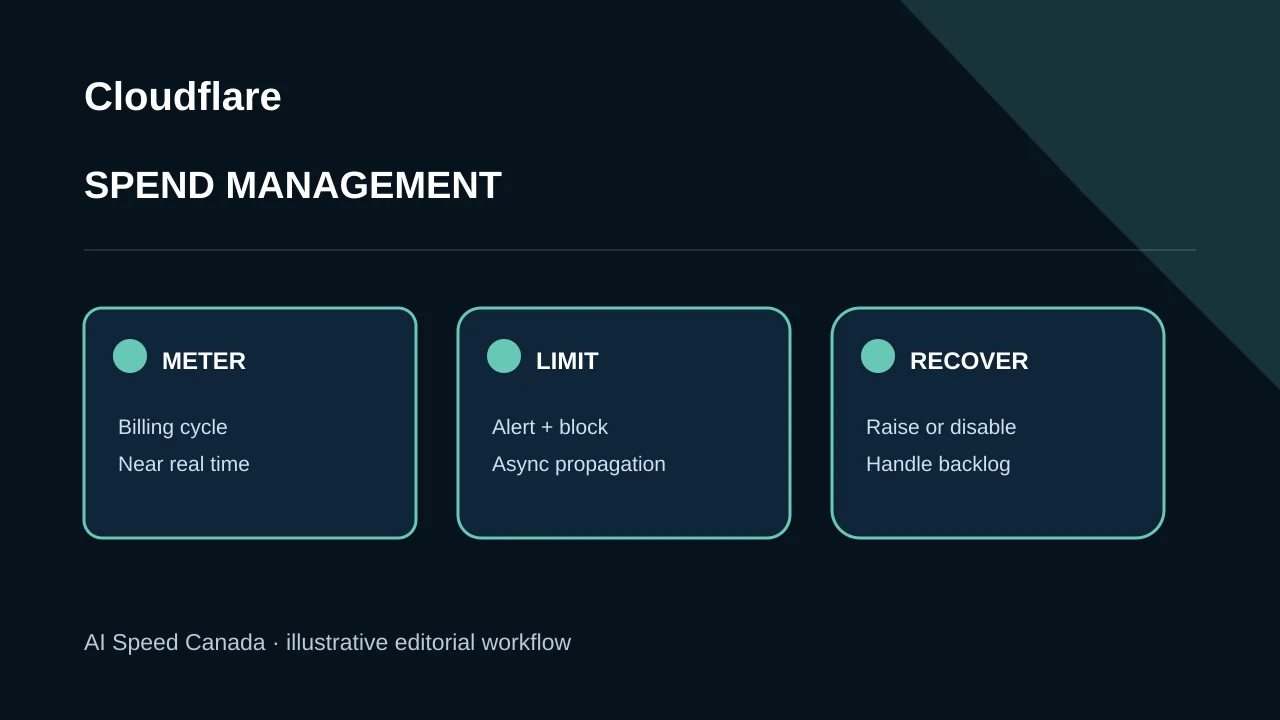
Cloudflare introduced Spend Management in beta on November 13, 2026 for pay-as-you-go customers, starting with Workers and Durable Objects. Unlike an alert that only sends a warning, a blocking policy can pause new billable activity after evaluated spend reaches the configured limit. The feature is an operational guardrail, not a guarantee that the final invoice will equal the threshold exactly.
Limits are configurable through the dashboard, API and CLI
An account can enable a product, set a spending limit, choose notification thresholds and provide an email recipient. Cloudflare also exposes REST and cf CLI operations plus an audit log showing policy changes and cap activity. Near-real-time cost values are described as arriving in under ten minutes.
Billing cycles follow the paid subscription’s start date rather than necessarily matching calendar months. Operations teams should document that boundary, the policy owner and the expected reset. Test alerts with a low-risk non-production workload before relying on them for a critical service.
Related sources: Cloudflare: Introducing Spend Management ↗
A cap can preserve static assets while stopping customer code
When a blocking policy propagates, new cost-incurring invocations are rejected. Cloudflare says Workers static assets continue to serve, while Cron Triggers and Queue consumer invocations pause. Service owners therefore need to identify which user journeys remain available and which scheduled or asynchronous work accumulates a backlog.
Recovery can require raising the limit above accumulated spend, disabling the policy or waiting for the next billing cycle. A runbook should cover data consistency, queued work and user messaging rather than simply restarting traffic. A hard stop can prevent runaway cost while still causing an availability incident.
Related sources: Cloudflare: Introducing Spend Management ↗
Asynchronous metering creates an overshoot window
Cloudflare aggregates usage before rating it, then distributes the resulting block asynchronously. The company says rating is outside the request path, which avoids adding rating latency to every request but means enforcement is not instantaneous. Concurrent traffic can continue between the threshold event and global policy propagation.
Canadian startups and small teams should keep provider billing alerts, application-level quotas and anomaly detection alongside the new cap. For AI agents, pair infrastructure controls with per-user or per-model AI Gateway budgets when applicable. Measure actual overshoot and recovery time during a controlled exercise; do not treat the configured number as a precise maximum until the account’s behaviour is observed.
Sources and editorial method
We use the linked original statements and reports to distinguish documented facts from our analysis. Company announcements describe their authors’ plans and claims; they are not independent verification of future outcomes. This article is dated and will be revised if material evidence changes. Read our editorial standards and corrections process.
- Cloudflare: Introducing Spend Management ↗ — Official November 13, 2026 beta announcement; product scope, controls, billing-cycle rules, blocking behaviour and asynchronous enforcement.