GitHub announced on November 13, 2026 that organizations can manage AI Scan for repository backlogs through existing REST enablement endpoints. The public preview adds a repository_scan property alongside the earlier pull-request setting. This is an administration capability, not evidence that a scan has run or that AI Scan found every vulnerability.
The same endpoints now control two scan modes
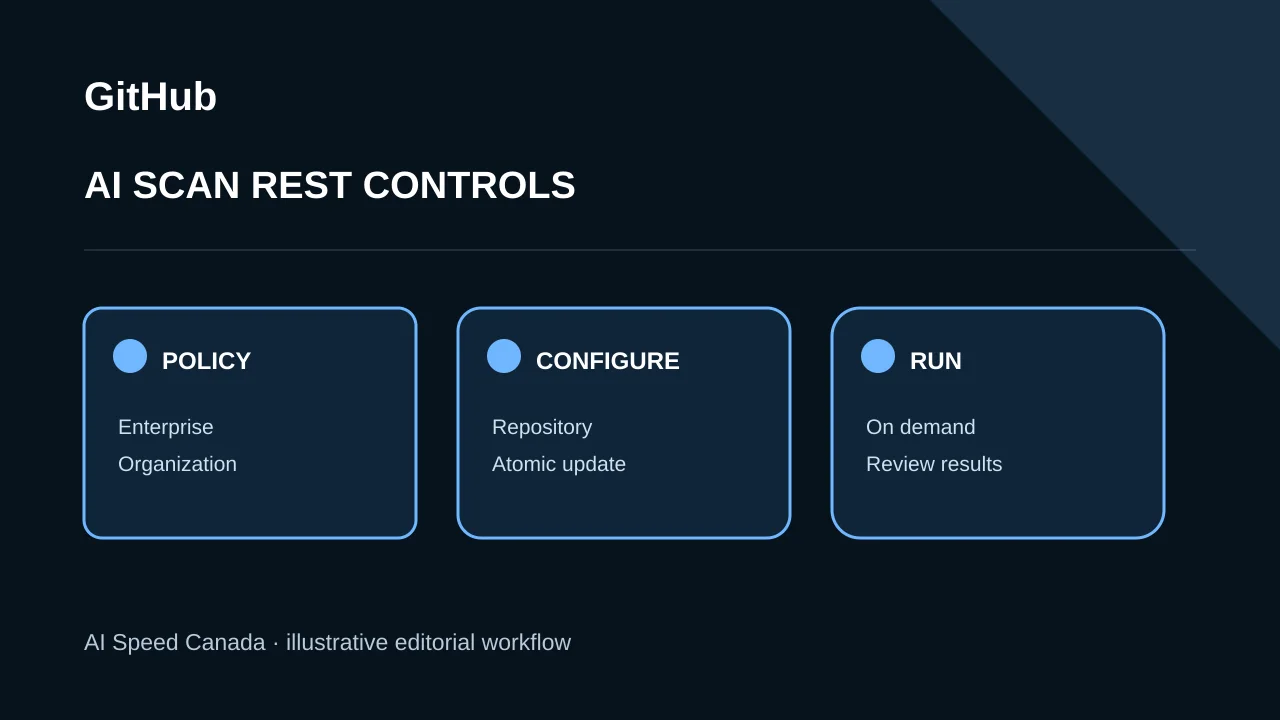
Organization owners and security managers can use GET and PATCH on the organization AI Scan endpoint; repository administrators can use the corresponding repository endpoint. A request can update pr_scan and repository_scan together, supporting scripts and infrastructure-as-code workflows.
Teams should first read current state, calculate the intended change and record the response. A bulk script should use stable repository identifiers, limit concurrency and produce a reviewable exception list rather than treating every non-200 response as safe to ignore.
Related sources: GitHub: Manage AI Scan for repositories using the REST API ↗
Enterprise and organization policy still wins
When an organization disables repository scanning, its repositories cannot enable it. When the organization enables the setting, repositories inherit it and may individually opt out. If enterprise policy disallows AI Scan, an enable request returns HTTP 422.
GitHub also says a combined update is atomic: if either pr_scan or repository_scan is blocked, neither setting changes. Automation should surface that failure and re-read the final state instead of assuming the unblocked half succeeded. Canadian organizations can use this hierarchy to document security ownership across enterprise, organization and repository levels.
Related sources: GitHub: Manage AI Scan for repositories using the REST API ↗
Enablement, execution and results are separate events
Turning on AI Scan for repositories does not start a scan. A user with write access must run one on demand, and each execution consumes GitHub Code Security AI credits. Public organization repositories are eligible; private and internal repositories require GitHub Code Security or Advanced Security. GitHub Enterprise Server is excluded.
Measure coverage by completed scans, dated repository state, reviewed findings and remediations—not by the number of enabled toggles. Before scaling, test permissions, 422 handling, credit budgets and opt-outs. Preview status also means contracts and behaviour can change; pin automation to documented fields and monitor release notes.
Sources and editorial method
We use the linked original statements and reports to distinguish documented facts from our analysis. Company announcements describe their authors’ plans and claims; they are not independent verification of future outcomes. This article is dated and will be revised if material evidence changes. Read our editorial standards and corrections process.
- GitHub: Manage AI Scan for repositories using the REST API ↗ — Official November 13, 2026 public-preview announcement; endpoints, inheritance, atomic failure, permissions, scope and credit use.