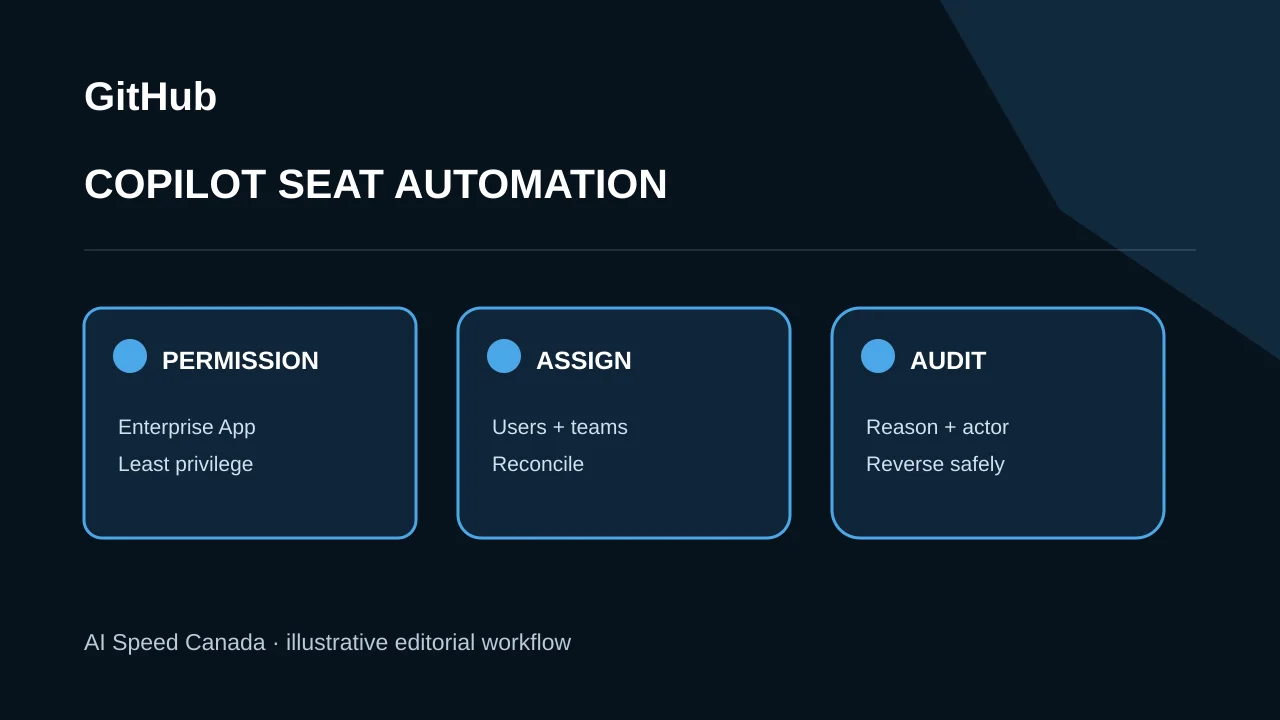
GitHub announced on November 10, 2026 that enterprise GitHub Apps can call enterprise-level Copilot seat-management APIs. Apps can automate which users and enterprise teams receive Copilot seats using a new fine-grained permission named “Enterprise Copilot license management.” The update changes the supported authentication path for administration; it does not prove that automated assignments reduce cost or improve adoption.
It also does not change who should receive access.
Before production use, administrators should test authorization, duplicate requests, partial failures and rollback with non-production identities and a deliberately limited installation.
App-based automation separates administration from a person
Seat workflows can now authenticate as an installed enterprise GitHub App rather than depending on a human administrator’s token. That can support joiner, mover and leaver processes, scheduled reconciliation and connections to identity-governance systems. The announcement names users and enterprise teams as assignment targets.
An App identity can be more durable than a personal token, but durability also increases the consequences of excessive permission. Limit installation ownership, rotate credentials, restrict the automation environment and avoid combining seat management with unrelated source-code permissions.
Related sources: GitHub: App support for Enterprise Copilot seat management ↗
The new permission should be explicitly reviewed
GitHub labels the capability as a new enterprise fine-grained App permission. Administrators should verify the exact requested permission during installation or upgrade, document why the App needs it and test denial behaviour when it is absent. Existing Apps should not be assumed to receive new authority silently.
Log every assignment and removal with actor, target, reason, request identifier and resulting state. Reconcile GitHub’s seat inventory with the approved identity source, but keep a controlled exception path for contractors, service accounts and temporary teams.
Related sources: GitHub: App support for Enterprise Copilot seat management ↗
Canadian organizations should connect licensing to employment and privacy controls
Seat records reveal workforce structure and tool access. Limit access to the data, define retention and avoid using assignment history as a proxy for individual productivity. Automated removal should account for legal holds, investigations and transitions without leaving active credentials behind.
Measure unused-seat reduction, provisioning delay, failed changes and unauthorized assignments. Those are operational outcomes; the API release alone is only evidence that the automation interface exists. Keep an accountable human able to review and reverse bulk changes.
Sources and editorial method
We use the linked original statements and reports to distinguish documented facts from our analysis. Company announcements describe their authors’ plans and claims; they are not independent verification of future outcomes. This article is dated and will be revised if material evidence changes. Read our editorial standards and corrections process.
- GitHub: App support for Enterprise Copilot seat management ↗ — Official November 10, 2026 changelog; App eligibility, assignment targets and new fine-grained permission.