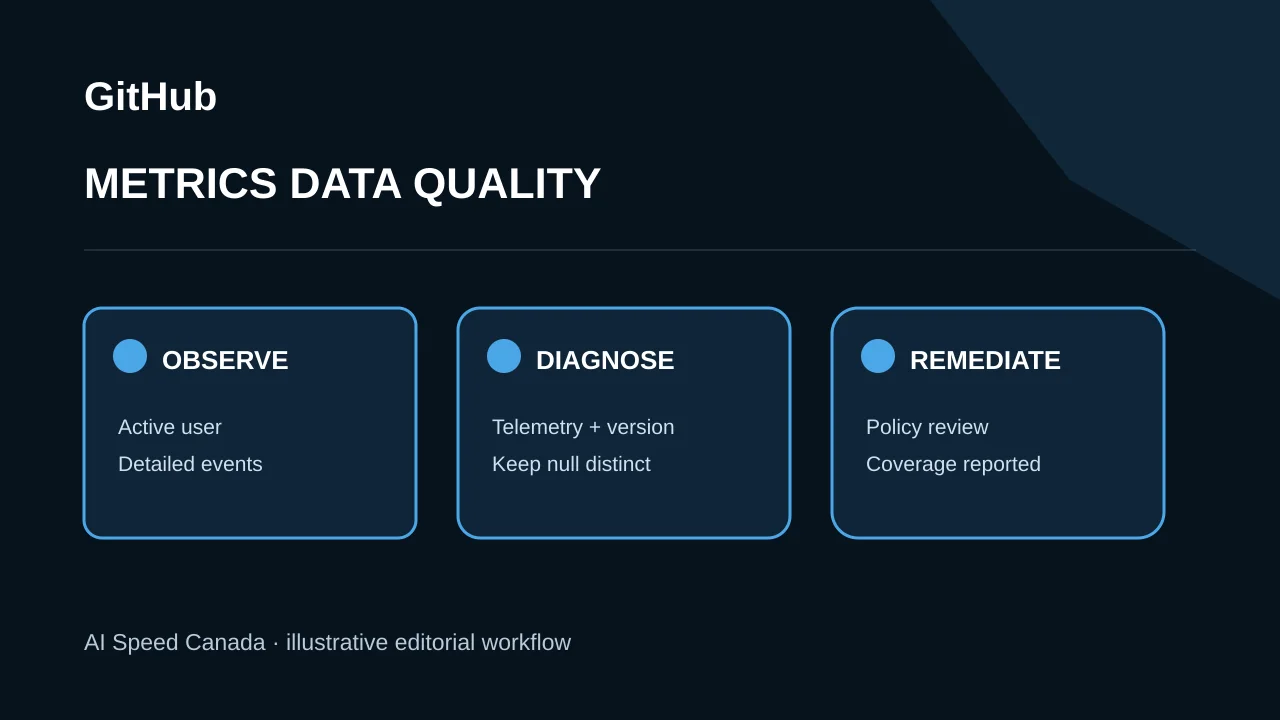
GitHub announced Copilot usage-metrics diagnostics on November 5, 2026. Enterprise and organization reports can now identify users for whom GitHub saw Copilot activity but received no client telemetry, and users whose editors or Copilot extensions fall below the minimum versions required for detailed metrics. The change makes missing-data conditions visible; it does not make the underlying dataset complete.
The API separates telemetry presence from version support
The client_telemetry_present field is false when GitHub observed user activity but received no editor usage events for that day. The usage_metrics_requirements collection marks each IDE and extension as met, unmet or unknown against GitHub’s supported minimum versions.
These signals are independent. A user can meet every version minimum while a proxy, firewall or disabled setting prevents events. Conversely, an older client may still send some data. One diagnostic cannot explain every missing field.
Related sources: GitHub: usage metrics API flags telemetry and version gaps ↗
Daily counts overlap and cannot be added as unique people
Aggregate reports add missing_client_telemetry_user_count and below_usage_metrics_minimum_user_count. GitHub says one person can appear in both counts on the same day. Adding them would double-count affected users, and summing daily values would count recurring users more than once.
Null or omitted values mean unavailable—not false and not zero. The fields are not backfilled for earlier periods. Trend charts need an explicit availability marker at the release boundary rather than a fabricated historical zero.
Related sources: GitHub: usage metrics API flags telemetry and version gaps ↗
Closing a data gap can conflict with privacy choices
A manager may see missing telemetry as a technical problem, but it can reflect deliberate policy or user choice. Before changing editor settings, review what events are transmitted, whether content fields are enabled, retention, access and the purpose of measurement.
The diagnostics report measurement quality; they do not authorize broader collection. Keep minimization separate from a desire for a complete dashboard, and do not use incomplete data to judge individual performance.
Related sources: GitHub: usage metrics API flags telemetry and version gaps ↗
Canadian organizations should define an acceptable coverage threshold
Record supported IDEs and extensions, the share of active users with usable detailed data and approved reasons for missing events. Investigate network or client problems without silently overriding privacy controls.
Publish the coverage rate beside every comparison. If coverage differs materially, the safer conclusion may be that reports are not comparable. The API identifies that limitation; it does not repair the evidence.
Sources and editorial method
We use the linked original statements and reports to distinguish documented facts from our analysis. Company announcements describe their authors’ plans and claims; they are not independent verification of future outcomes. This article is dated and will be revised if material evidence changes. Read our editorial standards and corrections process.
- GitHub: usage metrics API flags telemetry and version gaps ↗ — Official November 5, 2026 changelog; fields, daily-count rules, access requirements and null semantics.