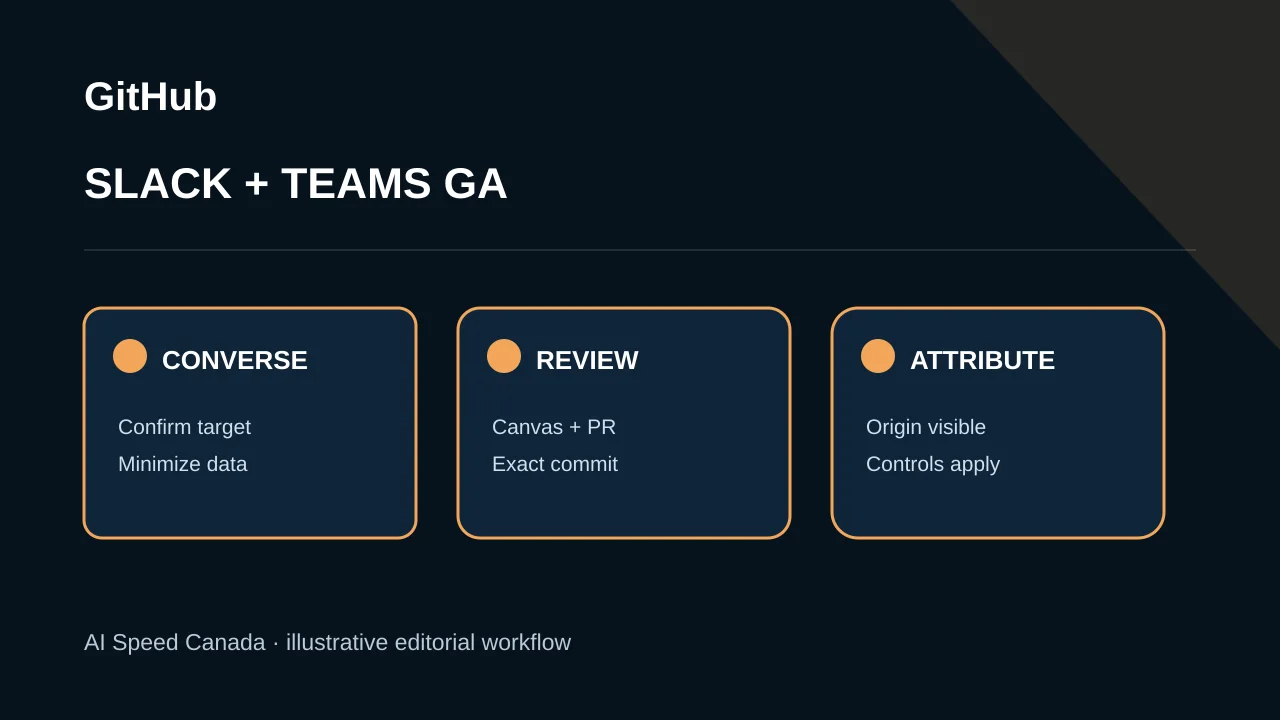
GitHub announced general availability for @GitHub in Slack and Microsoft Teams on November 6, 2026. Users can ask it to investigate bugs, create issues, implement changes and open pull requests from a conversation. Teams adds a Canvas where participants can review plans, code changes and previews beside the discussion. GitHub also added clearer attribution to issues and pull requests created from conversations.
Conversation can start repository work without becoming approval
GitHub says the integration can infer a repository from the message and launch a coding session with fewer selection steps. That reduces friction, but an incorrect repository choice can have consequences. Users should confirm the target, issue scope and account before allowing work to proceed.
Repository permissions, branch protections, required checks and human review still apply. A chat request is an instruction to prepare work, not authorization to merge or deploy it. Teams should define which channels and repositories may invoke the integration.
Related sources: GitHub: @GitHub in Slack and Teams general availability ↗
Teams Canvas brings plans, diffs and previews beside discussion
Canvas is presented as a shared surface for reviewing implementation plans, code changes and previews, then refining the work through conversation. It can improve shared context, but a preview is not evidence that tests, security and accessibility requirements passed.
Reviewers should follow the canonical pull request and exact commit. Comments in a collaboration tool can become stale after the code changes, so decisions should link back to the repository record.
Related sources: GitHub: @GitHub in Slack and Teams general availability ↗
Created work now records its conversational origin
Issues and pull requests created by @GitHub include text saying they came from a Slack or Teams conversation with a username. That improves traceability and can help distinguish an agent-created artifact from one opened directly in GitHub.
Attribution is not consent from everyone in a channel and should not copy unnecessary conversation content into a repository. Before invoking the tool, remove secrets and personal information that are not needed for the development task.
Related sources: GitHub: @GitHub in Slack and Teams general availability ↗
Canadian teams should map data and identity across both services
Organizations should confirm which chat content reaches GitHub, how identities map between systems, where logs are retained and whether guest users can invoke actions. Privacy, public-sector and regulated-data rules may differ between the collaboration workspace and source repository.
Pilot with a low-risk repository and measure incorrect target selection, review effort, rework and unauthorized action attempts. General availability describes product status, not a guarantee that the workflow fits every organization.
Sources and editorial method
We use the linked original statements and reports to distinguish documented facts from our analysis. Company announcements describe their authors’ plans and claims; they are not independent verification of future outcomes. This article is dated and will be revised if material evidence changes. Read our editorial standards and corrections process.
- GitHub: @GitHub in Slack and Teams general availability ↗ — Official November 6 release; GA status, Teams Canvas, onboarding changes, attribution and reliability fix.