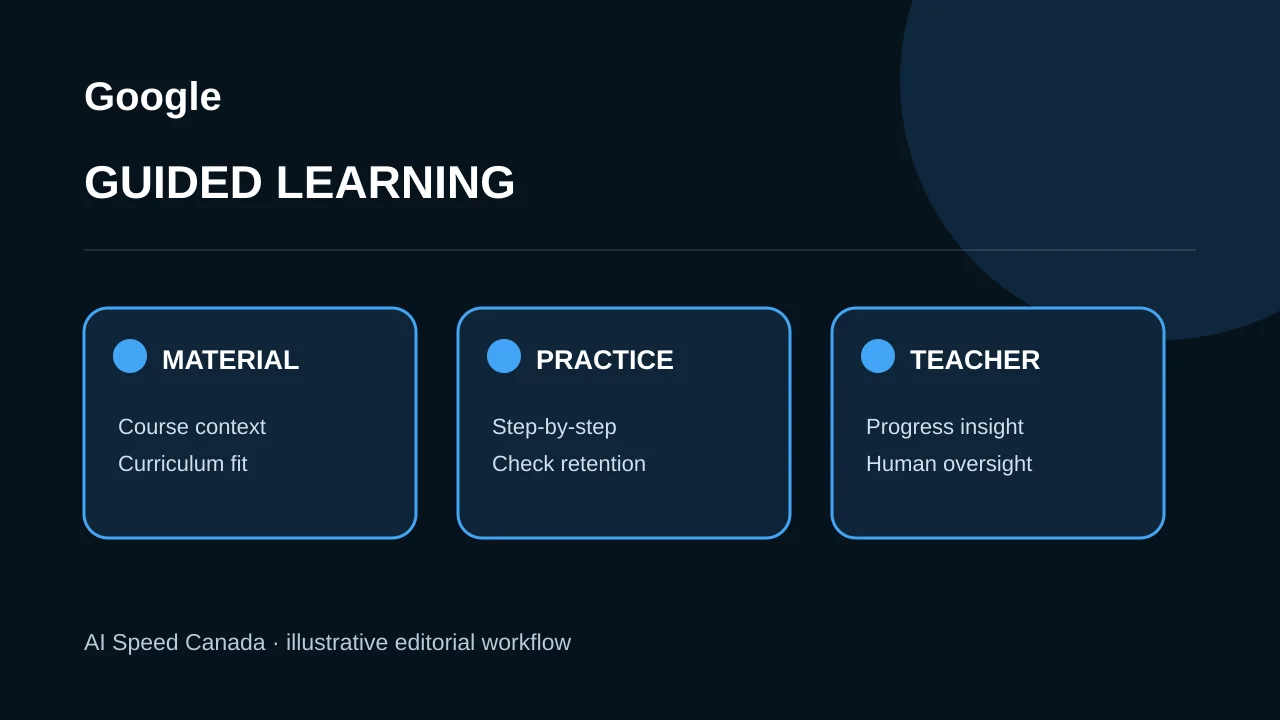
Google announced on November 3, 2026 that Guided Learning is beginning a global rollout in Google Classroom. The tool is designed to coach students step by step rather than return a direct answer. Google paired the product announcement with a randomized study involving more than 300 University of Tokyo students and a four-week pilot across three UK secondary schools. The research is more useful than an unsupported launch claim, but it remains provider-published evidence from specific settings.
The Tokyo trial found a larger gain during one statistics study session
Students received half a day to study a statistics lesson with standard online resources. Half also received Guided Learning in Gemini. Google reports that the standard-tools group improved its test score by 5.3 percentage points, while the Guided Learning group improved by 8.1 points.
Random assignment strengthens the comparison, but one short lesson cannot establish durable learning across subjects, ages or languages. Readers need the study protocol, assessment design, attrition and statistical uncertainty to judge the effect fully. The reported 1.5-times figure compares improvement amounts; it is not a claim that students learned 50 percent of all material.
Related sources: Google: AI in the learning era ↗ · Google: Guided Learning research and Classroom features ↗
The UK pilot shaped teacher visibility and assignment controls
Google and Ark piloted Guided Learning across four subjects in three secondary schools. Post-pilot surveys and interviews suggested that students used it for questions they might not ask aloud and that teachers could focus attention elsewhere. These observations are participant feedback, not a randomized outcome measure.
Teachers also requested clearer visibility into student activity and stronger focus on assigned materials. Google says it added educator insights and improved grounding on uploaded curriculum. Those controls can help supervision, but schools still need policies for errors, accessibility, acceptable assistance and what student interaction data is retained.
Related sources: Google: Guided Learning research and Classroom features ↗
Global rollout describes availability, not automatic classroom adoption
Teachers can assign a Guided Learning experience based on course materials and view progress insights. The broader education announcement also mentions Guided Learning in Search and revised controls for K-12 accounts across Gemini, Gemini Notebook, Classroom and Search. Exact availability can still depend on account type, administrator settings and regional product terms.
A school should pilot a defined lesson rather than enable a tool without an evaluation plan. Compare learning with an existing activity, review generated explanations for curriculum alignment and provide a non-AI alternative. Students and families should understand when the tool is used and which data flows to the provider.
Related sources: Google: AI in the learning era ↗ · Google: Guided Learning research and Classroom features ↗
Canadian evaluation must account for curriculum, language and provincial governance
Canadian schools should test both English and French where applicable and use materials aligned with the relevant provincial or territorial curriculum. A result from Tokyo statistics students or three UK schools should not be assumed to transfer to younger learners, Indigenous education contexts or accessibility needs.
Measure delayed retention, misconceptions, teacher correction time and who benefits or falls behind. Keep educators accountable for instruction and high-impact assessment. The next valuable evidence will be independent replication, longer follow-up and transparent reporting about privacy and subgroup outcomes.
Sources and editorial method
We use the linked original statements and reports to distinguish documented facts from our analysis. Company announcements describe their authors’ plans and claims; they are not independent verification of future outcomes. This article is dated and will be revised if material evidence changes. Read our editorial standards and corrections process.
- Google: AI in the learning era ↗ — Official November 3 portfolio overview; global Classroom rollout and wider education updates.
- Google: Guided Learning research and Classroom features ↗ — Official November 3 account of the Tokyo randomized trial, UK pilot, reported results and product changes.