Microsoft Research, Microsoft Security and UC Berkeley researchers published TokenEconomizer, an open-source plugin intended to reduce repeated work and cost in coding-agent sessions. Its repository reports 18.4% to 30.9% lower mean cost on SWE-Bench across five tested agent–model combinations, with lower cost in all 30 repository-by-combination cells and higher Pass@1 in four of five combinations. Those are project measurements under a disclosed experiment—not a forecast for every development team.
The project targets three kinds of repeated agent work
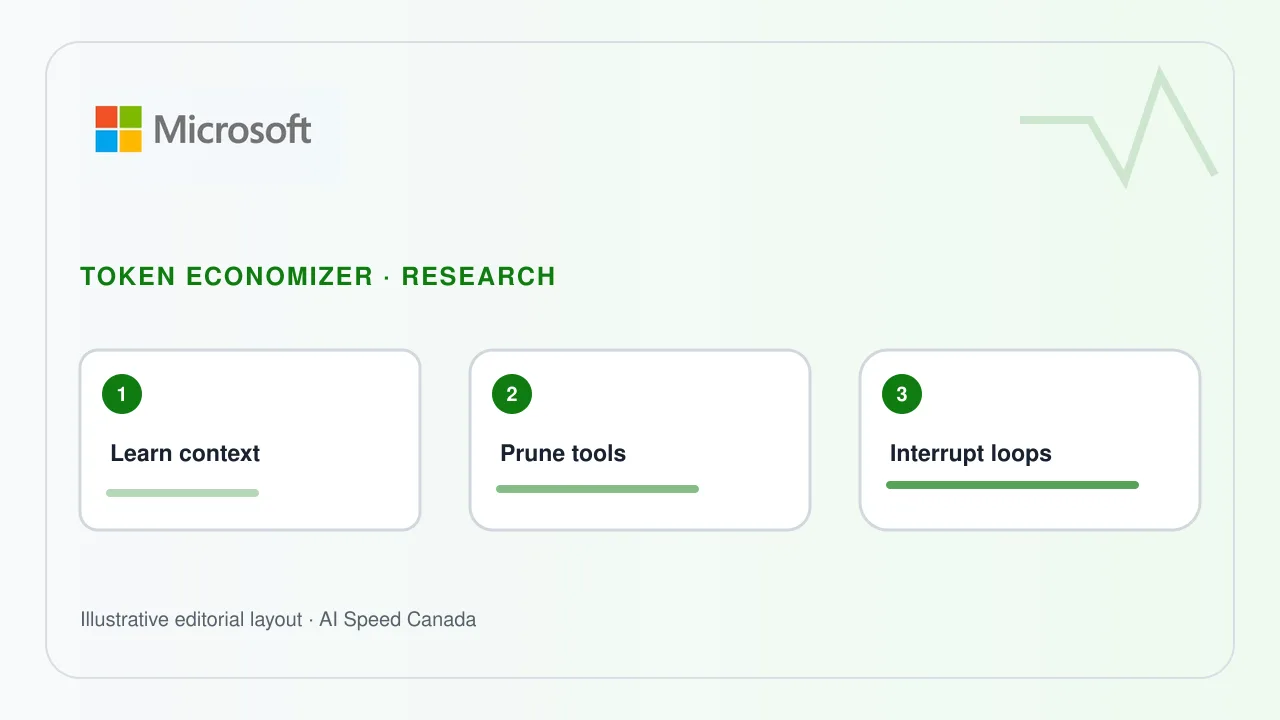
TokenEconomizer can form repository-specific micro-skills from repeated evidence, remove tools that have gone unused and detect failure loops that may need a redirect. The approach leaves model weights and agent source code unchanged, working through context and host configuration instead.
The repository says tool pruning and loop intervention are on by default while micro-skills are opt-in. A loop judge may add model calls, and the project says those costs are included in its reports. Operators should verify their installed version and configuration rather than assume every mechanism is active.
Related sources: Microsoft TokenEconomizer repository ↗ · TokenEconomizer paper ↗
The published savings need to be read with their benchmark boundaries
SWE-Bench tasks are useful for repeatable software-engineering evaluation, but real repositories differ in language, tool count, test quality, session length and billing. Cached-input prices and agent versions also affect the calculated cost. A team should reproduce the comparison on representative tasks before budgeting around the headline range.
Pass@1 improving in four of five tested combinations does not mean the plugin always improves solution quality. The fifth result, task-level variance and any additional maintenance burden matter. The project provides experiment code, which makes independent reproduction more practical than an unsupported marketing claim.
Related sources: Microsoft TokenEconomizer repository ↗ · TokenEconomizer paper ↗
Local learning reduces one privacy risk but creates a repository record
The repository says learned data stays under a local `.tokeneconomizer` directory and the plugin needs no separate API key. Local storage can reduce external data transfer, but learned facts may still contain repository structure, failure patterns or project terminology that should follow the organization’s workstation and backup rules.
Teams should inspect generated facts, configuration and logs before using the tool on confidential code. Reversible pruning is valuable: removed tools can be restored and contradictory facts dropped. That does not replace source review, least privilege or a supported uninstall and cleanup process.
Related sources: Microsoft TokenEconomizer repository ↗
Treat adoption as a measured repository experiment
Start with a non-critical repository and record the baseline agent, model, task set, cache pricing, success criteria and total billed cost. Compare completion, regressions, human intervention and elapsed time as well as tokens. Cost savings that increase review work may not improve the whole workflow.
The project lists supported version ranges for Claude Code, Codex, GitHub Copilot CLI and Pi, with experimental opencode support. Compatibility can change quickly, so confirm the current matrix and security policy before installation.
Sources and editorial method
We use the linked original statements and reports to distinguish documented facts from our analysis. Company announcements describe their authors’ plans and claims; they are not independent verification of future outcomes. This article is dated and will be revised if material evidence changes. Read our editorial standards and corrections process.
- Microsoft TokenEconomizer repository ↗ — Official code, configuration, claimed measurements, supported versions, Apache-2.0 licence and experiment links.
- TokenEconomizer paper ↗ — Research paper describing the approach and evaluation; results apply to the tested setup.