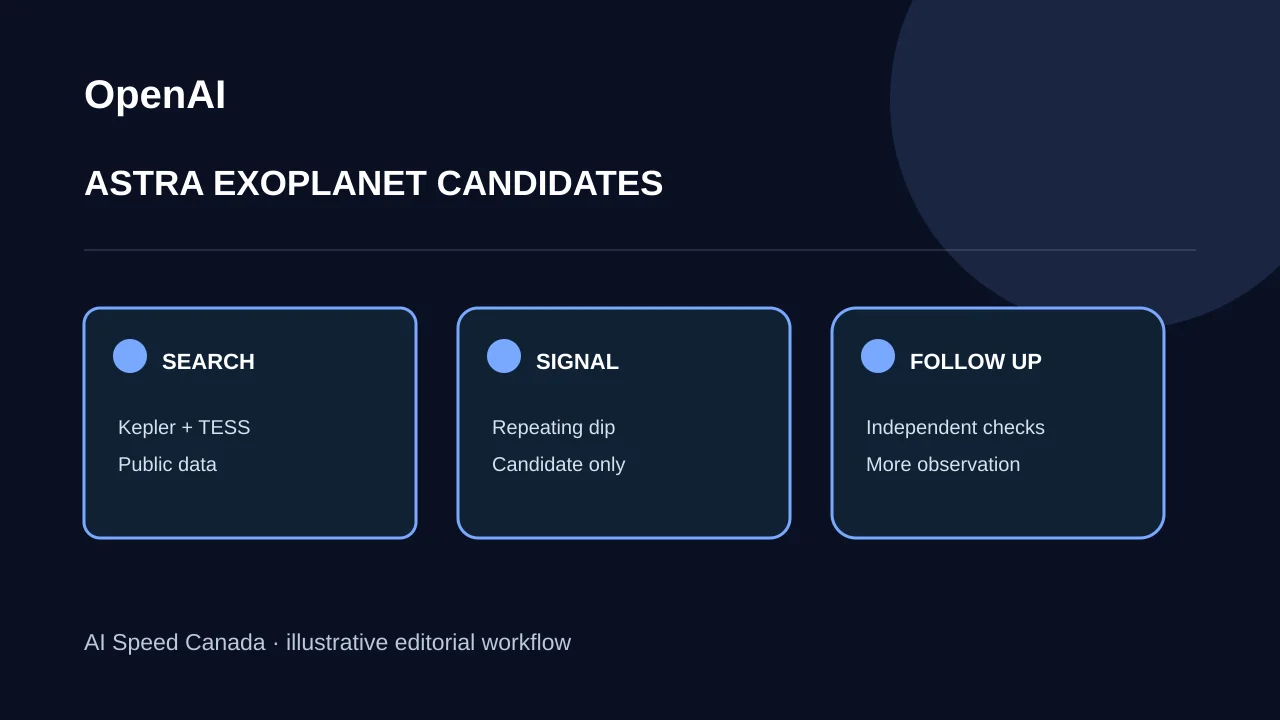
OpenAI described on November 24, 2026 how two amateur astronomers used Codex and Astra to build searches across public Kepler and TESS observations. The projects flagged several signals that could be produced by planets crossing in front of their stars. Two Kepler signals were independently recovered by a SETI Institute astronomer, and one TESS candidate awaits further analysis. They remain candidates—not confirmed exoplanets.
The systems helped construct and run search pipelines
Kevin Bond used Codex to compare published transit-search methods, combine them in software and test revisions across observations of roughly 100,000 Kepler stars. The search flagged more than 200 signals, including ten already-confirmed planets. Recovering known cases is a useful pipeline check, but it does not establish that every new signal has the same cause.
Ethan Byrd used Astra to review methods and build searches drawing on observations from about 19 million stars. His first pass produced 49 candidates, with the search continuing. These figures describe software output, not a confirmed discovery count.
Related sources: OpenAI: Searching for distant planets with Astra ↗
Two independently recovered signals are promising questions
For KIC 5689121, the pipeline found a brightness dip repeating about every 13.8 days; if a planet causes it, the reported depth is consistent with an object around 2.4 times Earth’s diameter. A second star, KIC 6691030, showed a 4.8-day cycle consistent with an object smaller than Neptune.
An independent search found both signals in the Kepler data. That supports the existence of the measured patterns, not the planetary explanation. Eclipsing stars, instrumental effects and other astrophysical events can resemble a transit.
Related sources: OpenAI: Searching for distant planets with Astra ↗
Confirmation requires observations and publication beyond the model
Astronomers may test whether a dip repeats on schedule, inspect nearby sources and use other measurements such as a star’s radial velocity. Statistical validation and peer-reviewed publication allow others to examine the assumptions and evidence. OpenAI says confirmation could take months or years.
The careful headline is therefore that AI-assisted pipelines produced leads for professionals to investigate. Calling them new planets today would turn a hypothesis into a result that the underlying researchers have not claimed.
Related sources: OpenAI: Searching for distant planets with Astra ↗
Canadian citizen scientists can participate without overstating results
Canadians can use public telescope archives and established citizen-science programs to learn light-curve analysis, but should document code, dataset versions, filters and false-positive checks. A model-generated pipeline needs the same reproducibility and domain review as hand-written analysis.
A useful contribution may be a clean negative result, recovery of a known transit or a well-documented candidate handed to professionals. The scientific value comes from testable evidence and shared methods—not from attaching a discovery label before follow-up is complete.
Sources and editorial method
We use the linked original statements and reports to distinguish documented facts from our analysis. Company announcements describe their authors’ plans and claims; they are not independent verification of future outcomes. This article is dated and will be revised if material evidence changes. Read our editorial standards and corrections process.
- OpenAI: Searching for distant planets with Astra ↗ — Official November 24, 2026 account; datasets, pipeline outputs, candidate status and follow-up requirements.
- NASA Exoplanet Watch ↗ — NASA citizen-science program and guidance for observing and analysing exoplanet transits.