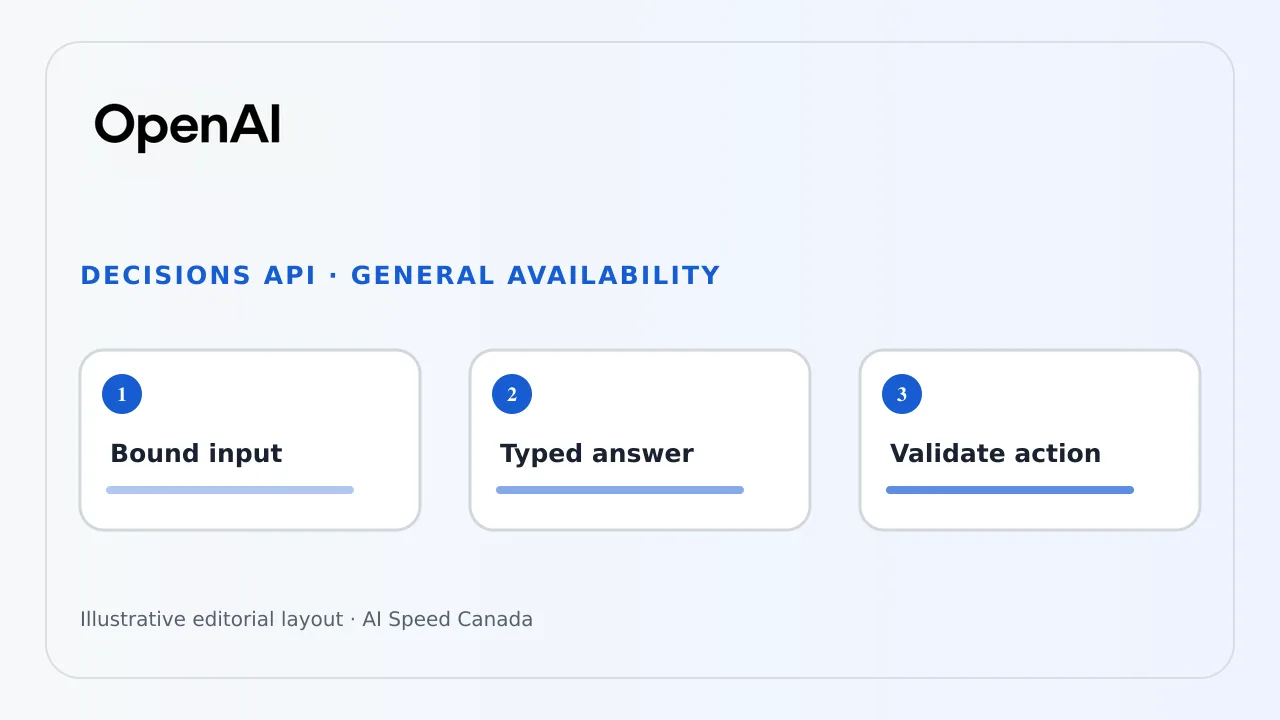
OpenAI made its Decisions API generally available on October 22, 2026. The service uses GPT-6 Luna to answer bounded questions about text, images or native JSON. Developers define the permitted answer shape instead of requesting a free-form essay: a predicate returns an estimated probability, a choice selects from supplied options, and a score maps evidence to ordered rubric levels. OpenAI says the service can answer up to 400 questions in one request and is up to ten times faster than GPT-6 Luna through the Responses API. That comparison is a vendor claim about a specific API path, not a guarantee for every workload.
General availability adds operational features
Since public beta, OpenAI says it added prompt caching for reused context, native JSON input, images inside question instructions, more regional capacity and inference residency in the United States and European Union. A native GPT-Live integration lets a voice session delegate bounded choices, such as whether to clarify, route or escalate.
General availability means OpenAI is presenting the service for production use. It does not mean the API is available in every data-residency region or appropriate for every decision. Canadian teams with geographic or contractual requirements should verify the exact processing location and current terms rather than infer Canadian residency.
Related sources: OpenAI: Decisions API general availability ↗ · OpenAI API docs: Decisions ↗
A typed output is easier to consume, not automatically correct
A fixed choice can reduce parsing errors and make an application’s next action explicit. It can also hide ambiguity if the allowed options omit “unknown,” “ask a human” or another safe fallback. Probability outputs need calibration checks: a value near 0.8 should not be treated as an 80% real-world success rate without validation on representative data.
OpenAI’s customer examples report faster routing and lower costs in particular evaluations. Those testimonials use different tasks, baselines and sample sizes. Reproduce the comparison with your own inputs, measure accuracy and latency distributions, and retain reviewed test cases for language, accessibility and Canadian operational contexts.
Related sources: OpenAI: Decisions API general availability ↗ · OpenAI API docs: Decisions ↗
Keep execution authority in the application
The API returns a decision; the surrounding application decides what to do with it. Before a high-impact action, validate schemas, enforce permissions and apply deterministic business rules. Security classifications, financial routing or access decisions need audit logs and an escalation route that does not depend on the same model output.
For low-risk interface choices, a bounded fast model may improve responsiveness. For consequential cases, use confidence bands and human review based on tested error costs. Do not send personal, confidential or regulated information until the organization has approved the provider, retention and residency path.
Sources and editorial method
We use the linked original statements and reports to distinguish documented facts from our analysis. Company announcements describe their authors’ plans and claims; they are not independent verification of future outcomes. This article is dated and will be revised if material evidence changes. Read our editorial standards and corrections process.
- OpenAI: Decisions API general availability ↗ — October 22 product release; capabilities, vendor benchmarks and customer examples.
- OpenAI API docs: Decisions ↗ — Official implementation guide, supported inputs, answer types and GA changes.
- OpenAI API reference: create a decision ↗ — Request schema, supported model and 1–400 question limit.