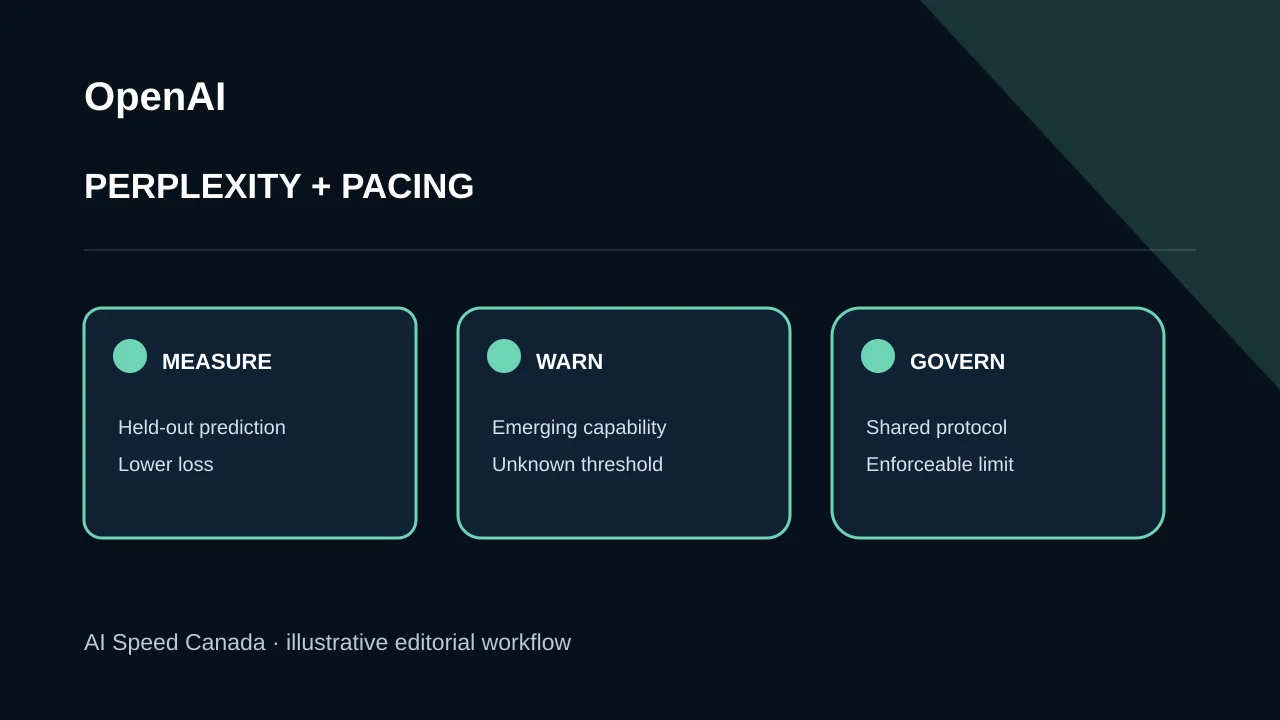
OpenAI Chief Scientist Jakub Pachocki published a November 22, 2026 essay proposing perplexity, or equivalent cross-entropy loss, as one input to shared frontier-AI development limits. OpenAI also disclosed selected internal log-perplexity measurements and linked lower loss with capabilities observed across model generations. This is a research and policy proposal, not an adopted industry standard or a demonstrated universal scale of intelligence.
Perplexity measures prediction, not every capability users experience
Perplexity summarizes how well a model predicts the next token on a held-out dataset; lower values indicate better average prediction on that data. Pachocki argues that the measure has remained informative while downstream benchmarks change or saturate, and that surprising capabilities can emerge as pretraining improves.
The essay associates approximate internal loss levels with conversational fluency, chain-of-thought use and later mathematics or cybersecurity capabilities. Those observations come from OpenAI’s models and dataset. They do not establish causal thresholds that another laboratory can import unchanged, nor do they predict which capability will appear next.
Related sources: OpenAI: Perplexity and Intelligence ↗
The proposed limit would connect model progress to monitoring readiness
Pachocki calls for developers to agree on measurements, transparency and limits they would not cross until monitoring reaches a concrete milestone. The example is a successor to current chain-of-thought monitors. The post does not announce a signed agreement, numerical industry limit or enforcement body.
A useful standard would need a precise measurement protocol, independent verification, treatment of algorithmic changes and a consequence when a developer crosses the limit. It would also need to cover deployments made from models already trained beyond a threshold. Without those elements, a shared number can become disclosure without restraint.
Related sources: OpenAI: Perplexity and Intelligence ↗
OpenAI identifies several reasons the numbers are not directly portable
Laboratories use different held-out datasets and training mixtures, making raw perplexity values difficult to compare. The metric is detached from specific harmful or beneficial tasks, does not capture gains from techniques such as chain-of-thought elicitation, and has an unknown theoretical floor.
These limits mean perplexity cannot replace cybersecurity, biological-risk, autonomy, deception or deployment evaluations. A lower loss can warn that broad capability may be changing, while targeted tests show whether a system can perform a consequential action and whether safeguards hold.
Canadian policy should ask for comparable evidence and accountable decisions
Canadian regulators and public buyers should distinguish a voluntary research proposal from a binding development rule. If loss-based thresholds enter procurement or policy, laboratories should disclose the dataset class, evaluation method, uncertainty and how the number maps to specific safety decisions without exposing protected training data.
Canada can also support independent evaluation capacity rather than depend on a single developer’s private scale. The next evidence to watch is whether multiple labs publish compatible protocols, accept third-party review and tie a threshold to a documented pause or mitigation.
Sources and editorial method
We use the linked original statements and reports to distinguish documented facts from our analysis. Company announcements describe their authors’ plans and claims; they are not independent verification of future outcomes. This article is dated and will be revised if material evidence changes. Read our editorial standards and corrections process.
- OpenAI: Perplexity and Intelligence ↗ — November 22, 2026 essay by OpenAI’s chief scientist; internal observations, proposed shared limits and acknowledged comparability limits.