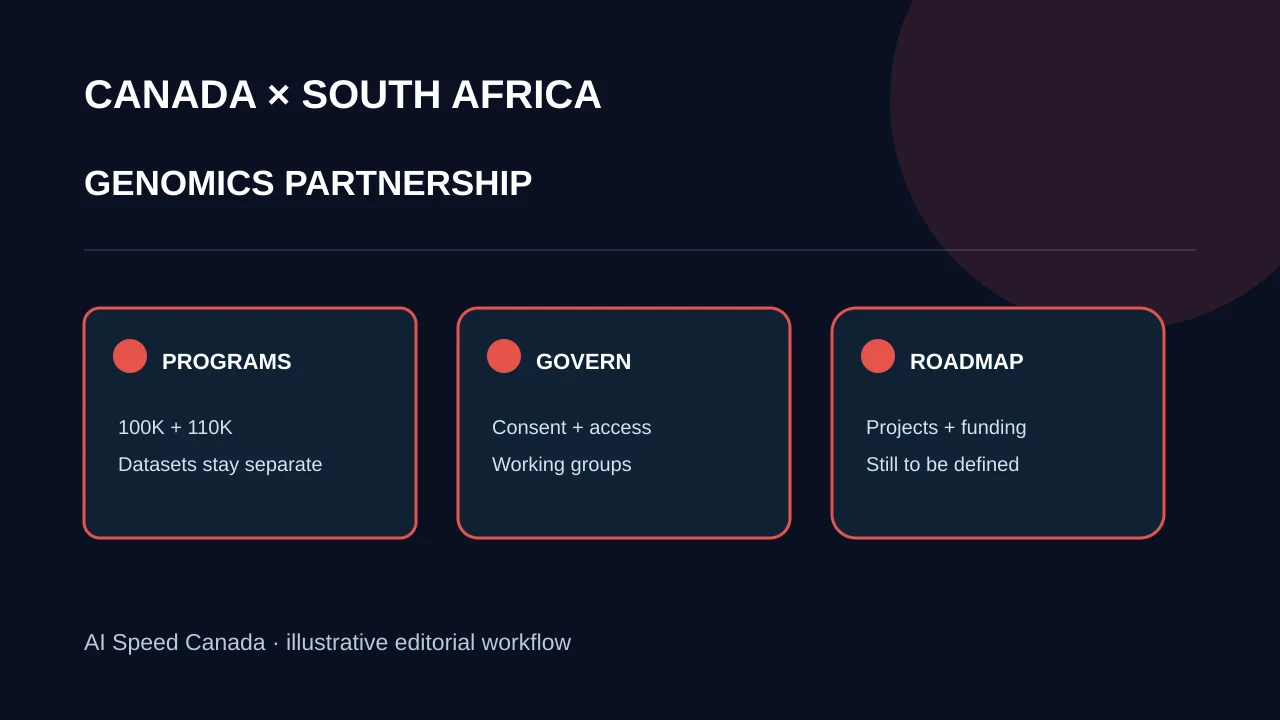
Canada and South Africa announced a new memorandum of understanding on November 24, 2026 between Genome Canada and the South African Medical Research Council. The framework connects expertise around two national initiatives: Canada’s Precision Health Initiative, which plans to generate more than 100,000 human genomes over four years, and South Africa’s 110,000 Human Genome Programme. The agreement creates a route for collaboration; it does not merge the datasets, announce a clinical product or prove improved health outcomes.
The MoU sets fields for cooperation, not a finished research program
Genome Canada says possible work includes clinical genomics, bioinformatics, artificial intelligence, variant interpretation, responsible data governance, workforce development and emerging health technologies. Joint working groups are expected to choose priorities, develop a roadmap and define concrete activities and deliverables.
That distinction separates the completed outcome—the signing of a framework—from future plans. The announcement does not provide project-level budgets, timelines, participating laboratories, data-access rules or performance targets for the new partnership.
Related sources: Genome Canada: Canada and South Africa link genomics expertise ↗ · Innovation, Science and Economic Development Canada: joint science and technology statement ↗
The national genome collections remain distinct
The Canadian and South African initiatives are described as complementary sources of expertise and representation, particularly for populations of African ancestry that have historically been underrepresented in genomic research. Genome Canada explicitly says the agreement does not combine the two datasets.
Any eventual cross-border research will need clear consent, access controls, cybersecurity, community governance and rules for secondary use. Genomic information can remain identifying and consequential for families, so a diplomatic framework is not a substitute for research ethics and privacy review.
Related sources: Genome Canada: Canada and South Africa link genomics expertise ↗ · Innovation, Science and Economic Development Canada: joint science and technology statement ↗
The agreement sits inside a broader science relationship
The federal joint statement also cites a recently awarded $1.5 million from Canada’s International Development Research Centre to South Africa’s National Research Foundation for science-granting capacity, a Mitacs mobility collaboration, and a 2026 seed-grant program. Those are related initiatives, not funding assigned to the new genomics MoU unless the parties later say so.
Officials also plan to explore biomanufacturing cooperation and exchanges on Indigenous Knowledge Systems. Explore and plan are the operative words: the statement does not report a completed manufacturing project or a new shared health database.
Related sources: Innovation, Science and Economic Development Canada: joint science and technology statement ↗
What Canadian researchers and communities should watch
The next useful evidence will be the working groups’ roadmap: named projects, funding sources, governance bodies, access criteria, participant recruitment and publication commitments. Community involvement should be visible before sensitive data is reused, particularly where research aims to address longstanding underrepresentation.
Success should be assessed through transparent research outputs, representative participation, capacity built in both countries and validated health or scientific findings—not the number of genomes named in the announcement. Until concrete projects begin, this is an enabling agreement with important potential rather than a measured precision-health result.
Sources and editorial method
We use the linked original statements and reports to distinguish documented facts from our analysis. Company announcements describe their authors’ plans and claims; they are not independent verification of future outcomes. This article is dated and will be revised if material evidence changes. Read our editorial standards and corrections process.
- Genome Canada: Canada and South Africa link genomics expertise ↗ — Official November 24, 2026 account; MoU scope, separate datasets and planned working groups.
- Innovation, Science and Economic Development Canada: joint science and technology statement ↗ — Official November 24, 2026 statement; wider funding, mobility, health and governance context.