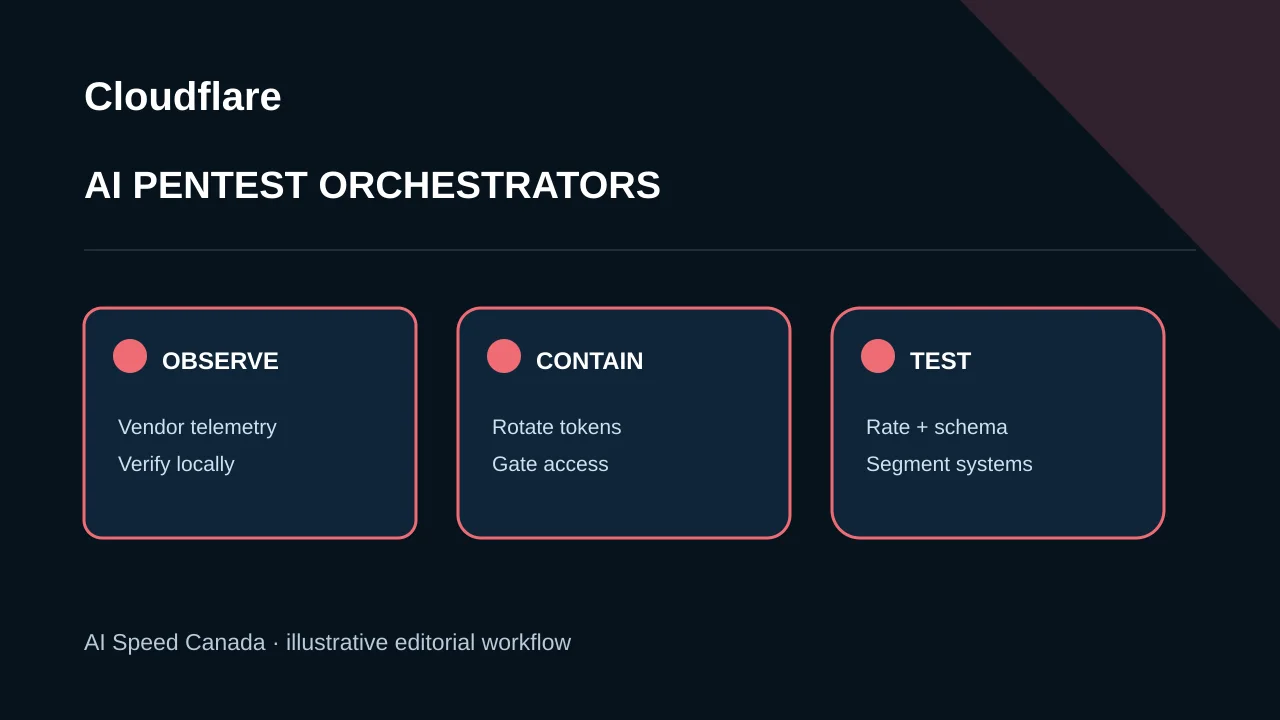
Cloudflare published threat observations on November 13, 2026 about AI-assisted penetration-testing and exploitation orchestrators. It says more than 50 framework families attempted to scan its customers during the preceding three days and that observed request volume from selected tools had risen sharply since October. These are Cloudflare’s attributed network observations, not an independent global count of successful compromises.
The report separates scanning scale from incident evidence
Cloudflare describes frameworks that coordinate multiple agents, conventional security tools and graphs of targets or findings. The company reports thousands of source IP addresses and many forks derived from the removed ARTEX repository. Attribution based on traffic patterns can indicate adoption while still missing disguised tools or counting infrastructure reused by several operators.
The stronger evidence comes from incident-response examples in which Cloudflare says attackers combined exposed, long-lived credentials with automated exploitation. Those examples show possible speed and lateral movement; they do not establish a success rate for every framework. Organizations should compare the indicators with their own logs instead of copying the headline counts into a risk register as universal statistics.
Related sources: Cloudflare: Adapting to AI penetration testing orchestrators ↗
Credential scope and exposed management paths deserve immediate review
The report’s practical concern is not that an AI system invents an unknown vulnerability. Automation can repeatedly enumerate exposed services, validate small configuration mistakes and reuse credentials across environments. Rotate static tokens where possible, shorten lifetimes, restrict scope and origin, separate development from production and verify that internal administration endpoints require identity-aware access.
Canadian organizations should preserve evidence and follow their incident and privacy-assessment procedures when a credential may expose personal information. Do not paste live secrets or sensitive logs into a public model while investigating. An authorized penetration test also requires written scope; the availability of an agent framework does not create permission to probe third-party systems.
Related sources: Cloudflare: Adapting to AI penetration testing orchestrators ↗
Layered controls need measurable tests
Cloudflare recommends rate limiting, anomaly detection, bot controls, identity-gated access, schema validation, micro-segmentation and threat intelligence. Several recommendations align with its own products, so buyers should translate them into vendor-neutral control objectives and verify whether existing systems already meet them.
Test whether direct origin access is blocked, stolen non-production tokens fail against production, API schemas reject unexpected input and alerts reach a person quickly. Measure time to revoke, containment coverage and recurrence. AI-labelled scanning changes attacker speed and volume; the defensive response remains disciplined asset inventory, least privilege, patching, monitoring and rehearsed containment.
Sources and editorial method
We use the linked original statements and reports to distinguish documented facts from our analysis. Company announcements describe their authors’ plans and claims; they are not independent verification of future outcomes. This article is dated and will be revised if material evidence changes. Read our editorial standards and corrections process.
- Cloudflare: Adapting to AI penetration testing orchestrators ↗ — Official November 13, 2026 threat report; attributed traffic, incident observations and the company’s recommended security controls.