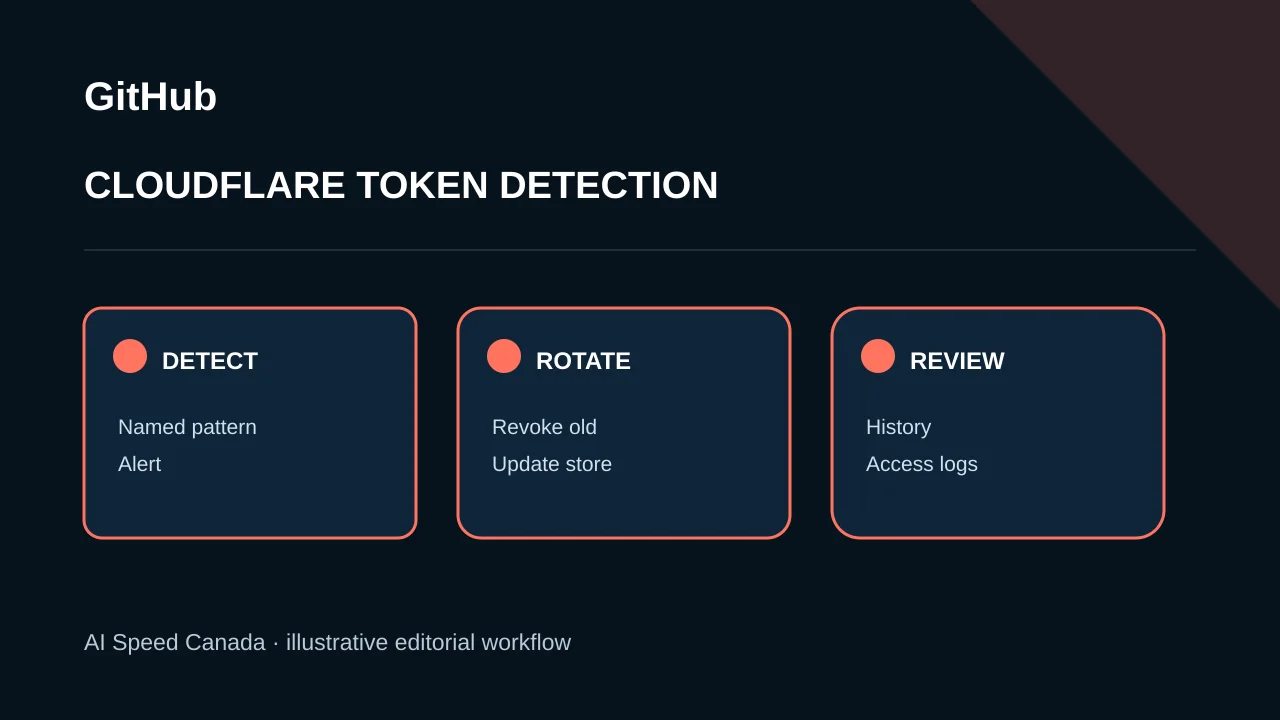
GitHub announced on November 12, 2026 that secret scanning recognizes Cloudflare Access service tokens under the cloudflare_access_service_token type. The detector extends coverage for a credential used by automated clients to reach applications protected by Cloudflare Access. Detection is a completed product update; it is not automatic revocation or proof that a flagged token was abused.
Partner and user secrets take different notification paths
GitHub classifies supported patterns as partner or user secrets. Partner secrets found in public repositories can be reported automatically to the issuing provider through GitHub’s partnership program. User secrets generate GitHub alerts when found in public or private repositories, subject to the repository’s enabled features and plan.
The announcement names the new pattern but does not say every historical encoding or transformed credential will match. Teams should check current supported-secret documentation and retain complementary controls such as pre-commit scanning, CI checks and least-privilege token design.
Related sources: GitHub: Secret scanning detects Cloudflare service tokens ↗
A valid alert begins the incident response
First identify the issuing account, protected application and token permissions without copying the secret into tickets or chat. Revoke or rotate the credential through Cloudflare, update the authorized workload through a protected secret store and confirm the old token no longer works.
Then review repository history, forks, build logs and access records for the exposure window. Removing the current line is insufficient when the credential remains in Git history or cached artifacts. A false-positive determination should record the tested pattern and reviewer rather than closing the alert without evidence.
Related sources: GitHub: Secret scanning detects Cloudflare service tokens ↗
Canadian teams should connect code scanning to identity governance
Service tokens can cross supplier and environment boundaries. Record an owner, purpose, expiry, protected application and rotation procedure. Keep production and development credentials separate, and avoid broad tokens shared across unrelated automation.
Measure time from commit to detection, rotation completion and recurrence. Those operational measures show whether the control reduces exposure. The detector release establishes that GitHub can recognize the named type; it does not guarantee coverage outside GitHub, erase leaked copies or establish compliance with an organization’s privacy and security obligations.
Sources and editorial method
We use the linked original statements and reports to distinguish documented facts from our analysis. Company announcements describe their authors’ plans and claims; they are not independent verification of future outcomes. This article is dated and will be revised if material evidence changes. Read our editorial standards and corrections process.
- GitHub: Secret scanning detects Cloudflare service tokens ↗ — Official November 12, 2026 announcement; named secret type and partner-versus-user reporting behaviour.