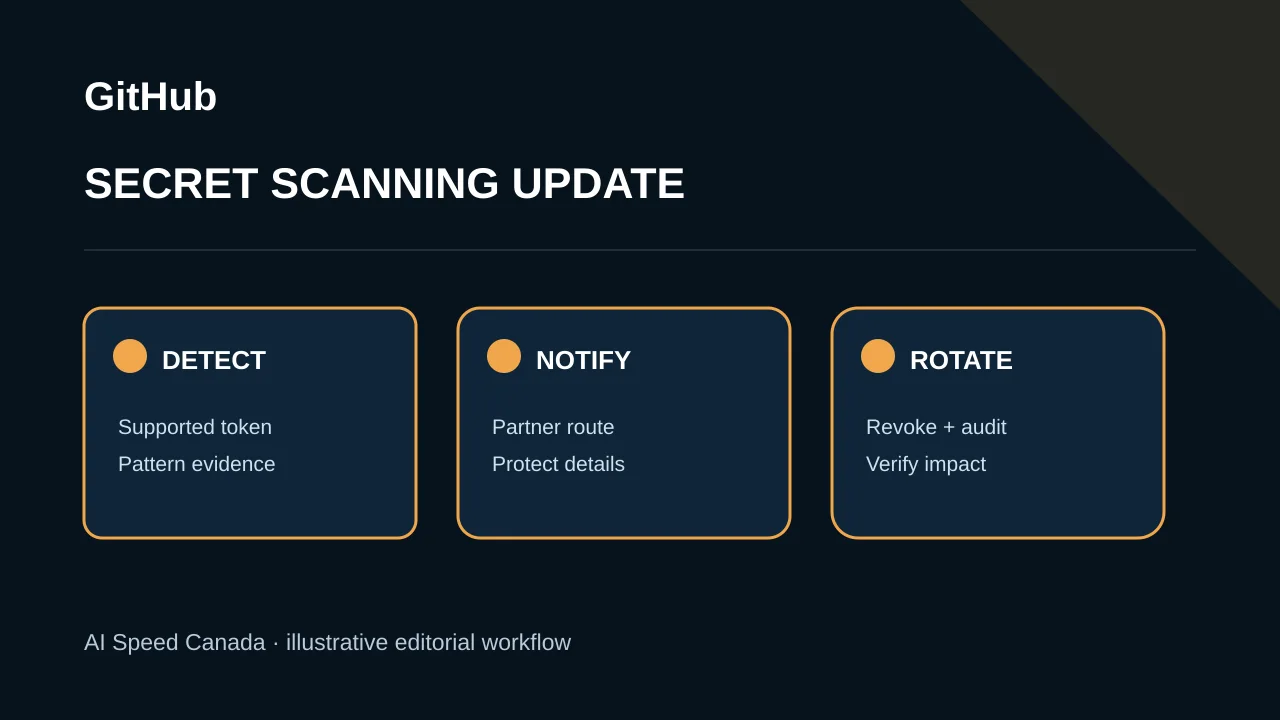
GitHub expanded secret scanning on November 5, 2026 by adding SpaceX as a partner and a detector for starlink_public_api_v2_secret. When a supported partner secret appears in a public repository, GitHub can report it to the issuer so the credential can be revoked or rotated. The release also changes false-positive filtering for Alibaba, AWS, Google, OpenVSX, Pydantic Services and Tencent token patterns.
Partner reporting and repository alerts are different paths
GitHub distinguishes partner secrets from user secrets. Partner secrets found publicly may be forwarded to the issuer. User-secret detections create repository alerts according to plan and configuration. Neither path guarantees that a leaked credential was unused before detection.
Maintainers should know which route applies to each token and who receives notifications. A public report to an issuer can accelerate revocation, but incident ownership, audit review and application recovery still belong to the affected organization.
Related sources: GitHub: secret scanning detector updates ↗
The filter changes target specific known false positives
AWS, Alibaba and Google updates suppress isolated identifiers when a qualifying companion secret is absent after dictionary filtering. OpenVSX matching is tighter around legacy tokens; Logfire matching excludes placeholders and public browser tokens; Tencent identifiers must contain both letters and digits.
These are targeted precision improvements, not proof that scanning now finds every credential. Encoded, split, novel or context-poor secrets can evade detectors. Teams still need least-privilege credentials, short lifetimes, pre-commit controls and log monitoring.
Related sources: GitHub: secret scanning detector updates ↗
Deleting the line is not sufficient remediation
Once a credential enters Git history, a later commit does not make the old value safe. Revoke or rotate it, inspect access logs, determine affected resources and decide whether history rewriting is appropriate. Avoid exposing the secret again in tickets or screenshots.
Measure detection-to-revocation time, confirmed use and recurrence. Alert volume alone can improve because filters got broader or worse because developers are leaking more credentials; it is not a direct risk-reduction metric.
Canadian teams should connect alerts to privacy and incident procedures
A credential can provide access to customer or employee data. Canadian organizations should involve security and privacy personnel when evidence suggests unauthorized access, and assess contractual and legal notification duties using verified facts.
Repository and alert exports can themselves reveal sensitive system names. Restrict access, retain only necessary evidence and test the response with non-production canary tokens before depending on the workflow.
Sources and editorial method
We use the linked original statements and reports to distinguish documented facts from our analysis. Company announcements describe their authors’ plans and claims; they are not independent verification of future outcomes. This article is dated and will be revised if material evidence changes. Read our editorial standards and corrections process.
- GitHub: secret scanning detector updates ↗ — Official November 5 release; new partner, Starlink secret type and provider-specific false-positive changes.