GitHub announced on November 12, 2026 that hosted Actions runners will stop supporting ARM32 job execution on Windows and Linux by December 8. The change removes native AArch32 user-space execution and follows GitHub’s Node 20 retirement path, because Node 24 does not support ARM32. This is a dated retirement notice, not a claim that ARM32 devices or every self-hosted configuration will stop working.
The change targets hosted runner execution
The announcement specifically names GitHub Actions hosted runners on Windows and Linux. Teams should not translate that into a blanket retirement of ARM32 software. The affected boundary is native AArch32 user-space execution inside those hosted environments.
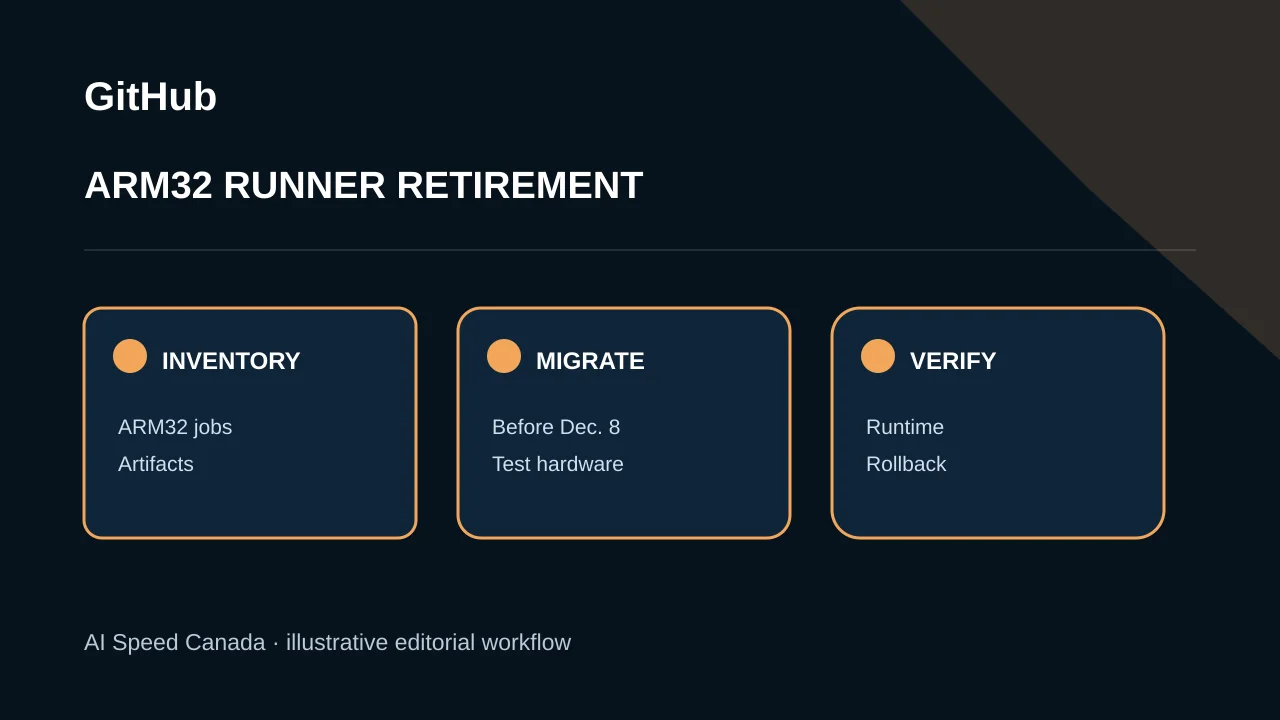
Search workflow files, composite actions, container definitions and build scripts for arm, armv7, armhf and aarch32. Also inspect release pipelines that create packages without naming the architecture in the workflow. A job may run on x64 while still producing or testing an ARM32 artifact through emulation or cross-compilation.
Related sources: GitHub: Actions for ARM32 Linux and Windows retirement ↗
Choose replacement testing based on the deployed hardware
Options can include cross-compilation, emulation, another supported runner architecture or a controlled self-hosted runner. None is automatically equivalent. Cross-compilation may verify that code builds but miss runtime assumptions; emulation can differ in timing or kernel behaviour; self-hosting adds patching, isolation and credential responsibilities.
Canadian teams supporting embedded, industrial, networking or older consumer devices should inventory the actual CPU and operating system combinations still in service. Preserve at least one representative runtime test when a field device cannot be replaced by an x64 build.
Related sources: GitHub: Actions for ARM32 Linux and Windows retirement ↗
Use the deadline to prove the new path before release day
Create a temporary branch that exercises the replacement, records produced artifact architecture and runs functional tests. Verify marketplace actions and setup scripts against Node 24 rather than assuming a repository-level runtime change covers every dependency.
Document the owner, affected products, chosen runner and rollback plan before December 8. After migration, compare artifact signatures, package contents and runtime results. GitHub’s one-minute notice establishes the support boundary and date; it does not provide a universal migration recipe or validate third-party actions.
Sources and editorial method
We use the linked original statements and reports to distinguish documented facts from our analysis. Company announcements describe their authors’ plans and claims; they are not independent verification of future outcomes. This article is dated and will be revised if material evidence changes. Read our editorial standards and corrections process.
- GitHub: Actions for ARM32 Linux and Windows retirement ↗ — Official November 12, 2026 retirement notice; December 8 deadline, hosted-runner scope and AArch32 removal.