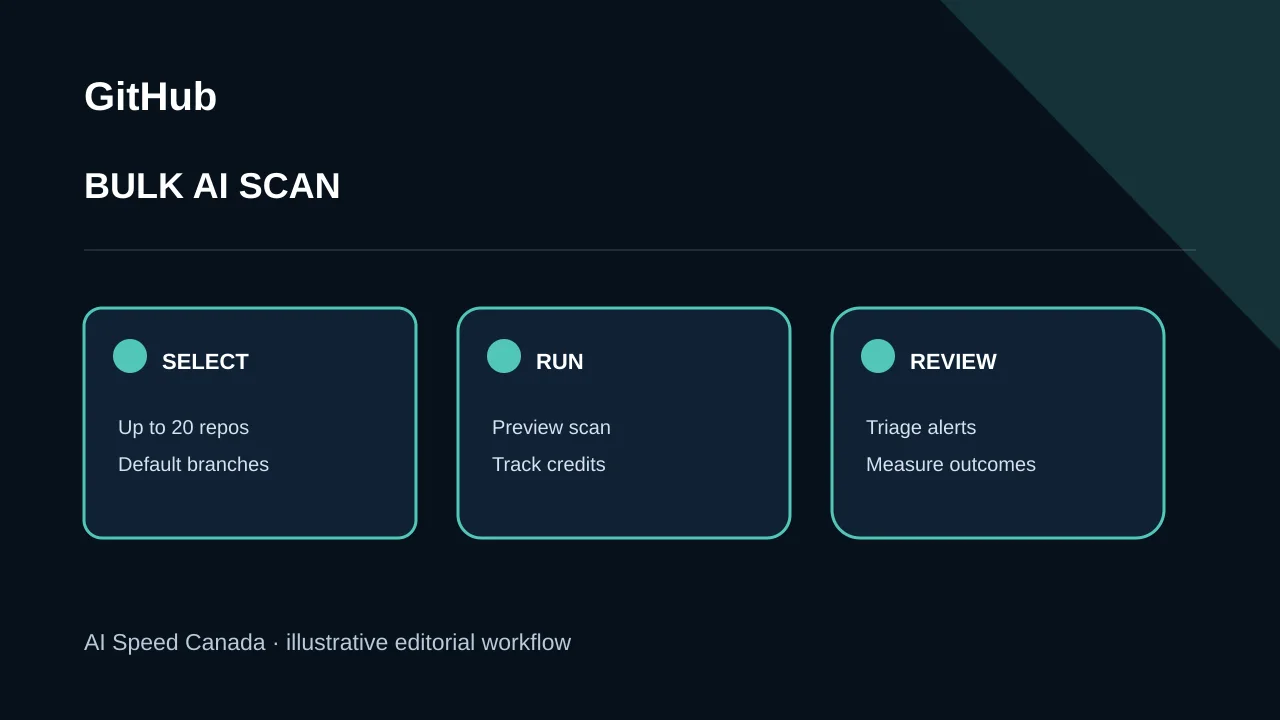
GitHub announced on November 16, 2026 that organizations can start AI Scan for repositories across as many as 20 selected repositories in one action. The public-preview feature runs scans on default branches and adds findings to the normal code-scanning backlog. It is a new execution control, distinct from the November 13 REST setting that only enabled or disabled repository scanning.
Bulk start joins policy and execution without making them identical
An organization can launch selected scans when enabling the organization-level setting or from its organization code-scanning alerts page. Individual repositories retain a start control on their own alerts page. Administrators should record which repositories were selected, which runs completed and which failed rather than treating one click as proof of coverage.
GitHub says AI Scan can inspect languages outside CodeQL support and find additional issue types in supported languages. That is a vendor description of intended coverage, not a guarantee that every vulnerability, generated file or branch is examined.
Related sources: GitHub: Bulk start AI Scan for repositories ↗
Plan, branch and preview boundaries remain
The preview is available on github.com and GitHub Enterprise Cloud with data residency; it does not require a Copilot licence. Private and internal repository eligibility still depends on GitHub Code Security or Advanced Security, while scans consume security AI credits under the existing product rules.
Canadian teams should pilot a representative mix of languages, repository sizes and sensitivity levels. Check data residency, administrator policy, credit budgets and whether generated or vendor code should be excluded before broad execution.
Related sources: GitHub: Bulk start AI Scan for repositories ↗
Measure reviewed outcomes, not started scans
A useful rollout records completion rate, alert volume, confirmed defects, false positives, remediation time and credit consumption. Compare findings with existing CodeQL, dependency and manual-review processes; do not replace them solely because the new tool uses a model.
Preview behaviour can change. Keep a named reviewer for every finding, preserve evidence behind dismissals and require ordinary tests and branch protection for fixes. Bulk operation is valuable when it reduces administration without turning unreviewed alerts into a compliance statistic.
Sources and editorial method
We use the linked original statements and reports to distinguish documented facts from our analysis. Company announcements describe their authors’ plans and claims; they are not independent verification of future outcomes. This article is dated and will be revised if material evidence changes. Read our editorial standards and corrections process.
- GitHub: Bulk start AI Scan for repositories ↗ — Official November 16, 2026 public-preview announcement; batch size, launch locations, default-branch scope and availability.