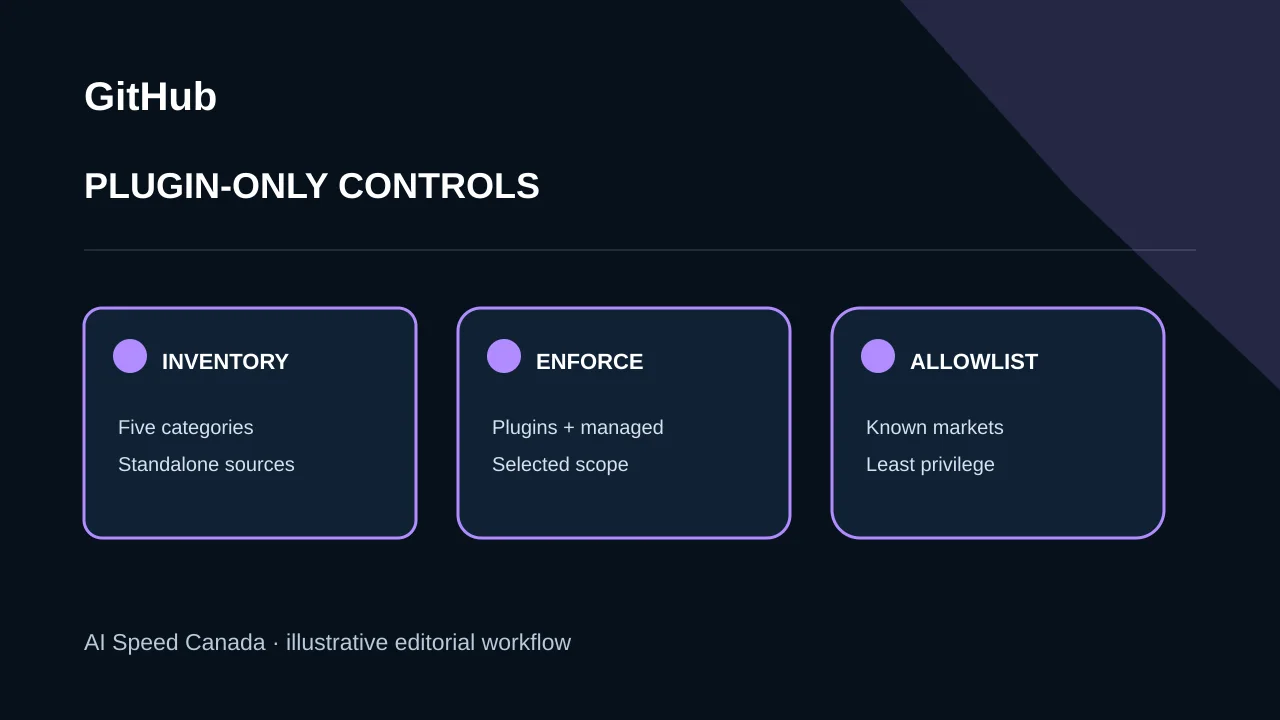
GitHub added an enterprise control on November 16, 2026 that can require selected Copilot customizations to come from plugins or managed settings instead of standalone user or project configuration. The control is available for Enterprise Cloud members whose Copilot Business or Enterprise licences are issued through the enterprise or its organizations.
Administrators can restrict five customization categories
The strictPluginOnlyCustomization setting can cover skills, custom agents, hooks, MCP servers and executable Copilot extensions. Administrators can select all five or apply the rule only to higher-risk categories. GitHub clarifies that extensions here means executable canvas providers, not VS Code Marketplace extensions.
A phased rollout can begin with MCP servers and executable extensions, where external tools and code execution create clearer authority boundaries. Inventory current standalone configurations first so the policy does not silently break a required workflow.
Related sources: GitHub: Control where Copilot customizations come from ↗
Plugin-only is not the same as enterprise-approved
GitHub explicitly says plugin-only does not mean enterprise-managed plugins only and is not a marketplace allowlist. Organizations that need approved sources must combine it with strictKnownMarketplaces and their existing managed marketplace definitions, required-plugin and blocked-plugin rules.
Treat the controls as layers: one governs packaging, another governs allowed sources, and ordinary identity and repository permissions govern what a plugin can reach. Test each layer with an allowed and denied example rather than assuming the setting name captures the complete policy.
Related sources: GitHub: Control where Copilot customizations come from ↗
Governance should follow data and action boundaries
Canadian organizations should document which plugins can read source code, call external services, execute tools or retain content. A centrally distributed plugin can still be overprivileged or send data to an unsuitable region; packaging alone is not a privacy or security assessment.
Measure unauthorized configuration attempts, exception requests and workflow failures after rollout. Preserve an emergency disable path and review marketplace ownership changes. The new control helps standardize distribution, but accountable use still requires least privilege, logging and periodic review.
Sources and editorial method
We use the linked original statements and reports to distinguish documented facts from our analysis. Company announcements describe their authors’ plans and claims; they are not independent verification of future outcomes. This article is dated and will be revised if material evidence changes. Read our editorial standards and corrections process.
- GitHub: Control where Copilot customizations come from ↗ — Official November 16, 2026 release; supported categories, managed setting, marketplace interaction and eligible plans.