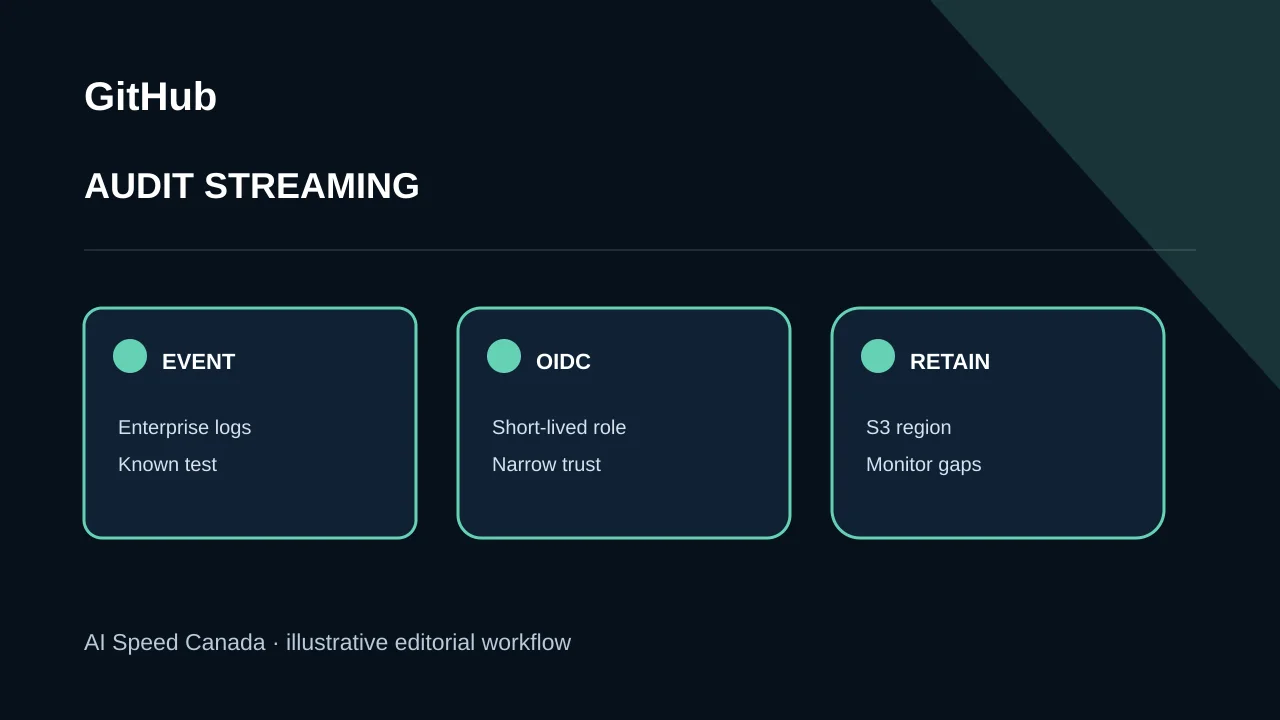
GitHub announced on November 19, 2026 that GitHub Enterprise Cloud with data residency, commonly identified by GHE.com subdomains, can stream enterprise audit logs to Amazon S3 using OpenID Connect. The capability already existed for enterprises on github.com. It replaces stored long-lived AWS credentials with short-lived credentials issued after AWS validates GitHub's identity token.
The change extends an authentication option to GHE.com
The expansion concerns the destination authentication method for S3 audit-log streaming. Administrators configure an AWS identity provider and role, then allow the GitHub enterprise to assume that role. GitHub can request temporary credentials for delivery without keeping a static AWS access key in its configuration.
Short-lived credentials reduce one persistent-secret risk; they do not make the integration permissionless. The AWS role still needs access to the chosen bucket, and an overly broad trust policy could let an unintended enterprise or repository context assume it.
Related sources: GitHub: S3 audit log streaming with OIDC expands to GHE.com ↗ · GitHub Docs: stream audit logs to Amazon S3 with OIDC ↗
Trust policy and delivery monitoring remain the control boundary
Teams should restrict the OIDC trust relationship to the documented GitHub issuer, enterprise identity and expected audience. Limit the role to the exact bucket and object operations required for log delivery. Separate production audit storage from general application buckets, enable encryption and record who can alter retention or lifecycle rules.
A successful configuration screen is not proof of continuous delivery. Generate a known auditable action, confirm its arrival, measure delay and alert on missing objects or authentication failures. Keep a documented fallback and test how investigators retrieve logs if GitHub or AWS is temporarily unavailable.
Related sources: GitHub Docs: stream audit logs to Amazon S3 with OIDC ↗
Data residency and audit storage are separate location decisions
Canadian organizations using a GHE.com region should not assume that GitHub data residency automatically determines the location of the S3 bucket. The AWS region, replication, backup, access and retention settings are separate choices. Contracts and internal policy should describe both services and the people or systems that can reach the resulting log archive.
Logs may contain usernames, repository names, IP-related records or security events. Apply least privilege, retention suited to the purpose and appropriate privacy review. Data residency is a deployment characteristic, not an automatic compliance conclusion.
Related sources: GitHub: S3 audit log streaming with OIDC expands to GHE.com ↗ · GitHub Docs: stream audit logs to Amazon S3 with OIDC ↗
Measure credential reduction and evidence availability
The useful outcome is fewer persistent cloud keys without losing audit evidence. Track whether static credentials were removed, whether the role can do anything beyond delivery, delivery latency, gaps, failed assumptions and access to stored objects. Rotate or remove any old key only after the OIDC path is verified.
GitHub's announcement establishes product availability, not that an individual enterprise has configured it correctly. Treat migration as a security change with peer review, rollback and a dated delivery test.
Sources and editorial method
We use the linked original statements and reports to distinguish documented facts from our analysis. Company announcements describe their authors’ plans and claims; they are not independent verification of future outcomes. This article is dated and will be revised if material evidence changes. Read our editorial standards and corrections process.
- GitHub: S3 audit log streaming with OIDC expands to GHE.com ↗ — Official November 19, 2026 announcement; availability and purpose.
- GitHub Docs: stream audit logs to Amazon S3 with OIDC ↗ — Official setup and audit-streaming guidance.