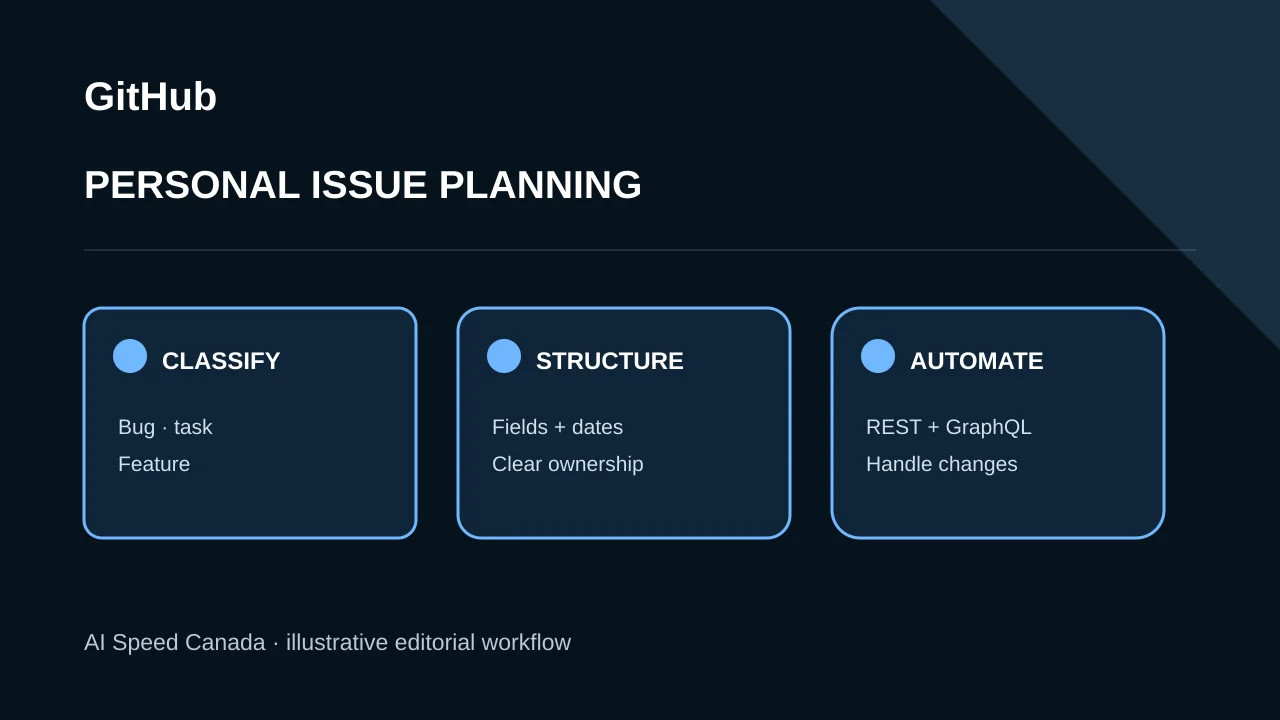
GitHub announced on November 11, 2026 that issue types and issue fields are generally available for repositories owned by personal accounts. The release extends planning controls that were already associated with larger team workflows to individual developers and open-source maintainers. It is a completed availability change, not a preview, but it does not automatically reorganize an existing backlog or determine which taxonomy will help a project.
Personal accounts can define up to 25 issue types
GitHub provides Bug, Task and Feature as defaults. A personal account owner can customize those entries and create as many as 25 issue types from the Planning area in account settings. The type can be selected while creating an issue or added to an existing one.
A larger list is not necessarily a better one. Maintainers should begin with categories that change how work is triaged or reviewed, then document the boundary between a type and an ordinary label. For example, a single Bug type may be more stable than separate types for every subsystem, while labels can describe platform or component.
Related sources: GitHub: Issue types and fields are available for personal accounts ↗
Fields add structured priority, effort and dates
The default issue fields are Priority, Effort, Start date and Target date. GitHub supports text, number, date, single-select and multi-select fields, again with a maximum of 25 custom fields. Fields can be pinned to particular issue types or made available on untyped issues, and Projects can use them for views and bulk updates.
Structured fields can make filtering and automation more dependable than free-form labels, but dates and effort values become misleading when nobody maintains them. An open-source project should explain who may change a field, what each value means and whether a target date is a commitment or only a planning signal.
Related sources: GitHub: Issue types and fields are available for personal accounts ↗
REST, GraphQL and webhooks support automation
GitHub says issue types and fields can be managed programmatically through REST and GraphQL APIs and observed through webhooks. The same release also lets a user create a missing label or milestone directly from an issue picker. Automation should use stable identifiers, handle deleted or renamed values and avoid silently overwriting a contributor’s update.
Canadian maintainers and small software teams can use the feature without moving a repository into an organization solely for these planning controls. Before a broad migration, test one repository, export the current labels, map only useful fields and verify permissions. General availability confirms product support; it does not prove that a more elaborate schema will shorten delivery time.
Sources and editorial method
We use the linked original statements and reports to distinguish documented facts from our analysis. Company announcements describe their authors’ plans and claims; they are not independent verification of future outcomes. This article is dated and will be revised if material evidence changes. Read our editorial standards and corrections process.
- GitHub: Issue types and fields are available for personal accounts ↗ — Official November 11, 2026 general-availability announcement; defaults, limits, field types, APIs and issue-picker changes.