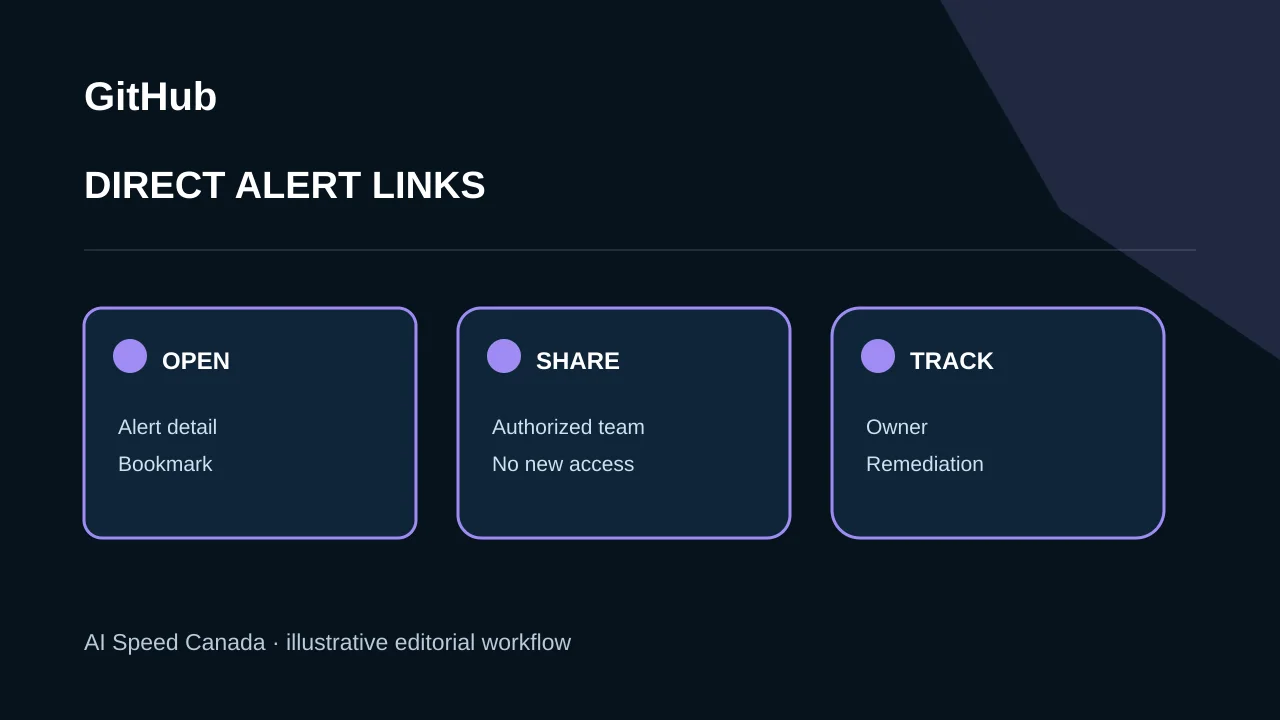
GitHub announced on November 12, 2026 that individual public-monitoring alerts now open on detail pages with direct URLs. Enterprise users can bookmark a finding or share its link with teammates who already have access. The feature improves navigation and handoff; it does not make security findings accessible to the open internet or grant a recipient new permissions.
The URL identifies an alert but authorization still applies
From an enterprise’s Public monitoring view, a user can select an alert number and copy the resulting address. GitHub explicitly limits sharing to teammates who have access. A direct link is therefore a locator within the existing access model, not an access token.
Teams should test the link with intended analyst and developer roles, and verify that a signed-out or unauthorized account cannot read the finding. Do not paste sensitive URLs into public issue trackers or channels whose membership is broader than the security program.
Related sources: GitHub: Public monitoring alerts now have direct links ↗
Links can make triage evidence easier to connect
An alert URL can be referenced from an internal case, remediation pull request or incident timeline so reviewers reach the same record. Keep the case system as the place for ownership, due date, severity rationale and final disposition; the GitHub page may change as the alert is updated.
Use descriptive link text rather than copying opaque addresses into reports. When exporting evidence, record the alert identifier and access date because a later viewer’s permissions or the alert state can differ. A bookmark is not a durable independent archive.
Related sources: GitHub: Public monitoring alerts now have direct links ↗
Public monitoring remains an enterprise security feature
GitHub says public monitoring is available to Enterprise Cloud customers with GitHub Secret Protection or GitHub Advanced Security at no additional cost. That statement means no separate public-monitoring add-on charge under the named plans; it does not mean the underlying enterprise security products are free.
Canadian organizations should keep least-privilege membership, periodic access review and retention rules around findings that may reveal exposed assets. Track acknowledgement and remediation time to see whether direct links improve response. The release adds a navigation primitive, not proof that a vulnerability was fixed.
Sources and editorial method
We use the linked original statements and reports to distinguish documented facts from our analysis. Company announcements describe their authors’ plans and claims; they are not independent verification of future outcomes. This article is dated and will be revised if material evidence changes. Read our editorial standards and corrections process.
- GitHub: Public monitoring alerts now have direct links ↗ — Official November 12, 2026 announcement; link behaviour, permission boundary and eligible enterprise plans.