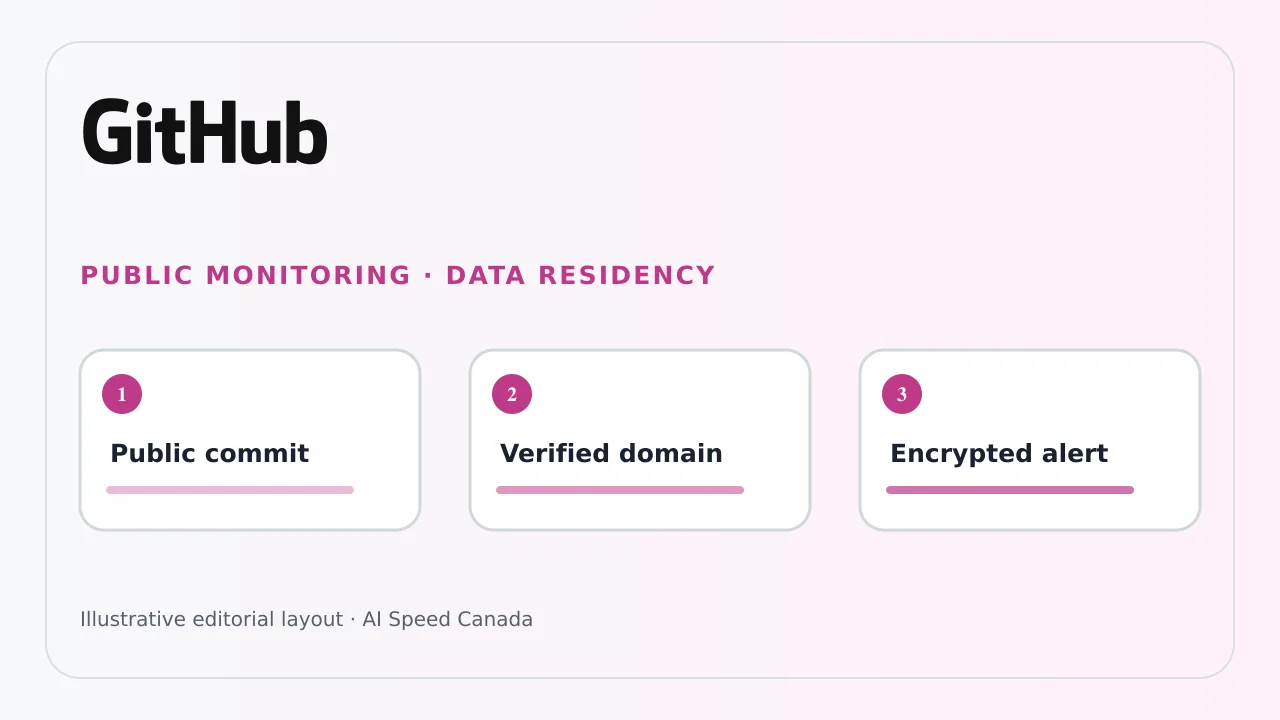
GitHub announced on October 22, 2026 that public monitoring is available in public preview for GitHub Enterprise Cloud with data residency. The feature extends secret scanning beyond repositories an enterprise owns by examining public commits across github.com and attributing exposed credentials to an enterprise. For data-resident tenants, GitHub says the attribution uses verified-domain matching instead of sharing enterprise membership rosters across the isolation boundary.
A verified-domain match is the attribution mechanism
When a public commit author’s email matches a domain the enterprise has verified, GitHub says an alert is encrypted and delivered to the enterprise dashboard in its designated geography. That can find an employee who commits with a corporate address outside an owned repository, but it also defines the visibility gap: an alternate personal email or incorrectly configured identity may not match.
Domain verification proves administrative control of the domain and helps GitHub associate profile email addresses. It does not prove that every matching commit was authorized by the named employee or that every contractor uses a corporate address. Treat the attribution as a response lead, then verify the repository, commit and credential with the responsible team.
Related sources: GitHub: public monitoring with data residency ↗ · GitHub Docs: verifying enterprise domains ↗
Detection must lead to revocation, not just removal
GitHub’s secret-scanning guidance recommends rotating an exposed credential immediately. Deleting the public file or rewriting Git history does not make a copied key safe. Revoke or rotate it at the issuing service, inspect relevant audit records, replace legitimate uses through a secrets manager and then remove the exposed value from current code.
Do not paste the credential into tickets or chat while coordinating. Record only the minimum identifiers needed for incident handling. A validity check or partner notification can help prioritize, but the absence of a positive validity result is not proof that a credential was never usable.
Related sources: GitHub Docs: secret scanning ↗
Preview availability is narrower than general secret scanning
GitHub limits this preview to data-resident Enterprise Cloud customers with an active GitHub Advanced Security or GitHub Secret Protection licence. It says public monitoring adds no separate charge beyond that licence. Enterprise administrators or security managers must enable it; the announcement does not establish that it is already active for a particular Canadian tenant.
Before enabling, confirm verified domains, response ownership, employee notice requirements and how alerts cross internal security boundaries. Test with a controlled non-production credential only if organizational policy permits. Public-preview status means behavior and availability can change, so keep ordinary leak-prevention controls such as push protection, least-privilege tokens and short expirations.
Sources and editorial method
We use the linked original statements and reports to distinguish documented facts from our analysis. Company announcements describe their authors’ plans and claims; they are not independent verification of future outcomes. This article is dated and will be revised if material evidence changes. Read our editorial standards and corrections process.
- GitHub: public monitoring with data residency ↗ — October 22, 2026 preview announcement; attribution, isolation, eligibility and billing.
- GitHub Docs: secret scanning ↗ — Official detection, remediation and public-monitoring context.
- GitHub Docs: verifying enterprise domains ↗ — Official domain-verification scope and identity context.