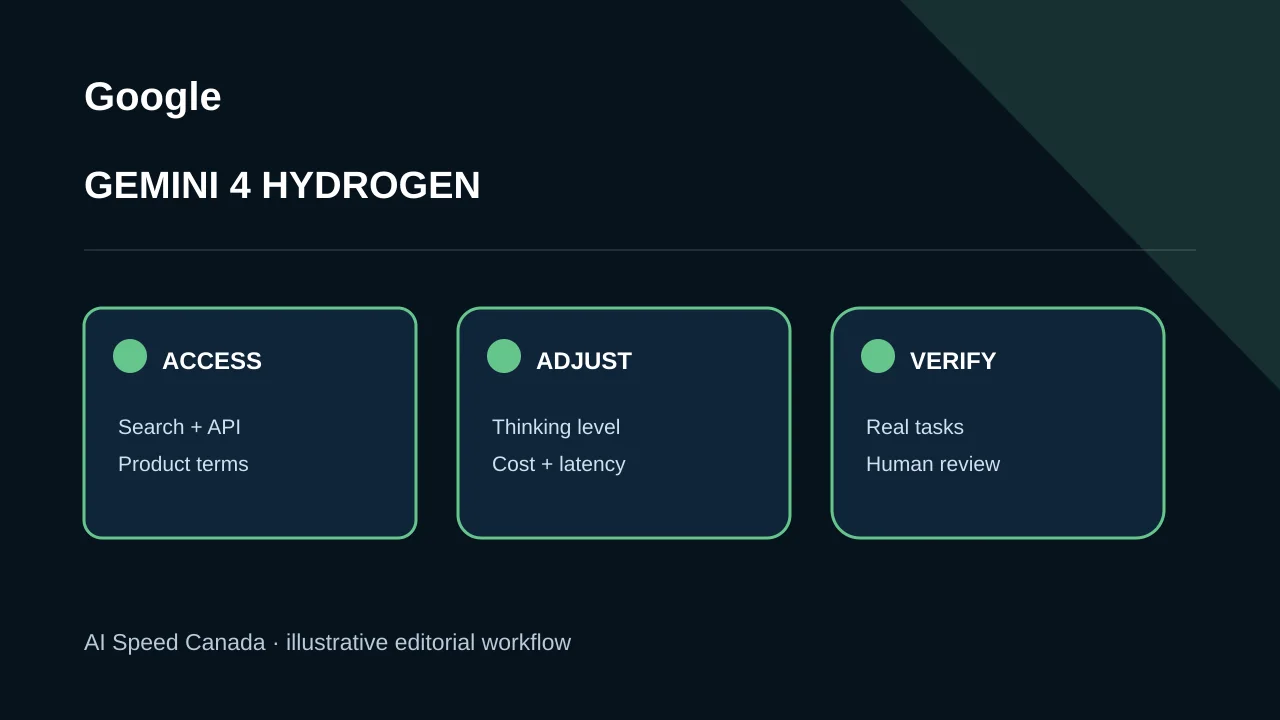
Google introduced Gemini 4 Hydrogen on November 12, 2026 as a faster Gemini 4 model for coding, agentic execution and everyday work. Google says it is available through all Google AI Studio tiers, the Gemini API, Gemini for business, the Gemini app, Search and paid Antigravity plans. This is a broad product launch; reported benchmark, speed and reliability improvements remain Google or partner measurements rather than universal outcomes.
Availability spans consumer and developer products
Hydrogen has a one-million-token input context and supports four thinking levels: low, medium, high and xhigh. Google lists high as the default. API pricing is US$1.50 per million input tokens and US$7.50 per million output tokens across the context window, according to the launch post.
Canadian buyers should verify the exact regional surface, taxes, exchange rate, quotas and data terms before budgeting. Search access, a Gemini app subscription and API billing are separate product relationships even when they use the same model family name.
Related sources: Google: Introducing Gemini 4 Hydrogen ↗ · Google: Gemini 4 Hydrogen in Search ↗
Google reports speed and benchmark gains that need task-level reproduction
Google says Hydrogen completes Terminal-Bench tasks 2.5 times faster at high thinking than Gemini 3.8 Flash while scoring 57% versus 18.2%, and reports lower fabricated-claim rates. It also cites internal partner results, external leaderboards and a new multimodal benchmark. Test setup, tool access and scoring determine how transferable those figures are.
Google’s Antigravity Orchestrator can switch between Carbon and Hydrogen in one session. The company reports near-Carbon success with 24% less quota and 19% faster completion on Terminal-Bench 4.0. Those are useful hypotheses for an evaluation, not a promise for every repository.
Related sources: Google: Introducing Gemini 4 Hydrogen ↗
Search adds more query fan-out, links and visual answers
Google says Hydrogen is live globally in Search for supported users, improving multi-part intent handling, simultaneous subqueries, structured tables, images and custom tools. It also says a wider query fan-out can connect people to more relevant sites.
Publishers and Canadian users should evaluate whether citations actually support the generated answer, especially for local services, prices, laws and health information. A more visual response can still contain an incorrect assumption. Record the query, date, language and linked evidence when testing English and French results.
Related sources: Google: Gemini 4 Hydrogen in Search ↗
Choose thinking level and model routing with measured evidence
Build a representative set of coding, bilingual knowledge-work and failure cases. Compare correctness, latency, token use, retries and human repair at each thinking level. For agentic tasks, log tool calls and require confirmation before consequential actions.
Google distinguishes Hydrogen’s rapid execution role from Carbon and Argon’s deeper reasoning. That positioning can support routing, but teams should not infer that a faster model is safer or cheaper overall. Measure the complete workflow and retain an accountable reviewer.
Sources and editorial method
We use the linked original statements and reports to distinguish documented facts from our analysis. Company announcements describe their authors’ plans and claims; they are not independent verification of future outcomes. This article is dated and will be revised if material evidence changes. Read our editorial standards and corrections process.
- Google: Introducing Gemini 4 Hydrogen ↗ — Official November 12, 2026 launch; availability, context, thinking levels, pricing and reported evaluations.
- Google: Gemini 4 Hydrogen in Search ↗ — Official November 12, 2026 Search release; global rollout, query fan-out, visual answers and supported languages.