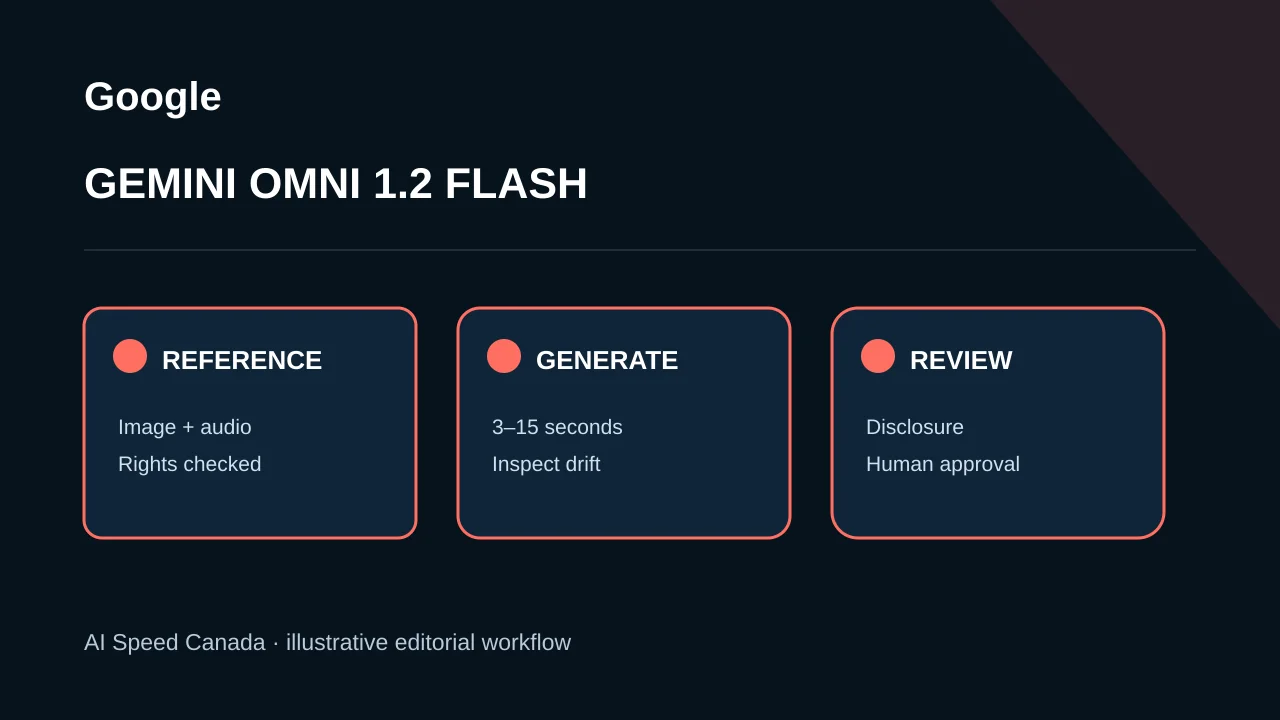
Google announced general availability of Gemini Omni 1.2 Flash on November 5, 2026 across the Gemini API and business products. The model generates and edits video with audio from text, images, audio or video inputs. It supports clips from three to fifteen seconds, up from ten seconds in Omni 1.1, and multi-turn conversational editing. Availability in consumer products is still rolling out by product and plan.
General availability applies to named developer and business surfaces
Developers can use the Gemini API and Google AI Studio; businesses can use Google Cloud and supported applications. Google also describes rollout through Flow, Google Vids, the Gemini app and advertising products. Those surfaces can have different plans, quotas and controls.
The company states US$0.07 per second for 720p video, 30% below Omni 1.1. That is a dated list price from Google, not a Canadian-dollar quote or total production cost. Editing rounds, upscaling, storage and other services may add costs.
Related sources: Google: Introducing Gemini Omni 1.2 Flash ↗ · Google Cloud: Omni 1.2 Flash generally available ↗
Reference adherence and consistency remain provider claims to test
Google says reference images, short motion clips and audio cues hold character, packaging, typography and brand details more consistently across frames. It also highlights steadier camera moves, dialogue and lip-sync. The examples are selected demonstrations, not a benchmark covering every style or language.
A team should seed representative assets and score identity drift, text errors, unwanted changes, edit success, retries and reviewer time. Keep the original media and verify claims depicted in product or training videos.
Related sources: Google: Introducing Gemini Omni 1.2 Flash ↗
Speech editing is restricted and outputs carry SynthID
The model card says SynthID watermarks are applied and that changing people’s speech is currently restricted while Google studies safer release. Watermarking can support provenance but does not prove that every copied or transformed file remains detectable.
Obtain consent for people and source assets, disclose synthetic scenes when they could be mistaken for real events, and avoid generating factual news imagery. Canadian publishers should test English and French captions, pronunciation and accessibility.
Related sources: Google DeepMind model card ↗
Google still names unresolved motion and physics problems
The launch says development continues for fast sports action, rapid script changes and complex physics. Those boundaries should remain beside claims of improved consistency. A longer clip increases the chance of drift and factual error even when the average result improves.
Measure usable seconds per dollar and correction time rather than generations. For consequential communications, require human approval and retain provenance, licence and consent records.
Sources and editorial method
We use the linked original statements and reports to distinguish documented facts from our analysis. Company announcements describe their authors’ plans and claims; they are not independent verification of future outcomes. This article is dated and will be revised if material evidence changes. Read our editorial standards and corrections process.
- Google: Introducing Gemini Omni 1.2 Flash ↗ — Official November 5 launch; GA surfaces, duration, editing, pricing, claims and disclosed ongoing limitations.
- Google DeepMind model card ↗ — Official model information, distribution, safety approach, SynthID and speech-editing restriction.
- Google Cloud: Omni 1.2 Flash generally available ↗ — Official business and developer availability summary.