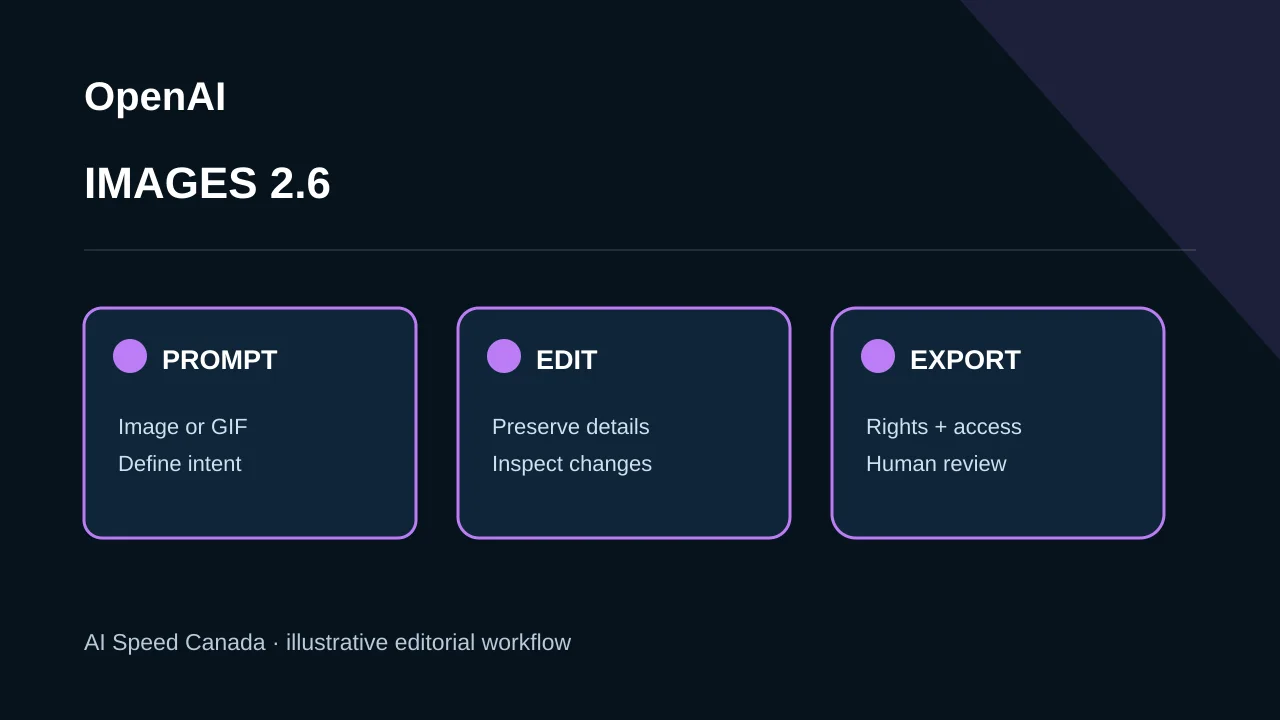
OpenAI announced Images 2.6 on November 4, 2026 for ChatGPT, Codex and the API. The company describes faster image generation, more precise editing, GIF creation and additional API controls. ChatGPT help documentation says the image experience is available across web, iOS and Android and supports transparent backgrounds. Availability still varies by product surface, account and rollout timing; a release announcement does not guarantee identical controls in every workspace.
The release spans conversation, coding and API workflows
In ChatGPT, users can generate a new image or edit an uploaded one through a prompt. Codex can use the model while building visual assets, and developers can integrate generation and editing through the API. These surfaces have different permission, billing and review contexts, so a capability shown in one interface should not be assumed to exist unchanged in another.
OpenAI calls the generation faster and editing more precise. Those are provider claims rather than an independent benchmark. Speed depends on output settings and service conditions, while edit quality depends on the instruction, source image and what must remain unchanged. Teams should measure completion time and unwanted changes on representative work.
Related sources: OpenAI: Introducing Images 2.6 ↗ · OpenAI Help: Creating images in ChatGPT ↗
Editing consistency matters more than a single polished example
A useful edit test should specify both the requested change and invariants: retain the subject, brand colours, text, composition or transparency unless the prompt says otherwise. Compare multiple runs, inspect small details and keep the original file. A visually attractive result can still alter a product feature or introduce incorrect text.
GIF creation expands the output formats people may request, but motion adds another review layer. Check frame sequence, flicker, file size, accessibility and whether the animation truthfully represents a product or event. Generated media should not be presented as documentary evidence of something that never happened.
Related sources: OpenAI: Introducing Images 2.6 ↗
New API controls do not remove production safeguards
Developers should pin the intended model identifier, validate dimensions and formats, set cost and rate limits, and retain provenance for source assets and prompts where appropriate. Generated output needs the same content review and rights checks as any other production asset. A successful API response only confirms delivery, not factual accuracy or legal clearance.
For editing, avoid sending confidential photographs or proprietary design files until retention, training use, residency and account controls meet organizational requirements. Application logs should not expose user prompts or uploaded images unnecessarily. Human approval should remain before publication or automated downstream use.
Related sources: OpenAI: Introducing Images 2.6 ↗ · OpenAI Help: Creating images in ChatGPT ↗
Canadian publishers should label illustrative output and test bilingual text
Canadian teams using generated media should make illustration status clear when an image could be mistaken for a real person, place or event. Obtain permission for uploaded assets and document licences for source material. Do not create a factual event photograph when no verified photograph exists.
English and French text rendering should be tested independently, including accents and small mobile sizes. Measure usable outputs per attempt, correction time, file weight and accessibility rather than counting generations. The release is a tool update; its value depends on a repeatable review workflow.
Sources and editorial method
We use the linked original statements and reports to distinguish documented facts from our analysis. Company announcements describe their authors’ plans and claims; they are not independent verification of future outcomes. This article is dated and will be revised if material evidence changes. Read our editorial standards and corrections process.
- OpenAI: Introducing Images 2.6 ↗ — Official November 4, 2026 release; generation, editing, GIF and API capability overview.
- OpenAI Help: Creating images in ChatGPT ↗ — Official product guidance for image creation, editing, supported clients and availability.