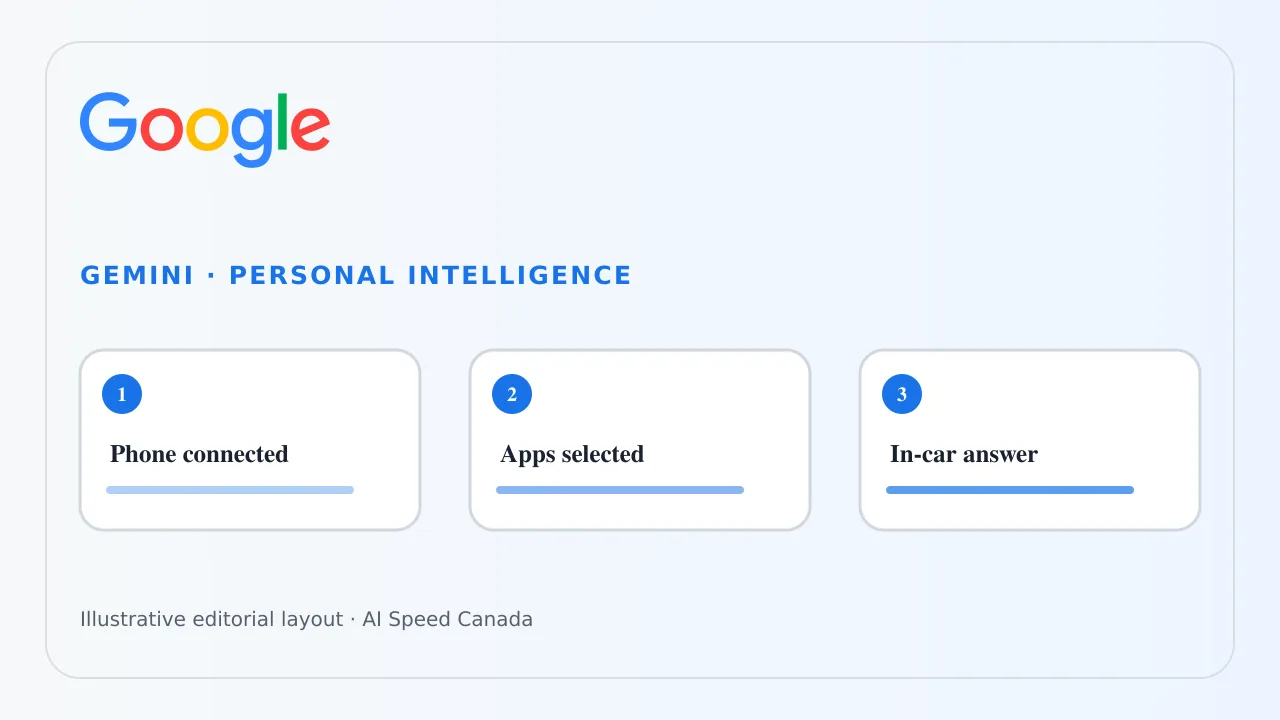
Google announced on October 20, 2026 that Gemini is available in cars globally and that Personal Intelligence is beginning to roll out on Android Auto. The personalized feature can, with permission, use information from connected Google services to answer requests such as locating a flight gate or navigating to an appointment. Google says cars with Google built-in are scheduled to receive the feature in coming months, so the two surfaces should not be described as arriving everywhere at once.
The personalized rollout is narrower than the headline
Google’s footnote limits the current Personal Intelligence rollout to eligible personal accounts for people aged 18 or older. Workspace business, enterprise and education accounts are excluded, as are the European Economic Area, Switzerland, the United Kingdom and Nigeria. Availability for one Canadian account still depends on eligibility and rollout timing.
Users must choose to enable Personal Intelligence and connect apps. Google says the feature can use Workspace services such as Gmail and Calendar, plus Photos, Maps, YouTube and Search. In a car with Google built-in, personal responses are shared only while the user’s phone is connected. Navigation, calls, music and ordinary questions remain available without the personalized feature.
Related sources: Google: Gemini Personal Intelligence in cars ↗
Read the connected-app data controls before opting in
Google’s help page says connected-app data may include emails, files, events, photos, videos, location and information that can be sensitive. It also explains that Gemini Apps activity—including relevant summaries, excerpts and inferences—can be used to improve Google services and train generative AI when Keep Activity is on, and that a subset may receive human review.
Disconnecting an app does not automatically remove material already in Gemini Apps Activity. Google points users to separate activity controls and says future activity can be excluded from model improvement by turning off Keep Activity. These are meaningful controls, but they require a deliberate settings review; “opt in” should not be treated as a complete description of downstream data use.
Related sources: Gemini Apps Help: personalization with Connected Apps ↗
Personalization does not remove the need for safe driving or verification
Natural-language requests may reduce screen interaction, but generated answers can still be incomplete or wrong. Confirm critical travel details through the responsible airline, calendar entry or navigation service when it is safe to do so. Do not troubleshoot settings while driving.
Canadian users can begin with the smallest useful set of connected apps, test whether the response exposes information to passengers and review activity settings before relying on it. The announcement provides examples and rollout claims, not measured evidence that the feature reduces collisions, distraction or travel errors.
Sources and editorial method
We use the linked original statements and reports to distinguish documented facts from our analysis. Company announcements describe their authors’ plans and claims; they are not independent verification of future outcomes. This article is dated and will be revised if material evidence changes. Read our editorial standards and corrections process.
- Google: Gemini Personal Intelligence in cars ↗ — October 20, 2026 announcement; surface timing, opt-in design and eligibility footnote.
- Gemini Apps Help: personalization with Connected Apps ↗ — Official data-use, activity, training, human-review and disconnection guidance; reviewed October 21.