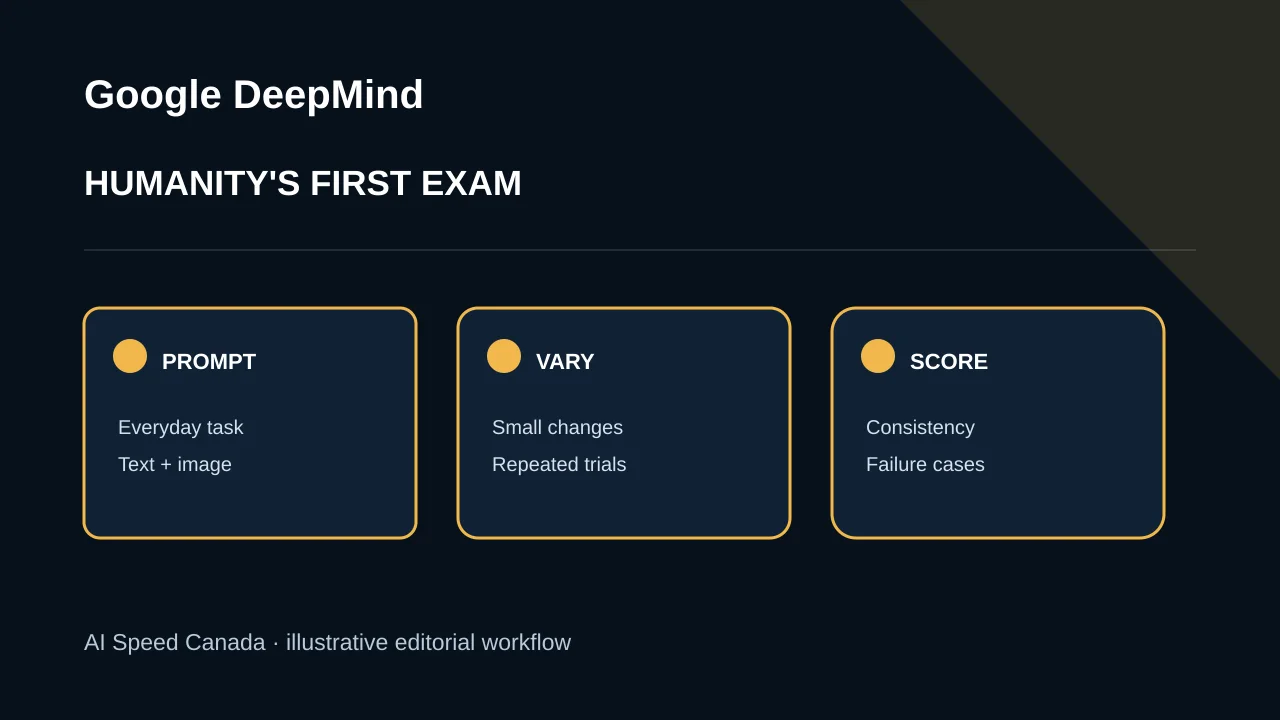
Google DeepMind launched Humanity’s First Exam on November 24, 2026 as a Kaggle benchmark for large-language-model reliability. It contains 544 elementary text and image prompts across 20 foundational capabilities. Rather than ask whether a model can solve an advanced task once, HFE tests whether it answers straightforward tasks consistently, including under small variations. The launch describes a benchmark and community data-collection effort—not an independent certification that any model is dependable in production.
Consistency is different from peak capability
A model may solve difficult mathematics yet fail on a simple visual or ordering instruction when wording changes. HFE is intended to expose that gap by repeating elementary tasks and varying them. One public example asks for the colours of particular letters in a neon sign, combining visual reading, position tracking and formatted output.
This focus is useful because real workflows often need a correct result every time, not an occasional benchmark success. It still covers a selected dataset; passing cannot establish reliability for every language, domain, tool or deployment setting.
Related sources: Google DeepMind: Humanity’s First Exam ↗
The launch provides scope, while methodology determines meaning
Google identifies 544 prompts and 20 capabilities and links a live leaderboard and technical report. Interpretation depends on how variations are generated, how many attempts count toward consistency, whether prompts leak into training, which models and settings are compared, and how image inputs are normalized.
Google says frontier models improved substantially during the previous six months. That statement should remain a company-reported trend unless the exact scores, versions and evaluation procedure are reproduced independently.
Related sources: Google DeepMind: Humanity’s First Exam ↗
A three-week competition seeks failures that remain difficult
The accompanying Kaggle competition runs through December 15 and invites participants to submit everyday questions that current models still answer incorrectly. Community submissions can refresh a benchmark, but they also need clear validation, licensing, privacy and contamination controls.
A difficult prompt is not automatically a useful test. Curators should verify a single unambiguous answer, remove private or copyrighted material where necessary and prevent scoring tricks from replacing the intended capability.
Related sources: Google DeepMind: Humanity’s First Exam ↗
Canadian teams should build local reliability sets too
Canadian deployments need tests that include English and French, accents, local document formats, accessibility needs and the exact images or tools used in practice. Run prompts repeatedly with recorded model versions and settings, then track the distribution of failures rather than quoting a single best score.
HFE can supply a general signal and useful examples. Procurement still requires a task-specific evaluation, human escalation for consequential decisions and monitoring after a provider changes the model behind a product.
Sources and editorial method
We use the linked original statements and reports to distinguish documented facts from our analysis. Company announcements describe their authors’ plans and claims; they are not independent verification of future outcomes. This article is dated and will be revised if material evidence changes. Read our editorial standards and corrections process.
- Google DeepMind: Humanity’s First Exam ↗ — Official November 24, 2026 launch; dataset scope, reliability framing and Kaggle competition deadline.