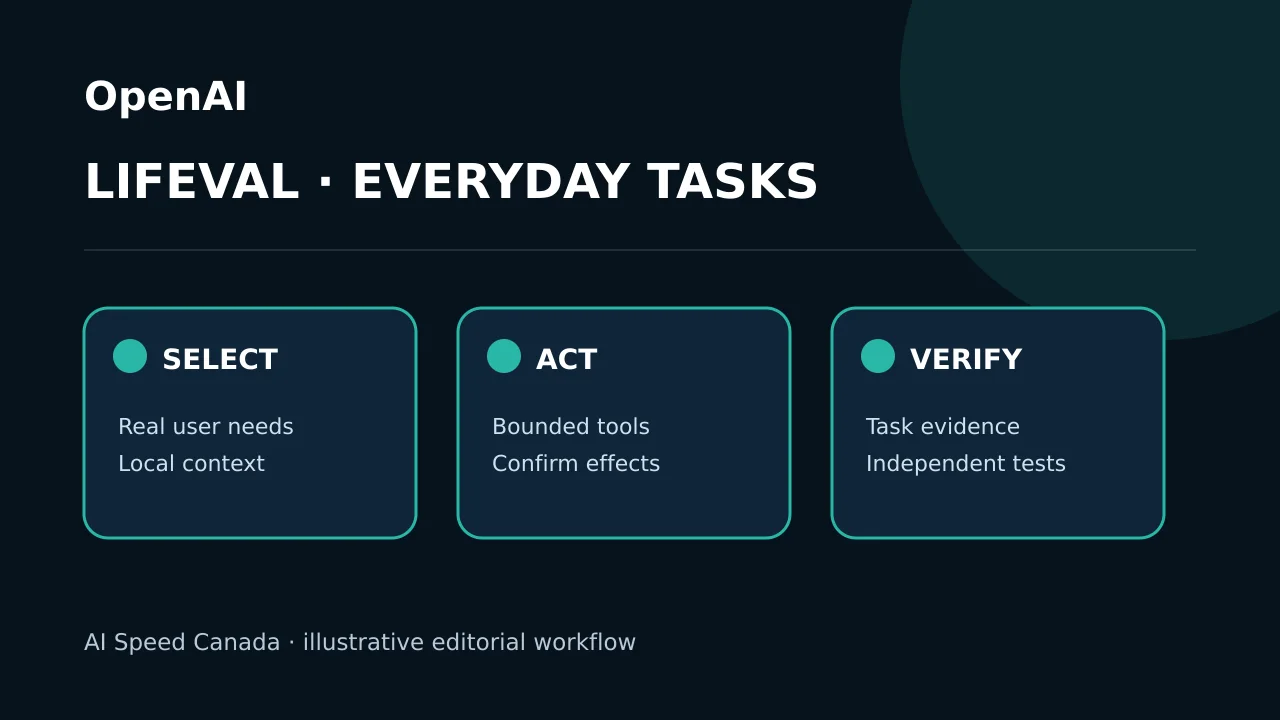
OpenAI published LifeVal on November 2, 2026 as an evaluation of practical tasks people may want a personal AI assistant to complete. The task areas include caregiving, health, education, household administration, personal finance, shopping and access to government services. That is a useful shift from benchmarks built mainly around factual questions or isolated coding problems, but it does not make every displayed score transferable to a Canadian household or a live service.
The task set begins with time-use research and a new survey
OpenAI says it drew on the American Time Use Survey and Multinational Time Use Study, then surveyed 3,995 respondents to identify tasks where people most wanted assistance. This links the benchmark to expressed needs rather than choosing tasks only because they are easy to grade. The publication does not establish that its respondent sample represents every country, language, disability or household structure.
A good evaluation should publish enough detail to distinguish the underlying need from one particular interface. Finding childcare, for example, can require current local availability, eligibility rules, price verification and a family decision. A benchmark can test a workflow without proving that a model has authoritative access to each changing fact.
Related sources: OpenAI: LifeVal ↗
Examples show task-level results, not a general reliability rate
The page displays high percentages for examples such as organizing flood-preparation volunteers, finding a home and planning support after a diabetes diagnosis. Those are OpenAI’s reported evaluation results. They should not be averaged into a universal success claim without the full task distribution, grading method, model configuration and failure analysis.
Some examples also involve consequential domains. A meal plan can organize questions for a care team, but it is not a medical diagnosis. A housing workflow can shortlist listings, but a user still needs to confirm availability, legal records, financing and accessibility. The proper lesson is to inspect the completed action and evidence, not to infer trust from a polished response.
Related sources: OpenAI: LifeVal ↗
Canadian testing needs local services, bilingual paths and consent boundaries
A Canadian version should include federal, provincial, territorial, municipal and Indigenous service routes; English and French content; and realistic handoffs when an online process cannot be completed. Researchers should test whether the agent identifies the governing jurisdiction and effective date instead of blending rules from another province or the United States.
Consent matters when the task concerns a child, relative or neighbour. Evaluators should record what personal information the agent requests, which external service receives it and which action requires confirmation. Speed is useful only after the user can see the destination, cost and consequence.
Related sources: OpenAI: LifeVal ↗
What would make LifeVal easier to assess independently
The next useful evidence would include public task specifications, evaluator instructions, model and tool versions, uncertainty estimates and representative failures. Independent teams could then reproduce a subset and test whether scores hold across regions and changing websites. Until that detail is available, LifeVal is best read as OpenAI’s research direction and internal measurement framework.
The benchmark’s strongest contribution is its question: can an agent complete work that people actually value? The answer still needs task-level evidence. Buyers should build a local test set, include failed and ambiguous cases, require confirmation before consequential actions and measure recovery when a service changes.
Sources and editorial method
We use the linked original statements and reports to distinguish documented facts from our analysis. Company announcements describe their authors’ plans and claims; they are not independent verification of future outcomes. This article is dated and will be revised if material evidence changes. Read our editorial standards and corrections process.
- OpenAI: LifeVal ↗ — Official November 2, 2026 research publication; task sources, survey size, example domains and reported results.