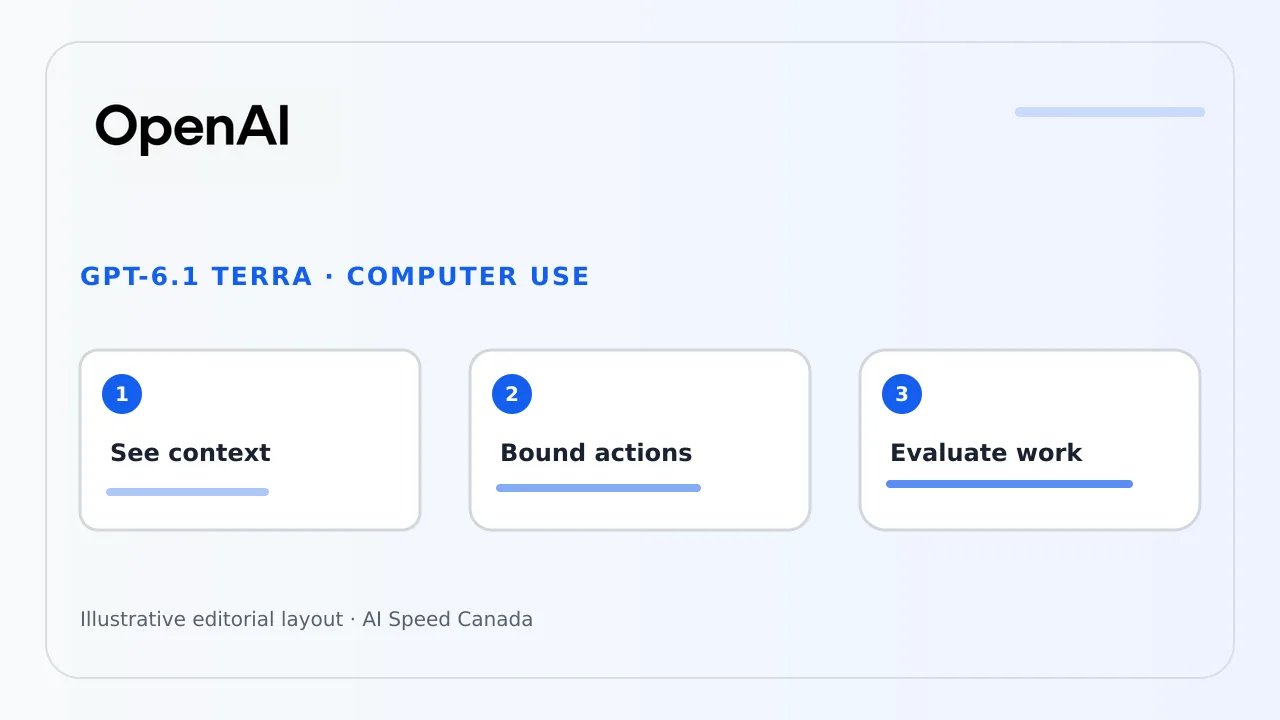
OpenAI introduced GPT-6.1 Terra on October 26, 2026 as a faster model for visual reasoning, writing, coding and computer-based work. It is available to Plus, Pro, Enterprise and Edu users in ChatGPT Work and Codex, and to developers as `gpt-6.1-terra` in the API. OpenAI lists standard API prices of US$1 per million input tokens, five cents per million cached input tokens and US$5 per million output tokens. Those are current vendor prices in US dollars, not a Canadian invoice estimate; exchange rates, taxes, tool calls and application overhead can change total cost.
The performance figures are OpenAI benchmark results
OpenAI says Terra scores 15 percentage points above GPT-5.6 Terra on Agents’ Last Exam at medium reasoning while costing about one third as much. The company also reports stronger visual reasoning on MMMU-Pro, faster task completion than GPT-6 Astra and GPT-6.1 Sol, and a 50.3% result on Terminal-Bench 4.0 at maximum effort versus a published 21.5% for GPT-5.6 Terra.
These comparisons describe selected benchmarks, settings and price assumptions. They do not establish success on a company’s browser, regional website, private documents or accessibility tooling. Teams should replay representative tasks, include failed and ambiguous cases, and record completion quality, human correction time and total run cost.
Related sources: OpenAI: Introducing GPT-6.1 Terra ↗
Computer use needs boundaries beyond model selection
A model that can interpret screens and act through software can also click the wrong control, misunderstand stale page state or follow hostile content embedded in a website or document. A deployment should constrain the allowed domains, tools and data; require confirmation before consequential actions; and avoid exposing unrelated credentials or customer records.
Canadian organizations should also identify where screenshots, prompts and files are processed and retained. Availability in a product plan does not by itself answer a regulator, client or internal data-residency requirement. Logs should capture the approved goal and outcome without storing unnecessary personal data.
Related sources: OpenAI: Introducing GPT-6.1 Terra ↗
The cybersecurity threshold is a deployment signal, not a guarantee
OpenAI states that Terra meets the Critical threshold for cybersecurity under its Preparedness Framework and carries safeguards developed for GPT-6 Astra. It also reports stronger prompt-injection resistance and more honest disclosure of blockers than GPT-5.6 Terra. These are company evaluations and controls, not immunity from attack.
For sensitive automation, keep independent authorization checks outside the model, isolate untrusted content, cap the scope of credentials and test attempts to redirect the agent. A safe failure should stop and explain the blocker instead of improvising around permissions.
Related sources: OpenAI: Introducing GPT-6.1 Terra ↗
Choose from measured task evidence, not the model family name
A useful pilot compares Terra with the current model on the same tasks and environment. Measure completion rate, severe errors, intervention frequency, elapsed time and cost per accepted result. Keep a human review path for changes to production, payments, permissions or external communications.
OpenAI says its larger Sol and Astra models remain preferable for the most complex coding work. That reinforces the practical conclusion: Terra is a newly available option with published tradeoffs, not a universal replacement.
Sources and editorial method
We use the linked original statements and reports to distinguish documented facts from our analysis. Company announcements describe their authors’ plans and claims; they are not independent verification of future outcomes. This article is dated and will be revised if material evidence changes. Read our editorial standards and corrections process.
- OpenAI: Introducing GPT-6.1 Terra ↗ — Official October 26 release; availability, pricing, benchmark and safety claims.