Microsoft published a technical account on November 11, 2026 of rebuilding a Novo Nordisk clinical-trial data agent on Microsoft Foundry hosted agents. The system helps medical experts perform secondary analyses whose steps vary with each question: it can inspect available data, write and execute analysis code, revise the approach and return a summary and visualization. The article describes an operating-model migration and company-reported experience, not an independent clinical validation or a claim that the agent makes treatment decisions.
The platform now manages sessions, scaling and identity
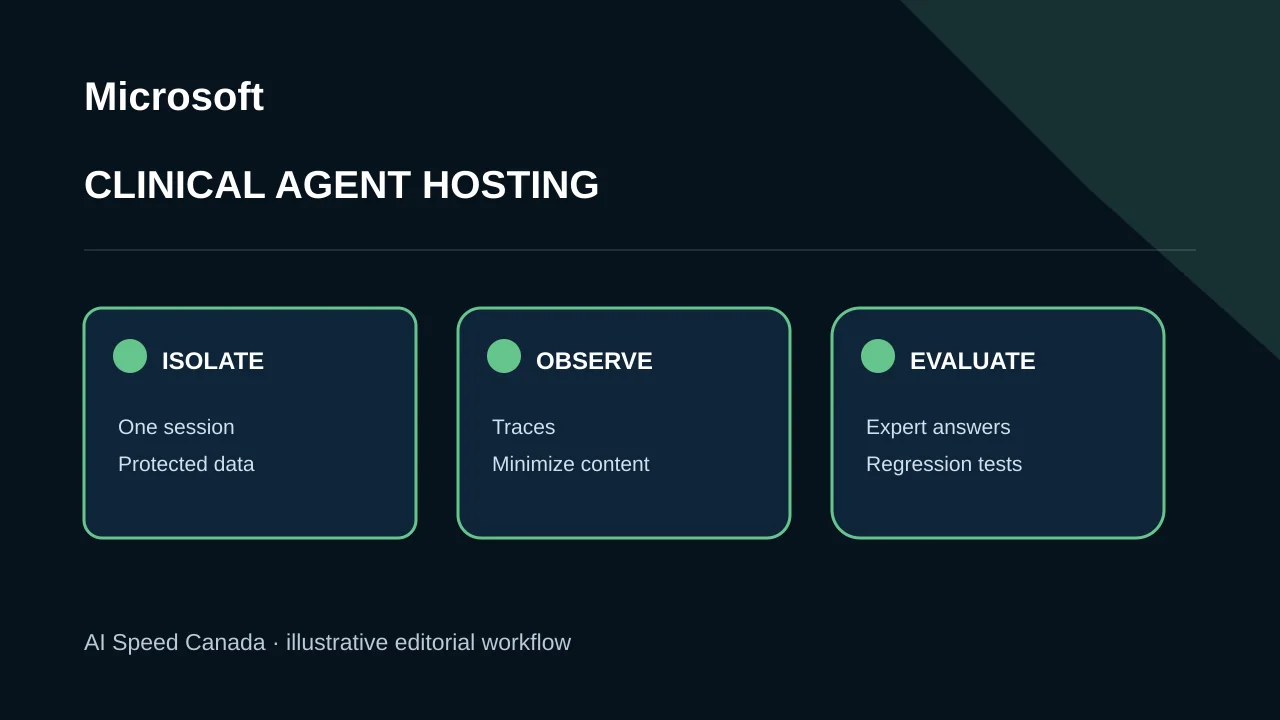
The earlier production architecture used Azure Container Apps, PostgreSQL and dynamic sessions for sandboxed code. In the hosted design, Novo keeps control of orchestration logic, models, tools and runtime behaviour, while Foundry manages the endpoint, agent identity, state, scaling and lifecycle. Microsoft says each active session receives a VM-isolated sandbox and can restore files when resumed.
That boundary can reduce custom infrastructure, but managed does not mean risk-free. The deployment still has to restrict tool access, authenticate users, test generated code and define which datasets an analysis may reach. Isolation is one control; it does not establish statistical correctness or clinical usefulness.
Related sources: Microsoft Command Line: From custom infrastructure to hosted agents ↗
Network design has to be decided before production
Microsoft says private networking, subnet capacity, private endpoints and DNS should be planned early. Hosted sessions consume network capacity, and the Foundry account’s subnet reference is immutable. The article cites current guidance recommending a /24 subnet for production deployments and documenting /27 as the supported minimum for smaller ones.
Those sizes are vendor guidance for this service, not a universal prescription. Canadian health organizations should separately verify approved regions, data residency, access logging, encryption, retention and applicable privacy obligations. Capacity planning must include peak concurrent sessions and deployment headroom rather than average user counts alone.
Related sources: Microsoft Command Line: From custom infrastructure to hosted agents ↗
Tracing helps diagnosis but can also expose sensitive content
Foundry tracing can capture prompts, outputs, model calls, tool activity, tokens and latency. Microsoft says the team kept its existing interface and evaluation set during migration, including graders based on subject-matter-expert answers, so it could compare versions and detect regressions. That continuity is stronger evidence than treating a successful deployment as proof of quality.
Clinical traces can contain sensitive prompts, tool arguments and results. They need minimization, redaction, access controls and retention rules comparable to other protected data. Any Canadian pilot should predefine expert-reviewed test cases, record failure categories and keep consequential decisions with qualified people. The published account offers architectural lessons; it does not publish enough independent outcome data to generalize performance.
Sources and editorial method
We use the linked original statements and reports to distinguish documented facts from our analysis. Company announcements describe their authors’ plans and claims; they are not independent verification of future outcomes. This article is dated and will be revised if material evidence changes. Read our editorial standards and corrections process.
- Microsoft Command Line: From custom infrastructure to hosted agents ↗ — Microsoft’s November 11, 2026 technical account of the Novo migration, architecture boundary, networking, tracing and evaluation process.