OpenAI introduced BioBasicsBench on November 6, 2026 with Ligo, a biotechnology company focused on enzyme design. The benchmark contains 100 tasks built from raw wet-lab evidence such as gel images, colony plates, microscopy and instrument readouts. It asks agents to interpret results, spot errors and recognize when evidence does not support a conclusion. OpenAI reports a 66.7% mean reward for GPT‑6 Astra at xhigh reasoning effort, leaving roughly one-third of available credit unearned.
The benchmark targets routine ambiguity rather than polished figures
Scientific papers often show selected, cleaned figures. Everyday laboratory work includes weak bands, failed controls, unclear images and conflicting observations. BioBasicsBench spans protein methods, imaging and cytometry, quantification and assays, nucleic-acid methods and molecular cloning.
This scope is useful because misreading a control can send a researcher toward the wrong follow-up experiment. It remains a benchmark: the tasks and scoring cannot reproduce every instrument, protocol, lab practice or consequence of a mistaken real-world decision.
Related sources: OpenAI: measuring wet-lab agents with BioBasicsBench ↗
The reported gains depend on model and effort settings
OpenAI evaluated seven model families across 37 model-and-effort combinations, with five attempts on each task and 18,500 scored results. At xhigh effort it reports 66.7% mean reward for GPT‑6 Astra, 62.0% for GPT‑6.1 Sol and 43.8% for GPT‑5.6 Sol. Confidence intervals were calculated by resampling whole tasks.
These are OpenAI’s benchmark measurements. More output tokens or a higher named effort setting is not automatically better in every row, and a mean can hide critical failures. Independent teams should reproduce task-level results and examine error severity, not only rank models by one aggregate number.
Related sources: OpenAI: measuring wet-lab agents with BioBasicsBench ↗
A benchmark score is not permission for autonomous laboratory decisions
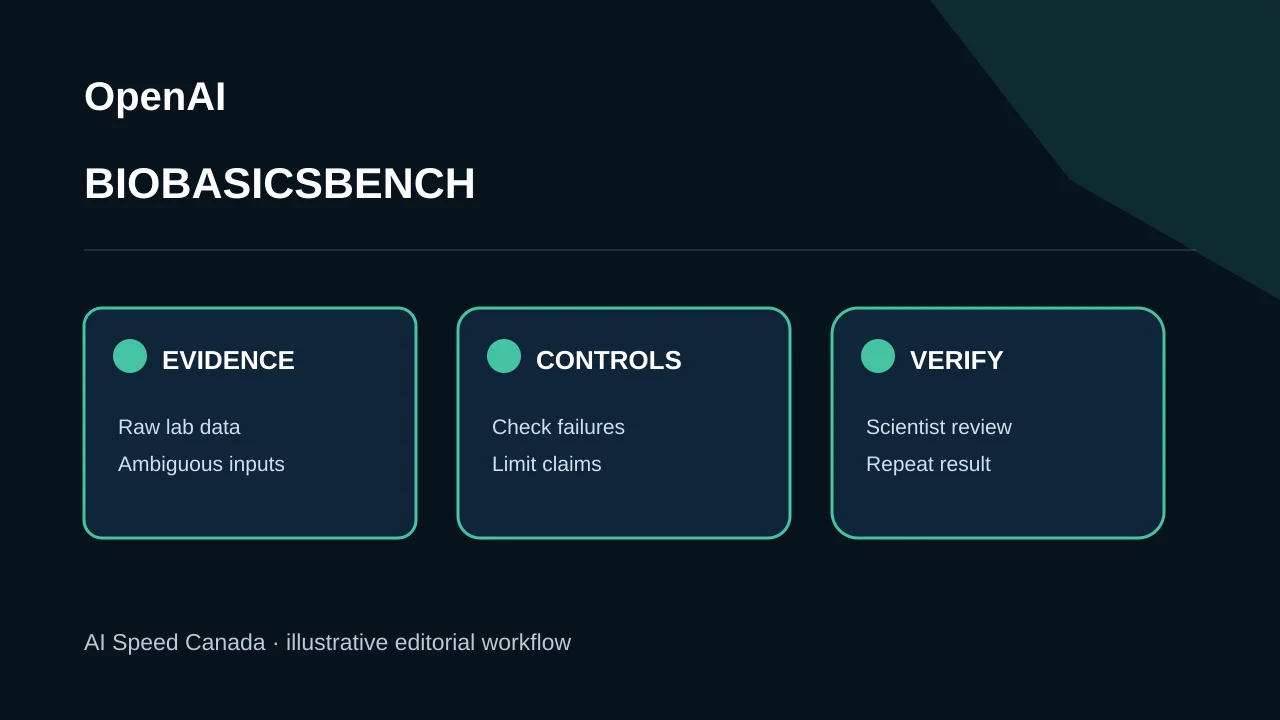
An agent may suggest that a control failed, but a scientist must inspect the original evidence, protocol, sample history and instrument conditions. A plausible explanation can still be wrong. Biological safety, chemical hazards, ethics and regulatory requirements are outside a single interpretation score.
A responsible pilot begins with archived, labelled experiments. Record unsupported conclusions, missed controls, correction time and whether another scientist reaches the same answer. Keep the agent away from automated equipment or consequential decisions until the workflow has independent safeguards.
Related sources: OpenAI: measuring wet-lab agents with BioBasicsBench ↗
Canadian labs can use the benchmark as a starting test set, not a procurement score
Universities, hospitals and biotechnology companies should assess data residency, confidentiality, intellectual property and approved research environments before uploading raw results. Patient-derived or unpublished data requires particular care under institutional policy.
The benchmark can inform a local evaluation, but it does not establish clinical validity, regulatory compliance or productivity in a Canadian lab. Measure reproducibility and corrected scientist time on the actual protocols that matter.
Sources and editorial method
We use the linked original statements and reports to distinguish documented facts from our analysis. Company announcements describe their authors’ plans and claims; they are not independent verification of future outcomes. This article is dated and will be revised if material evidence changes. Read our editorial standards and corrections process.
- OpenAI: measuring wet-lab agents with BioBasicsBench ↗ — Official November 6, 2026 research publication; task design, evaluation method, results and stated limitations.