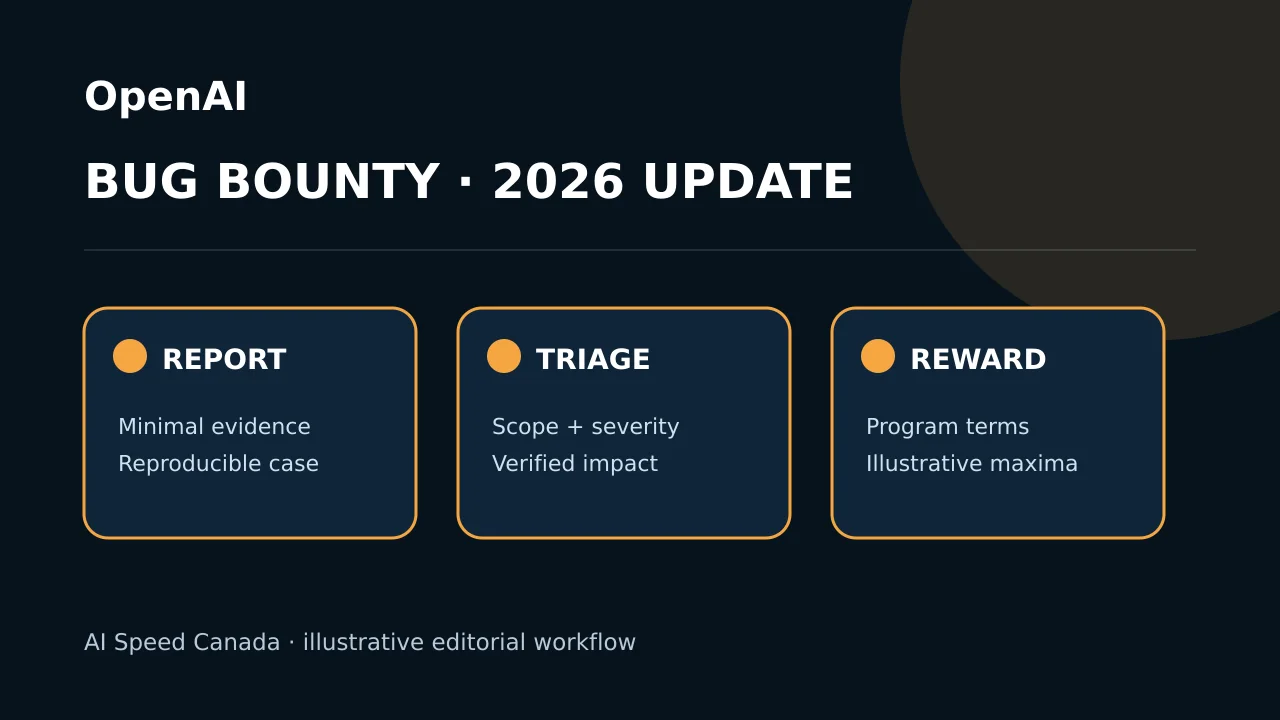
OpenAI announced expanded Security Bug Bounty rewards on November 2, 2026. The company says it more than quadrupled the midpoint of reward ranges for medium, high and critical findings on average, and added multipliers for report quality, researcher loyalty and priority campaigns. A critical vulnerability in a core product such as ChatGPT, Codex or the API Platform can now earn up to US$30,000. Exceptional critical findings remain eligible for a US$100,000 base and, with bonuses, up to roughly US$172,000.
The program now rewards both severity and usable evidence
OpenAI says a reliable proof of concept that isolates a defect, identifies when it is exploitable and demonstrates impact may receive a quality multiplier. The loyalty program has five tiers for researchers who repeatedly submit useful findings. Short priority campaigns can add bonuses for newly launched features.
These incentives can reduce the time from report to reproduction, but a multiplier is not automatic. Eligibility, scope, severity and final payment remain subject to the live program rules. Researchers should read those rules before testing rather than infer authorization from the announcement.
Related sources: OpenAI: Rewarding defenders with bigger bug bounties ↗
Published payout examples are illustrations, not guaranteed prices
The post shows sample calculations for medium, high, critical and exceptional reports. Its exceptional example combines a base award with quality, campaign and loyalty multipliers for a result of US$171,925. OpenAI explicitly labels the scenarios and historical awards illustrative.
A real report may be a duplicate, out of scope, less severe than first believed or ineligible for a particular campaign. Researchers should preserve timestamps and reproduction detail but avoid accessing more data than needed to demonstrate impact. Responsible disclosure is not permission to retain or publish another person’s information.
Related sources: OpenAI: Rewarding defenders with bigger bug bounties ↗
Some recent and pending reports can receive the new calculation
OpenAI says pending reports will use the new reward ranges. For awards made in the 30 days before the announcement, it plans to pay the difference when the same finding would have earned more under the new base and loyalty awards. Researchers should rely on the program’s official case communication for an individual payment.
The retroactive provision is a concrete policy change, not evidence that every earlier bounty will increase. Quality and priority-campaign bonuses may depend on conditions that did not apply to a prior submission. Keep the original report and award record when checking eligibility.
Related sources: OpenAI: Rewarding defenders with bigger bug bounties ↗
Canadian researchers still need authorization and tax records
A Canadian security researcher can participate only within the published scope and safe-harbour conditions. Before testing, confirm the permitted assets, prohibited techniques, data-handling requirements and disclosure timeline. Stop if a test risks service disruption or access to real user content beyond the minimum needed for evidence.
Rewards are stated in U.S. dollars and are not a salary or predictable monthly income. Recipients should keep program, payment and currency-conversion records and obtain appropriate tax advice for their circumstances. The stronger program may attract useful scrutiny, but its security value should ultimately be judged by report handling and verified fixes as well as payout size.
Sources and editorial method
We use the linked original statements and reports to distinguish documented facts from our analysis. Company announcements describe their authors’ plans and claims; they are not independent verification of future outcomes. This article is dated and will be revised if material evidence changes. Read our editorial standards and corrections process.
- OpenAI: Rewarding defenders with bigger bug bounties ↗ — Official November 2, 2026 announcement; new ranges, bonus categories, illustrative calculations and retroactive-payment policy.