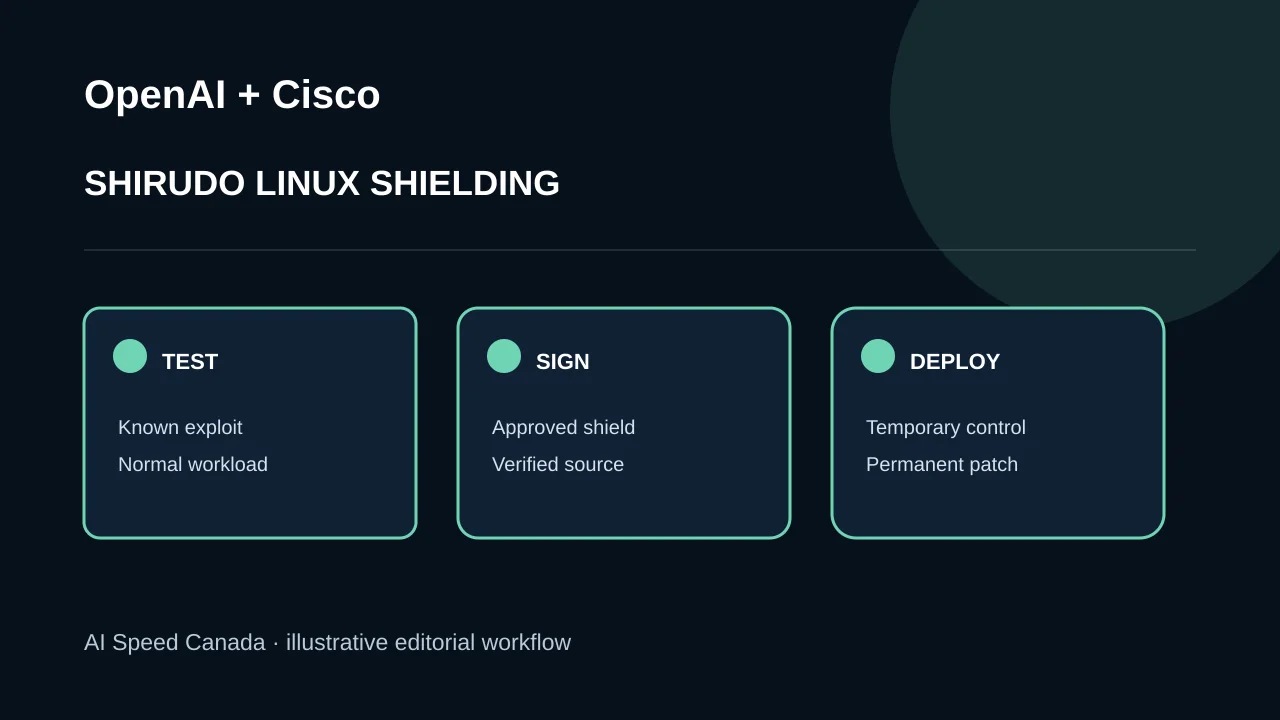
OpenAI and Cisco introduced Shirudo on November 23, 2026 as an open-source runtime for protecting vulnerable Linux services while a permanent patch is prepared and deployed. The project uses eBPF programs, cryptographic signing and hardware-backed measurement. OpenAI reports that a Codex-generated shield blocked a controlled Java4Shell exploit attempt against a running Elasticsearch service without a restart. That is a company-run demonstration of one controlled case—not proof that Shirudo can automatically protect every Linux workload.
Shirudo is a temporary shield, not a substitute for patching
When a vulnerability is disclosed, operators may need time to test and roll out a permanent fix. Shirudo is designed to place a narrow protection at the relevant operating-system or application path during that interval. OpenAI says teams can observe a proposed shield’s effect before enforcement and keep deployment authority with security staff.
The distinction matters: a shield reduces exposure to a known exploit path, while a vendor patch repairs the underlying software. A shield may miss variants, interfere with legitimate traffic or create a false sense of completion. Operators still need asset inventory, patch management, rollback and incident response.
Related sources: OpenAI: OpenAI and Cisco introduce Shirudo ↗ · Cisco: Shirudo launch announcement ↗
Signed programs and TPM evidence add controls, not certainty
The project verifies signatures before loading protections, relies on Linux’s eBPF verifier and records changes to the loaded shield set with a Trusted Platform Module. Those mechanisms can help an operator confirm which approved code was loaded and detect an unauthorized change.
They do not prove that a shield’s logic is correct or complete. A valid signature identifies approved provenance; it does not independently establish security effectiveness. Reviewers need a reproducible exploit, legitimate-workload tests, performance measurements and a defined rollback threshold before enforcement.
Related sources: OpenAI: OpenAI and Cisco introduce Shirudo ↗ · Shirudo GitHub repository ↗
The repository labels the software pre-release
Shirudo’s public repository says production targets require a Linux kernel with the project’s signed-loader interface and patches, plus TPM 2.0. The main branch is development code, with release tags used for published packages. These requirements make a local virtual-machine quickstart materially different from deploying on a production fleet.
The code is available under BSD 2-Clause, while BPF programs are dual-licensed under BSD and GPL. Open source allows inspection and contribution, but each organization remains responsible for reviewing dependencies, threat models, update processes and compatibility.
Related sources: Shirudo GitHub repository ↗
Canadian operators should pilot against owned systems and measured risks
A Canadian critical-infrastructure or public-sector team should begin in an isolated environment it owns or is authorized to test. Reproduce a known defect, measure whether the shield blocks it, run representative legitimate traffic and verify that signed state can be independently checked. Protect exploit material and operational telemetry as sensitive data.
Useful pilot metrics include blocked exploit variants, false positives, application latency, reviewer time, rollback success and time until the permanent patch reaches the fleet. The next evidence to watch is independent testing, stable releases and documented production deployments—not the number of generated shields.
Sources and editorial method
We use the linked original statements and reports to distinguish documented facts from our analysis. Company announcements describe their authors’ plans and claims; they are not independent verification of future outcomes. This article is dated and will be revised if material evidence changes. Read our editorial standards and corrections process.
- OpenAI: OpenAI and Cisco introduce Shirudo ↗ — Official November 23, 2026 announcement; architecture, Java4Shell demonstration, operator controls and licensing.
- Cisco: Shirudo launch announcement ↗ — Official November 23, 2026 partner release; intended use and company-reported testing.
- Shirudo GitHub repository ↗ — Project README, pre-release status, production requirements, supported uses and licence.