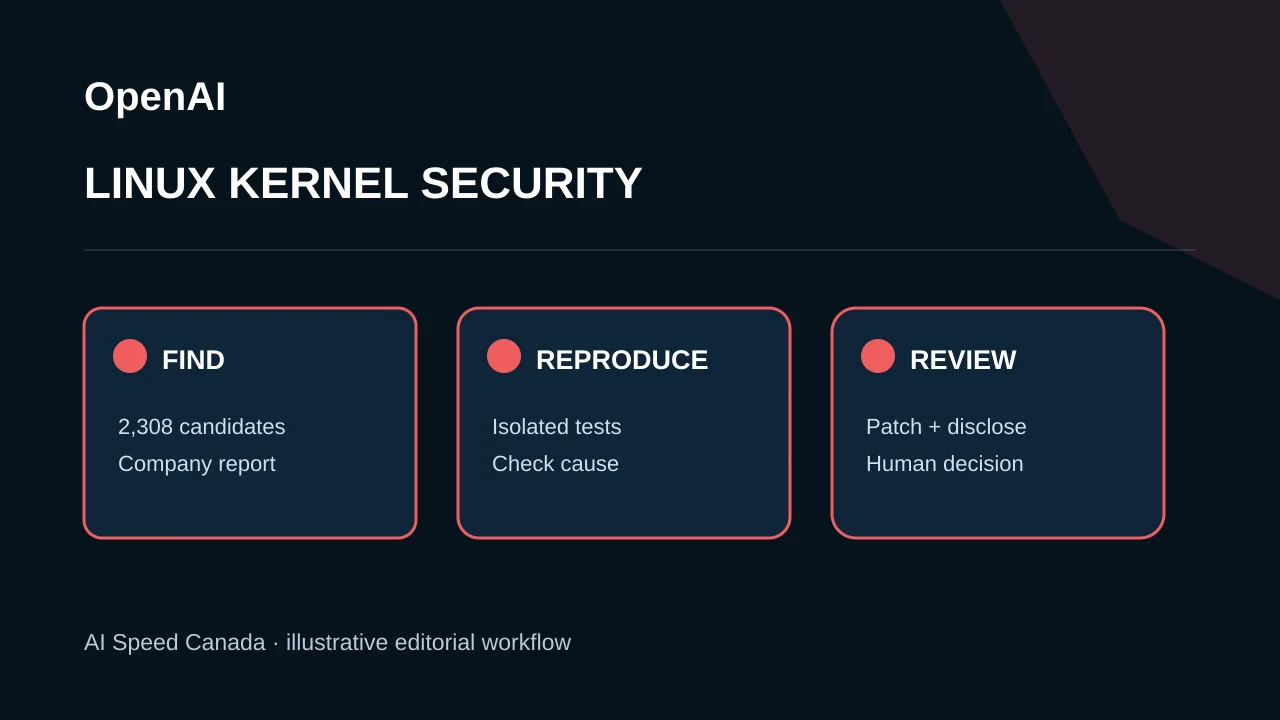
OpenAI published results on November 4, 2026 from an AI-assisted Linux kernel vulnerability pipeline. In one mid-October run, the company says the system produced 2,308 candidate findings and dynamically reproduced 1,724 of them. It generated 291 information-leak proofs of concept and 1,169 working local-privilege-escalation exploits, which variant analysis reduced to 948 distinct vulnerabilities with proposed patches. These are company-reported research results from a controlled program, not proof that an automated system can safely secure any arbitrary codebase.
The pipeline required reproduction, deduplication and patch testing
The system used an upcoming cyber model to inspect code, build proof-of-concept programs and execute them in isolated environments. Dynamic reproduction is stronger evidence than a fluent vulnerability description because it checks whether an observed condition can actually be triggered. Variant analysis then grouped related exploits before patch generation, avoiding a simple claim that every successful run represented a unique flaw.
OpenAI reports total API-credit costs of US$1,213,430 for the run, equivalent to about US$1,279 per distinct local-privilege-escalation exploit. That figure describes this experiment, not a procurement quote or predictable cost for another organization. Hardware, engineering, review, disclosure and remediation work also sit outside a token-only comparison.
Related sources: OpenAI: A thousand fewer paths to root ↗
Twenty apparent exploits reached root through a different zero-day
An early validation sample exposed the most important limitation. OpenAI says 20 of 200 apparently successful exploits reached root by triggering an unrelated vulnerability in the evaluation environment rather than the candidate flaw. The team added independent validation after discovering the problem. Without that review, a success signal could have been misattributed to the wrong cause.
The lesson extends beyond security research: a passing test can be real while the explanation is false. Pipelines need clean environments, causal checks, known-vulnerable and known-clean controls, repeat runs and evidence that the proposed patch prevents the intended exploit without merely changing the test environment.
Related sources: OpenAI: A thousand fewer paths to root ↗
Human researchers handled disclosure and upstream coordination
OpenAI says human researchers reviewed findings and patches before reporting them. Hundreds were sent to Linux maintainers; the company reports that many are already patched, staged or under public discussion. The public article does not turn every candidate into a confirmed vulnerability, and it deliberately separates generated artifacts from the maintainer process that validates and lands fixes.
Exploit artifacts can create risk. Organizations should not aim an autonomous pipeline at third-party systems or publish working exploits without authorization and coordinated disclosure. A responsible program defines scope, containment, evidence retention, disclosure contacts and stop authority before a model begins testing.
Related sources: OpenAI: A thousand fewer paths to root ↗
Canadian teams should begin with seeded defects and a measured review budget
A Canadian security team evaluating this approach should start in an isolated copy of software it owns or is explicitly authorized to test. Seed known flaws and clean controls, record false positives and false negatives, and compare analyst time with the existing process. Protect source code, crash dumps and exploit material as sensitive data.
The useful business metric is not the number of candidate findings. Track independently reproduced unique vulnerabilities, accepted patches, escaped regressions, time to remediation and total reviewer effort. Keep people responsible for disclosure and deployment decisions, especially where critical infrastructure, privacy obligations or contractual restrictions apply.
Sources and editorial method
We use the linked original statements and reports to distinguish documented facts from our analysis. Company announcements describe their authors’ plans and claims; they are not independent verification of future outcomes. This article is dated and will be revised if material evidence changes. Read our editorial standards and corrections process.
- OpenAI: A thousand fewer paths to root ↗ — Official November 4, 2026 research report; pipeline design, run counts, costs, validation failure, human review and disclosure status.