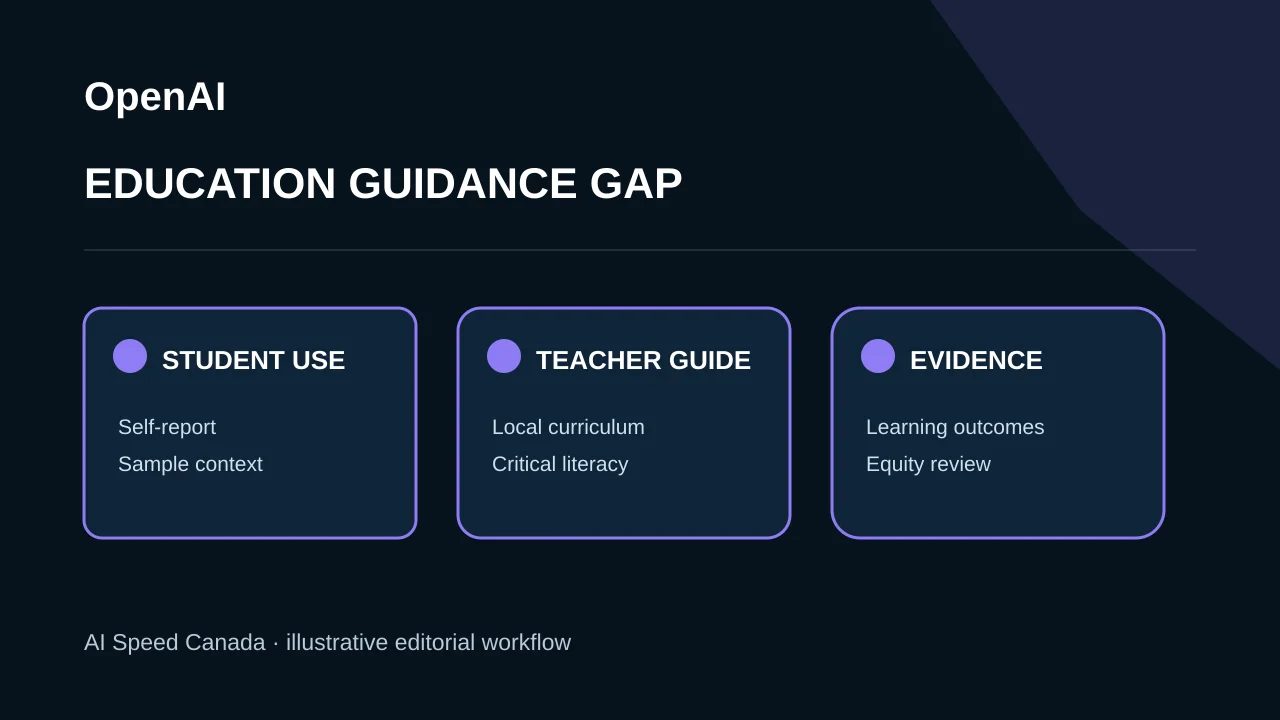
OpenAI published “Closing the AI guidance gap in education” on November 10, 2026, combining lessons from education partnerships in Estonia, Slovakia, Greece and Italy with new ThinkYoung research. The headline finding says 79% of surveyed students reported using AI for homework or assignments, while 47% reported being shown how. The difference is useful as a prompt for policy, but it should not be generalized beyond the sample without the report’s recruitment, geography and question wording.
The publication separates early patterns from a universal model
OpenAI organizes the lessons around clear educational goals, educator preparation, local partnerships, critical AI literacy and credible evidence. It argues that teacher expertise becomes more important as AI grows more capable. The country examples emphasize public leadership, teacher confidence and support adapted to local curricula.
The company explicitly describes the partnerships as early experiences rather than one model for every education system. That caveat is important: access to a tool, reported adoption and teacher time savings are implementation signals. They do not by themselves establish stronger knowledge, independent thinking, retention or equitable outcomes.
Related sources: OpenAI: Closing the AI guidance gap in education ↗
Reported use and instruction require careful denominators
The 79% and 47% figures are self-reports. They can identify a mismatch between student activity and perceived guidance, but they do not measure the quality of use, whether school rules were understood or whether AI caused a learning change. Students may also interpret “shown how” differently across classrooms.
A school system evaluating its own gap should publish the questionnaire, respondent count, age range, response rate and subgroup results. It should add direct measures: source-checking skill, unaided mastery, accessibility, disciplinary differences and incidents. Comparing outcomes before and after a defined intervention would be stronger than treating use volume as success.
Related sources: OpenAI: Closing the AI guidance gap in education ↗
Canadian policy should be provincial, bilingual and evidence-led
Education responsibilities, curricula and privacy requirements vary across Canada. Provincial ministries, school boards, teachers, students, parents, Indigenous education partners and accessibility specialists need roles in setting acceptable uses. Guidance should distinguish brainstorming, tutoring, translation, assessment and prohibited substitution for student work.
Teacher training should include model limits, citations, personal-data minimization and ways to design assessments that reveal understanding. English and French materials need equivalent scrutiny, and local evaluation should include rural, northern and low-connectivity settings. A vendor report can inform those decisions; it cannot replace public accountability or independent research.
Sources and editorial method
We use the linked original statements and reports to distinguish documented facts from our analysis. Company announcements describe their authors’ plans and claims; they are not independent verification of future outcomes. This article is dated and will be revised if material evidence changes. Read our editorial standards and corrections process.
- OpenAI: Closing the AI guidance gap in education ↗ — Official November 10, 2026 report summary; partnership scope, survey claims, themes and stated evidence limits.