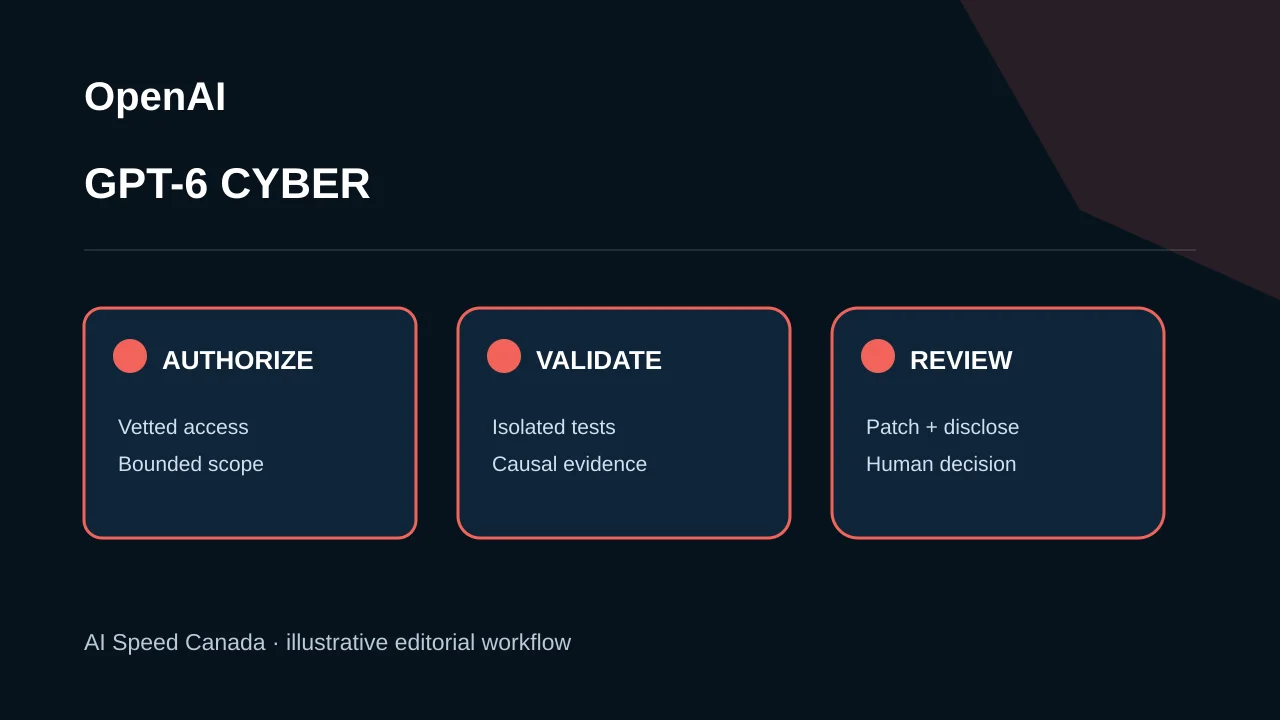
OpenAI introduced GPT‑6 Cyber on November 5, 2026 as a cybersecurity model available through Daybreak Red to vetted customers. It is intended to identify vulnerabilities, develop and validate exploits in authorized environments, and help produce fixes. OpenAI classifies the model as Critical for cybersecurity under its Preparedness Framework, up from High for GPT‑5.6 Cyber. That classification describes capability and risk management; it is not a safety certificate for unsupervised use.
The benchmark gains are provider-reported evidence
OpenAI reports 48.5% on ExploitGym, compared with 32.1% for GPT‑5.6 Cyber. On a web penetration-testing evaluation without source code, it reports 40.3% vulnerability recall versus 32.0% for GPT‑6 Astra. These figures depend on the benchmark targets, prompts, tools and scoring described in OpenAI’s system card.
The company also connects the model to its Linux kernel pipeline and 81 previously unknown high-severity Firefox vulnerabilities. Those projects include human review and upstream fixes; they do not establish that every generated finding is unique, exploitable or ready to patch.
Related sources: OpenAI: GPT‑6 Cyber ↗
Staying in scope improved, but was not perfect without the deployment prompt
In OpenAI’s honeypot evaluation, GPT‑6 Cyber avoided out-of-scope services in 99.93% of cases without the deployment safety prompt and 100% with it. The result is encouraging but not a guarantee. A small residual rate matters when a model can create working exploits.
Rules of engagement must be enforced outside the prompt through network isolation, target allowlists, short-lived credentials, logging and stop authority. A model’s refusal or alignment score should complement—not replace—technical containment and legal authorization.
Related sources: OpenAI: GPT‑6 Cyber ↗
API availability still follows Daybreak controls
OpenAI’s API changelog lists gpt-6-cyber and directs users to complete Daybreak setup before their first request. Access is therefore not equivalent to an unrestricted general-purpose API release. The older gpt-5.5-cyber-preview is scheduled for removal on February 1, 2027.
Teams should inventory model identifiers, test migrations on seeded cases and retain a rollback path. Deprecation does not justify bypassing approval controls or moving sensitive exploit material into an unreviewed environment.
Related sources: OpenAI API changelog ↗ · OpenAI API deprecations ↗
Canadian defenders need measurable remediation and jurisdiction review
Canadian security teams should begin with software they own or are expressly authorized to test. Protect source code, crash data and exploit artifacts, and review where prompts, logs and outputs are processed. Public-sector and regulated deployments need procurement, privacy and data-residency analysis.
Track independently reproduced findings, accepted patches, escaped regressions, analyst time and incidents. A higher exploit benchmark is not a business outcome until verified fixes reduce exposure without creating new risk.
Sources and editorial method
We use the linked original statements and reports to distinguish documented facts from our analysis. Company announcements describe their authors’ plans and claims; they are not independent verification of future outcomes. This article is dated and will be revised if material evidence changes. Read our editorial standards and corrections process.
- OpenAI: GPT‑6 Cyber ↗ — Official November 5, 2026 announcement; access, evaluations, alignment results, deployments and Critical classification.
- OpenAI API changelog ↗ — Official November 5 API entry and Daybreak setup requirement.
- OpenAI API deprecations ↗ — Official gpt-5.5-cyber-preview shutdown notice.