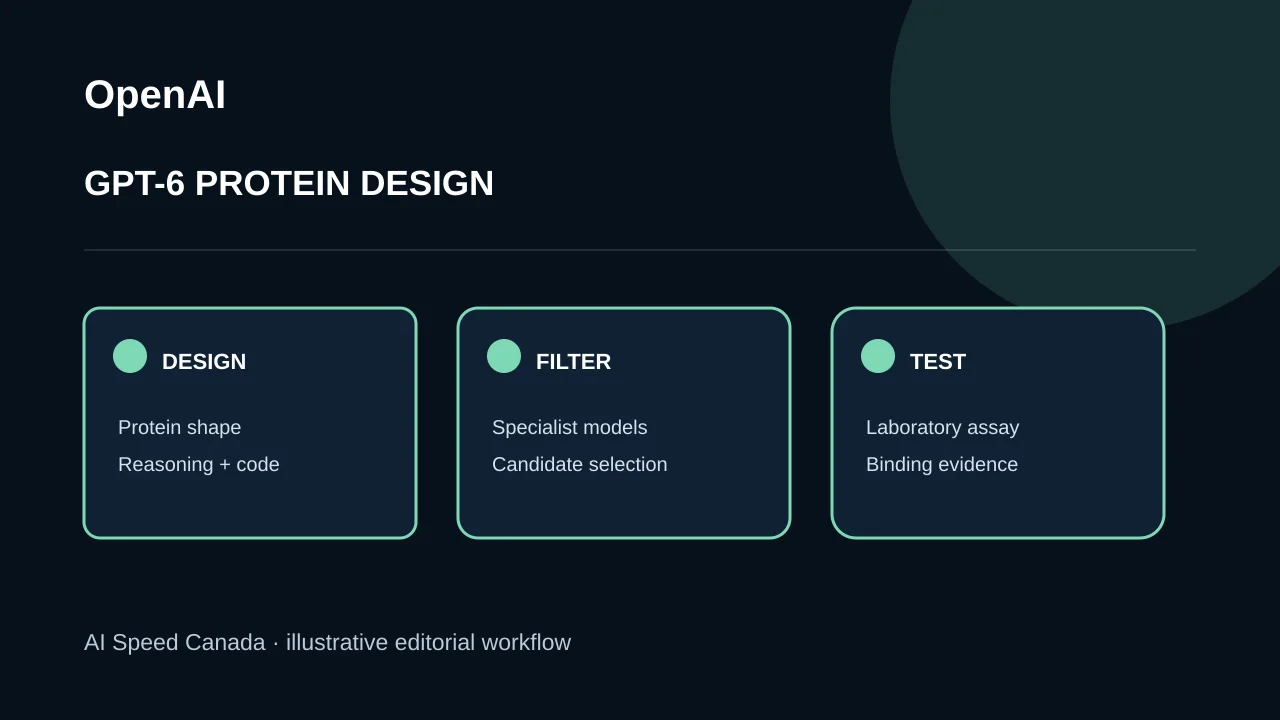
OpenAI published a November 24, 2026 preprint and research summary arguing that GPT-6-family models can design protein structures and sequences using reasoning and code. In one laboratory campaign with Onava, researchers tested 322 small proteins derived from GPT-6.2 designs against five targets; 35, or 10.9%, showed evidence of binding. This is an early research result from the authors’ workflow, not an independently replicated discovery of a medicine or proof of end-to-end general-purpose protein design.
The experiment combined general and specialized models
GPT-6.2 generated three-dimensional minibinder shapes after researchers supplied target structures and attachment sites. A specialized model, SolubleMPNN, then proposed amino-acid sequences, while other protein models helped filter candidates before synthesis and testing. OpenAI therefore does not claim that GPT-6.2 produced the tested proteins without specialist assistance.
The distinction matters because structure generation, sequence design, candidate selection, synthesis and laboratory measurement are separate stages. Success at one stage can depend heavily on the filters applied before the next.
Related sources: OpenAI: GPT-6 models demonstrate intrinsic protein-design capabilities ↗ · OpenAI preprint: GPT-6 as a Universal Foundation Model for Protein Biology ↗
Binding across five targets is measurable but narrow evidence
OpenAI reports hits for PD-L1, IL-7Rα, TrkA, VEGF-A and IL-17A. The company notes that an earlier RFdiffusion study reported higher hit rates and that comparisons depend on filtering and the definition of binding. A positive binding assay shows attachment under the test conditions; it does not establish specificity, stability, biological activity, manufacturability, safety or therapeutic benefit.
The work also reports redesigned sequences for existing minibinders and antibody fragments that retained binding. Those are research milestones, not clinical outcomes. No patient trial, regulatory filing or approved treatment is reported.
Related sources: OpenAI: GPT-6 models demonstrate intrinsic protein-design capabilities ↗
Whole-protein prediction remains a stated weakness
The authors say complete structure prediction from an amino-acid sequence remained substantially weaker than specialized models. They also flag possible memorization or dataset artifacts in some sequence-recovery evaluations. These disclosures limit how far readers should generalize from benchmark tables.
The durable test is prospective: can independent teams reproduce designs on unfamiliar targets, measure activity beyond binding and disclose failed candidates as well as successes? A preprint invites that scrutiny but has not completed it.
Related sources: OpenAI: GPT-6 models demonstrate intrinsic protein-design capabilities ↗ · OpenAI preprint: GPT-6 as a Universal Foundation Model for Protein Biology ↗
Canadian labs should measure the full design-test loop
Canadian biotechnology teams evaluating a general model should preserve human scientific responsibility and use approved, non-sensitive inputs. Track successful designs per synthesized candidate, assay reproducibility, specialist-model dependence, laboratory time, reviewer effort and failure modes. Biosecurity review is also necessary because broader design capability can create dual-use risks.
The practical question is not whether a language model can draw a plausible protein. It is whether a documented, governed workflow produces reproducible experimental value over existing methods without hiding the work performed by specialist tools.
Sources and editorial method
We use the linked original statements and reports to distinguish documented facts from our analysis. Company announcements describe their authors’ plans and claims; they are not independent verification of future outcomes. This article is dated and will be revised if material evidence changes. Read our editorial standards and corrections process.
- OpenAI: GPT-6 models demonstrate intrinsic protein-design capabilities ↗ — Official November 24, 2026 research summary; workflow, laboratory counts, comparisons and limitations.
- OpenAI preprint: GPT-6 as a Universal Foundation Model for Protein Biology ↗ — Authors’ preprint linked from the research announcement; methods and results remain subject to independent review.