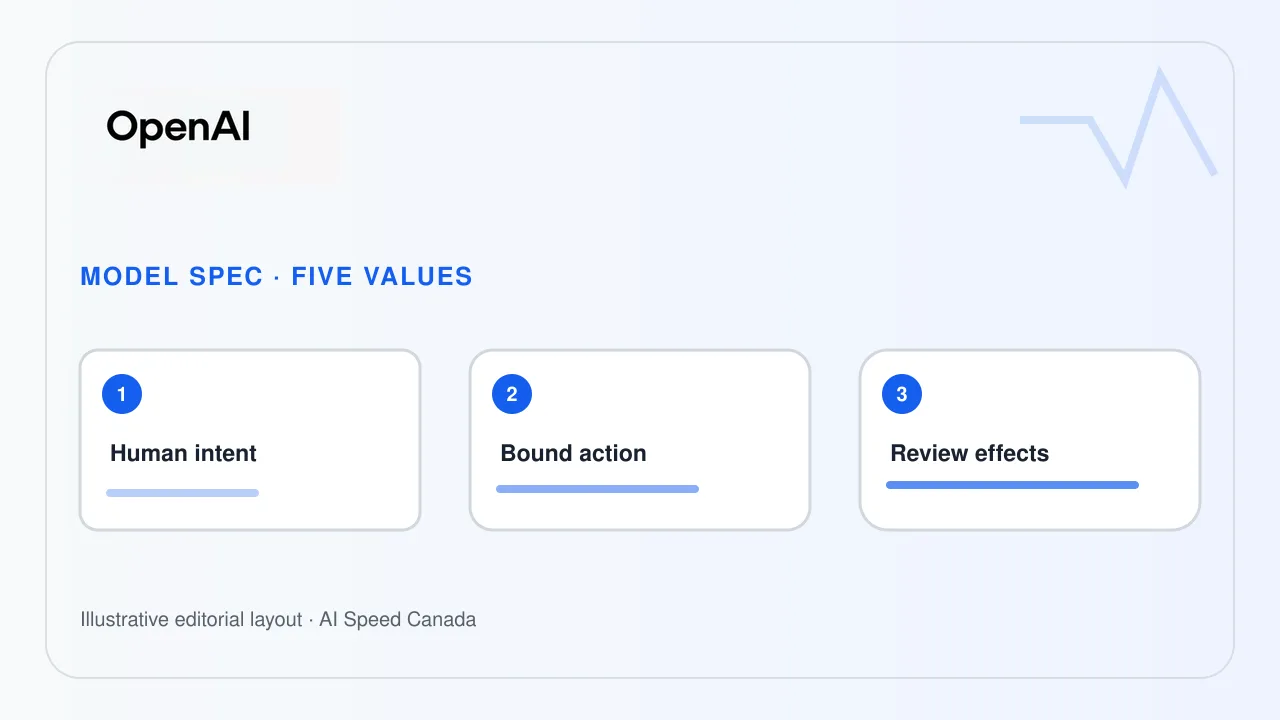
OpenAI published an updated Model Spec on October 29, 2026. The document describes how the company wants GPT systems to behave, reorganizing earlier rules around five values: faithfulness to human intent, harm minimization, honesty and transparency, human agency, and care. It is a normative specification and training target—not proof that every model response will satisfy every principle.
The revision changes the structure and adds agent guidance
OpenAI says the update adds guidance on context, memory, personalization, oversight and agency, while revising how a model should control and communicate side effects. It also replaces most detailed style guidance with broader behavioural principles and uses “GPT” instead of “the assistant” to reflect systems that can take actions as well as answer questions.
The chain of command remains important. OpenAI sets platform boundaries; developers direct an application within them; users give instructions within both layers. A higher-level rule can override a lower-level request, so an apparent refusal or clarification may reflect the surrounding product policy rather than the user prompt alone.
Related sources: OpenAI: updated Model Spec ↗ · OpenAI Model Release Notes ↗
Human agency includes informed control over consequential actions
The five-value framing asks models to preserve meaningful human control, particularly when work has side effects. For an agent that can send a message, change a record or run code, a good answer is not only fluent—it must identify uncertainty, respect authorization and make important consequences visible.
Canadian teams should translate that principle into product controls: narrow permissions, confirmation before irreversible actions, logs that a responsible reviewer can understand and a rollback path. A policy sentence cannot replace those engineering controls or the organization’s privacy and sector obligations.
Related sources: OpenAI: updated Model Spec ↗
A public policy is useful evidence, not a reliability score
The Spec gives evaluators a stable source for asking whether observed behaviour matches OpenAI’s stated goals. It does not provide a failure rate for a particular model, language, tool configuration or Canadian deployment. Models may still misunderstand context, follow hostile content or produce an answer that conflicts with the stated values.
Test the exact released model and application on representative tasks. Record refusals, unsupported claims, permission errors and unwanted side effects. Repeat the evaluation after model or policy changes because a living specification and a changing service can shift behaviour without changing an organization’s own workflow.
Related sources: OpenAI: updated Model Spec ↗ · OpenAI Model Release Notes ↗
Read product behaviour and the specification together
Users can use the Model Spec to understand the intended rationale behind clarification, uncertainty or refusal. Developers can cite it when documenting expected behaviour, but should clearly separate OpenAI’s target from their own application rules and observed results.
The strongest evidence is a three-part record: the published policy, the deployed system configuration and reproducible tests. If those disagree, report the disagreement rather than treating the policy as the outcome. The update improves transparency about intent; it does not eliminate the need for monitoring and human judgment.
Sources and editorial method
We use the linked original statements and reports to distinguish documented facts from our analysis. Company announcements describe their authors’ plans and claims; they are not independent verification of future outcomes. This article is dated and will be revised if material evidence changes. Read our editorial standards and corrections process.
- OpenAI: updated Model Spec ↗ — Official October 29 announcement describing the five values and major changes.
- OpenAI Model Release Notes ↗ — Official dated summary of the Model Spec update and its behavioural scope.