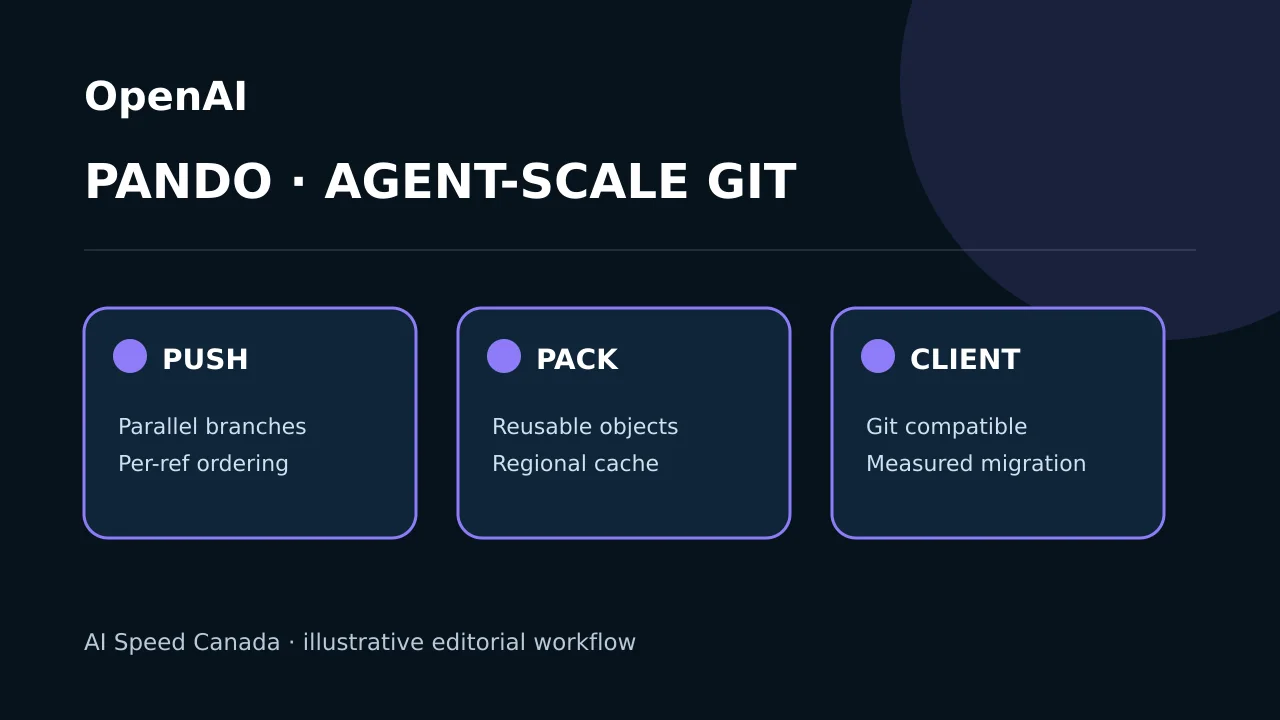
OpenAI described Pando on November 2, 2026, a source-control backend it built as coding agents increased parallel work in the company monorepo. Pando now handles that repository while preserving compatibility with the Git protocol and client. OpenAI reports nearly five-times lower median push latency and almost a petabyte of Git data delivered per day. Those are production claims from the operator, not an independent benchmark or a generally available product.
More agents create a concurrency problem, not just a larger repository
When developers and agents create many branches, pushes and CI jobs at once, a design that orders every repository write through one coordination point can become a bottleneck. OpenAI says its earlier systems experienced slow operations and failed merges as this load increased. Pando instead coordinates updates to each branch independently so unrelated pushes can proceed in parallel.
The design retains serializable updates for an individual reference while relaxing the idea that every branch read must represent one repository-wide instant. Two clients fetching several branches could observe different combinations of recent versions. OpenAI says its workflows do not depend on a global ordering, but that assumption should be reviewed for tools that inventory many refs at once.
Related sources: OpenAI: Scaling Git at OpenAI ↗
Reusable packfiles trade extra bytes for scalable delivery
A conventional Git server often computes a client-specific pack containing the objects the client lacks. Pando stores incoming packs and can reuse them for later fetches, tracking their dependencies in metadata. A regional delivery service caches the packfiles, while background compaction combines many small packs so clients do not need thousands of downloads.
OpenAI reports cache hit rates above 99 percent and says standard cloud virtual machines saturated 10-gigabit links in its tests. These figures describe its environment and workload. They do not establish a cost or performance result for another company, particularly one with smaller repositories, different branching patterns or requirements for a point-in-time view of all refs.
Related sources: OpenAI: Scaling Git at OpenAI ↗
Compatibility let the team migrate without replacing familiar tools
OpenAI first deployed Pando as a read-and-write-through proxy, then moved systems in phases. Standard Git compatibility meant engineers and agents could continue using familiar commands. The company also describes contributing packfile-URI fixes and tracing improvements upstream, while keeping other work in a public patch tracker.
Compatibility is broader than accepting a command. Teams evaluating any alternative backend should test hooks, webhooks, code review, continuous integration, backup, disaster recovery and tools that call legacy repository APIs. A migration is complete only when those dependencies and rollback paths are verified.
Related sources: OpenAI: Scaling Git at OpenAI ↗
The transferable idea is measured architecture, not automatic reinvention
Most Canadian development teams do not need to replace their Git server. They can still learn from the diagnosis: measure push and fetch latency, identify whether contention is per branch or repository-wide, and separate data delivery from negotiation. Optimizing a guessed bottleneck can add operational risk without improving developer time.
Pando is running internally, but OpenAI says it is only exploring ways to share the technology. That is not a product release or availability commitment. The next evidence to watch is public implementation detail, upstream Git changes and results that another operator can reproduce.
Sources and editorial method
We use the linked original statements and reports to distinguish documented facts from our analysis. Company announcements describe their authors’ plans and claims; they are not independent verification of future outcomes. This article is dated and will be revised if material evidence changes. Read our editorial standards and corrections process.
- OpenAI: Scaling Git at OpenAI ↗ — Official November 2, 2026 engineering report; architecture, deployment sequence, tradeoffs and company-reported production measurements.