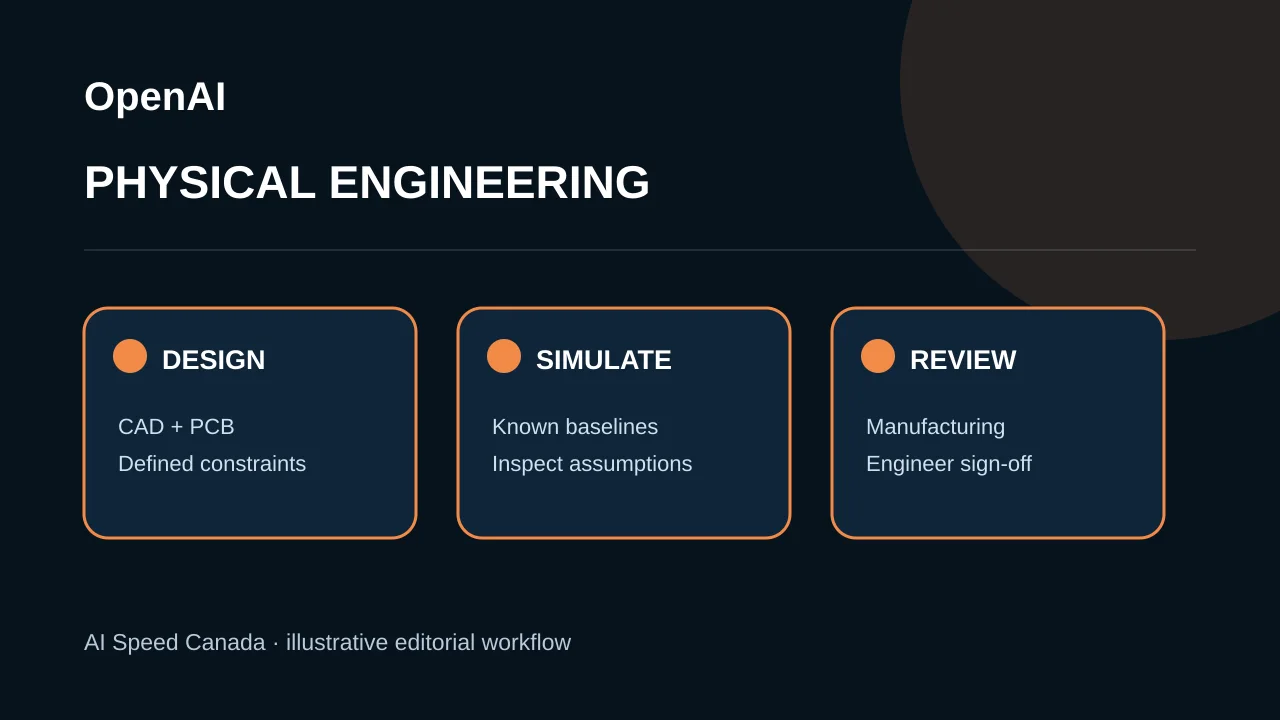
OpenAI published research on November 3, 2026 describing how ChatGPT and Codex are being tested across mechanical design, electronics, simulation and manufacturing preparation. The strongest example is a small device whose enclosure, printed circuit board, interface and software were developed with GPT-6 Astra. Two team members produced the design in under a week as a side project, and a contract manufacturer built a small prototype batch in under a month. Those are company-reported project details, not a controlled productivity study.
The prototype reached hardware, but not without engineering correction
OpenAI says Astra selected components, laid out the PCB, designed internal mechanical structures and generated firmware and integrations. Building physical units is more informative than showing a rendering because fit, electrical connections and assembly expose errors that a screen may hide.
The post also reports several rounds of review and iteration. Astra did not consistently account for manufacturing constraints, tolerances or assembly detail. That limitation is central: a model can create plausible CAD while missing a clearance, material, fastener or fabrication rule that determines whether a part is safe and producible.
Related sources: OpenAI: Accelerating engineering for the physical world ↗
BenchCAD measures selected design tasks, not the whole product lifecycle
OpenAI reports that a newer internal model scored 0.875 on BenchCAD 2.0, compared with 0.594 for GPT-6 Astra at its highest reasoning setting. The benchmark covers reconstruction of 3D parts and assemblies plus identification of circuit-board connections. It does not by itself measure certification, supplier variation, fatigue, serviceability or manufacturing yield.
The 23-fold growth in token use across OpenAI hardware teams since February is adoption evidence, not an efficiency result. A team can use more tokens because the system is useful, because workloads expanded or because tasks require repeated correction. Useful evaluation pairs usage with elapsed engineering time, escaped defects, review effort and downstream rework.
Related sources: OpenAI: Accelerating engineering for the physical world ↗
Industry collaborations are tests, not completed commercial outcomes
OpenAI describes work with Chip Ganassi Racing on converting part scans into editable CAD and manufacturing drawings. Engineers review accuracy and manufacturability. A new Mazda collaboration will explore aerodynamics and crash-safety simulation; OpenAI says progress will be shared later.
These descriptions establish active collaborations, not validated vehicle improvements or regulatory approval. Simulated airflow and structural behaviour still depend on geometry, boundary conditions, material models and comparison with physical tests. Human sign-off remains especially important when a design can affect safety.
Related sources: OpenAI: Accelerating engineering for the physical world ↗
Canadian teams should measure the review burden as carefully as generation speed
A Canadian manufacturer or engineering consultancy can start with reversible work: reconstruct a non-critical part, prepare a drawing draft or automate a simulation setup whose expected answer is already known. Keep approved libraries, units and tolerances explicit, and prevent models from silently substituting unavailable components.
Record the source model, generated artifact, engineering corrections, physical inspection and acceptance decision. Privacy and export-control requirements may restrict which drawings or supplier files can enter a hosted system. A faster first draft is valuable only when total verified cycle time improves without moving risk into manufacturing.
Sources and editorial method
We use the linked original statements and reports to distinguish documented facts from our analysis. Company announcements describe their authors’ plans and claims; they are not independent verification of future outcomes. This article is dated and will be revised if material evidence changes. Read our editorial standards and corrections process.
- OpenAI: Accelerating engineering for the physical world ↗ — Official November 3, 2026 research report; prototype, internal adoption, benchmark, partner work and disclosed limitations.