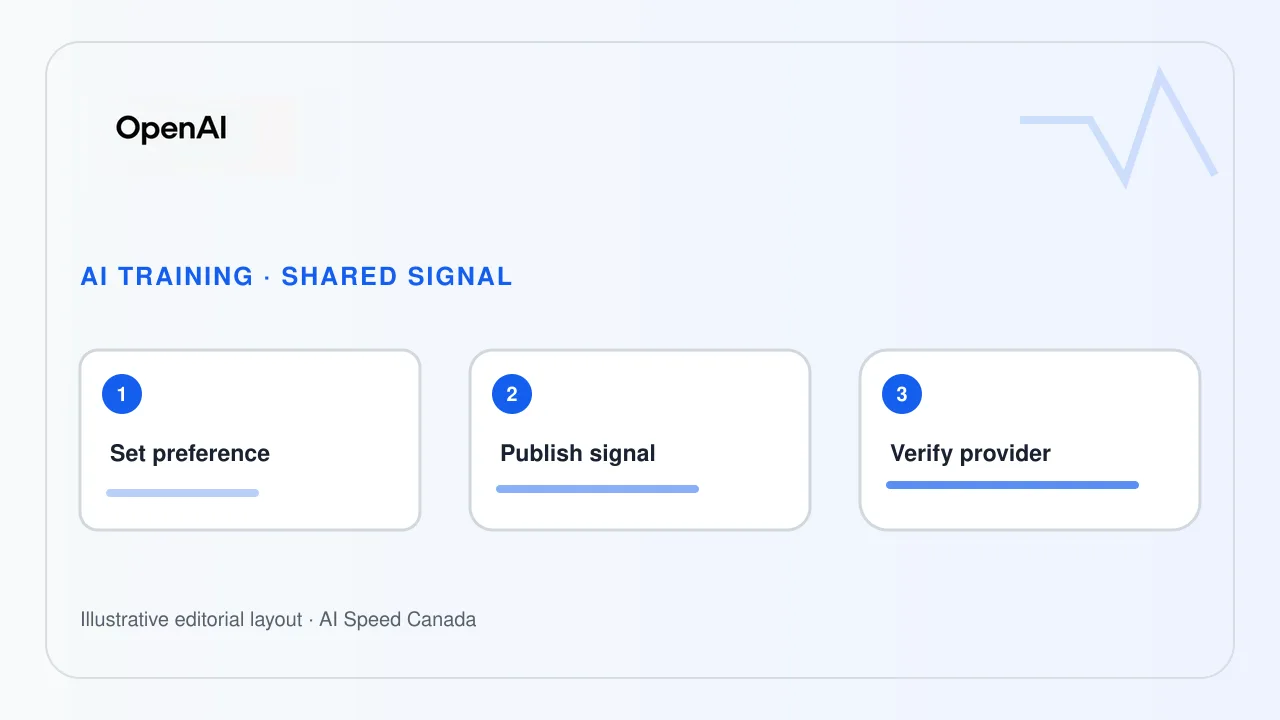
OpenAI announced on October 30, 2026 that it plans to honor a common robots.txt signal for foundational generative-AI training. The proposal is meant to let a website operator communicate one preference to several participating providers rather than maintain separate rules for every crawler. OpenAI says implementation is planned for the coming months, so the announcement is a commitment—not evidence that the shared signal is already enforced on every crawl.
The shared signal addresses training preference, not every automated use
OpenAI describes the signal as a way to express a preference about using site content for foundational generative-AI training. That scope should not be stretched into a promise about search indexing, user-requested browsing, security scanning or every future retrieval product. Different automated activities can have separate crawler identities and purposes.
A Canadian publisher should document the outcome it wants before changing robots.txt. Blocking search discovery, an AI search crawler and model training are different decisions. A compact shared signal may reduce maintenance, but only participating providers and documented uses fall within the announced commitment.
Related sources: OpenAI: helping websites express AI training preferences ↗ · IETF AI Preferences working group ↗
OpenAI has not yet published its final implementation details
The company says it aims to implement the signal in coming months and will issue another update. The announcement does not provide an activation date, exact syntax example, retroactive effect or audit mechanism. Site owners should therefore follow the standards work and wait for provider documentation before assuming a new directive is active.
Existing OpenAI crawler controls remain in place and, according to the company, will continue to be respected. Operators should preserve reviewed rules until they understand how the common signal and provider-specific directives interact. Replacing a working configuration early could create an unintended permission or block.
Related sources: OpenAI: helping websites express AI training preferences ↗ · IETF AI Preferences working group ↗
The proposal sits inside an active standards discussion
OpenAI points to the Internet Engineering Task Force AI Preferences working group and calls the effort voluntary. A standards process can improve interoperability, but an announced participant list or draft does not guarantee identical interpretation, enforcement timing or legal effect across providers.
Implementation evidence should include a stable specification, dated provider documentation, testable crawler behavior and a path for reporting noncompliance. robots.txt is a public machine-readable preference mechanism; it is not access control for confidential files. Sensitive material still needs authentication and server-side authorization.
Related sources: OpenAI: helping websites express AI training preferences ↗ · IETF AI Preferences working group ↗
AI Speed Canada is not changing its crawler policy on a preview
AI Speed currently uses robots.txt for crawl directives and sitemap discovery. This story does not change those production rules because OpenAI has not yet published the final shared-signal syntax and effective behavior. Any future edit should be reviewed against search discovery, news eligibility and the site’s content policy before deployment.
For other site owners, the responsible next step is inventory rather than a rushed edit: list current bot-specific directives, identify which content is public, record training preferences and monitor the final provider documentation. A preference signal can improve communication, but it cannot substitute for licensing decisions or technical access controls.
Sources and editorial method
We use the linked original statements and reports to distinguish documented facts from our analysis. Company announcements describe their authors’ plans and claims; they are not independent verification of future outcomes. This article is dated and will be revised if material evidence changes. Read our editorial standards and corrections process.
- OpenAI: helping websites express AI training preferences ↗ — Official October 30 announcement; intended scope, timeline and relationship to existing controls.
- IETF AI Preferences working group ↗ — Official standards-group page for the ongoing AI preference expression work.