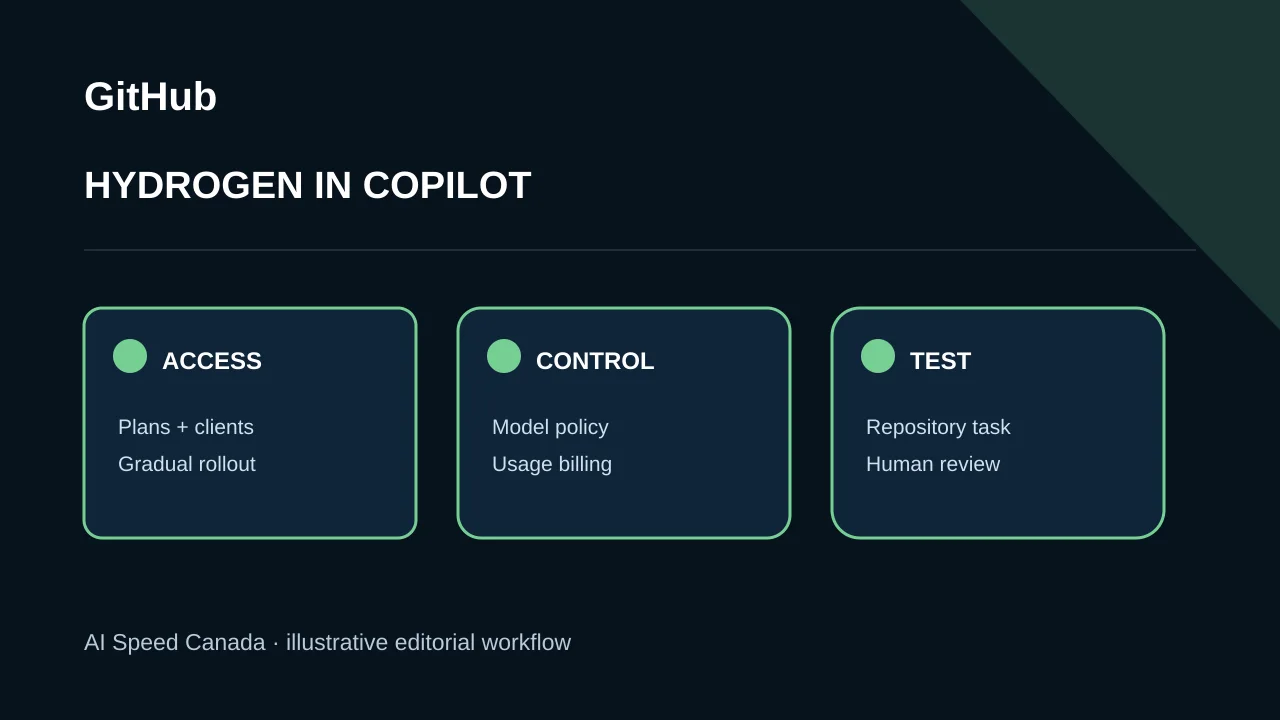
GitHub announced on November 13, 2026 that Gemini 4 Hydrogen is generally available in GitHub Copilot. The event is distinct from Google’s November 12 launch across Search, the Gemini app and developer APIs: GitHub’s notice defines Copilot plans, clients, billing and administrator controls. Availability does not validate generated code or prove the model is fastest for a particular repository.
The client list is broad, while rollout remains gradual
GitHub lists Copilot Pro, Pro+, Max, Business and Enterprise as eligible plans. Supported model pickers span Visual Studio Code, Visual Studio, Copilot CLI, the coding agent, Copilot app, github.com, GitHub Mobile, JetBrains IDEs, Xcode, Eclipse and the Copilot SDK.
GitHub also says rollout is gradual. A missing picker can therefore reflect rollout timing, client version, plan or policy rather than a universal outage. Record the client, version, account and organization before escalating an access problem.
Related sources: GitHub: Gemini 4 Hydrogen in GitHub Copilot ↗
Business and Enterprise administrators control model access
Administrators can manage Hydrogen through Copilot model policy. Under default enablement, new models are on unless the global default or the specific model was disabled. Teams with an approved-model list should review policy deliberately rather than inheriting a new provider route unnoticed.
GitHub says Hydrogen uses provider list pricing under usage-based billing. Exact cost depends on current GitHub documentation and consumption, so organizations should inspect the account’s billing configuration rather than copying an old public price into a budget.
Related sources: GitHub: Gemini 4 Hydrogen in GitHub Copilot ↗
Use a repository-specific comparison before routing work
GitHub describes Hydrogen as designed for fast agentic coding, tool use and multistep work with improved instruction following over Gemini 3.8 Flash. Those are product claims. Compare it on a labelled set of repository tasks and capture tests, failed tool calls, security findings, review edits, latency and billed usage.
For Canadian deployments, verify contractual terms, data location expectations and bilingual prompts where relevant. Keep human approval before merges and releases. A model’s general availability expands choice; it does not transfer accountability from the organization operating the workflow.
Sources and editorial method
We use the linked original statements and reports to distinguish documented facts from our analysis. Company announcements describe their authors’ plans and claims; they are not independent verification of future outcomes. This article is dated and will be revised if material evidence changes. Read our editorial standards and corrections process.
- GitHub: Gemini 4 Hydrogen in GitHub Copilot ↗ — Official November 13, 2026 release; eligible plans, supported clients, gradual rollout, administrator policy and billing basis.
- Google: introducing Gemini 4 Hydrogen ↗ — Official November 12 model announcement; broader positioning and provider-reported evaluations.