GitHub detailed a new Git storage architecture called Rubicon on November 5, 2026. The company reports internal tests with 5,000 concurrent agents and 7,200 pushes per second to one repository while serving reads with consistently low latency. The system is in limited private preview, with broader rollout planned for early next year. Those results are GitHub’s measurements under its test conditions, not a general throughput promise.
Only small reference updates need global ordering
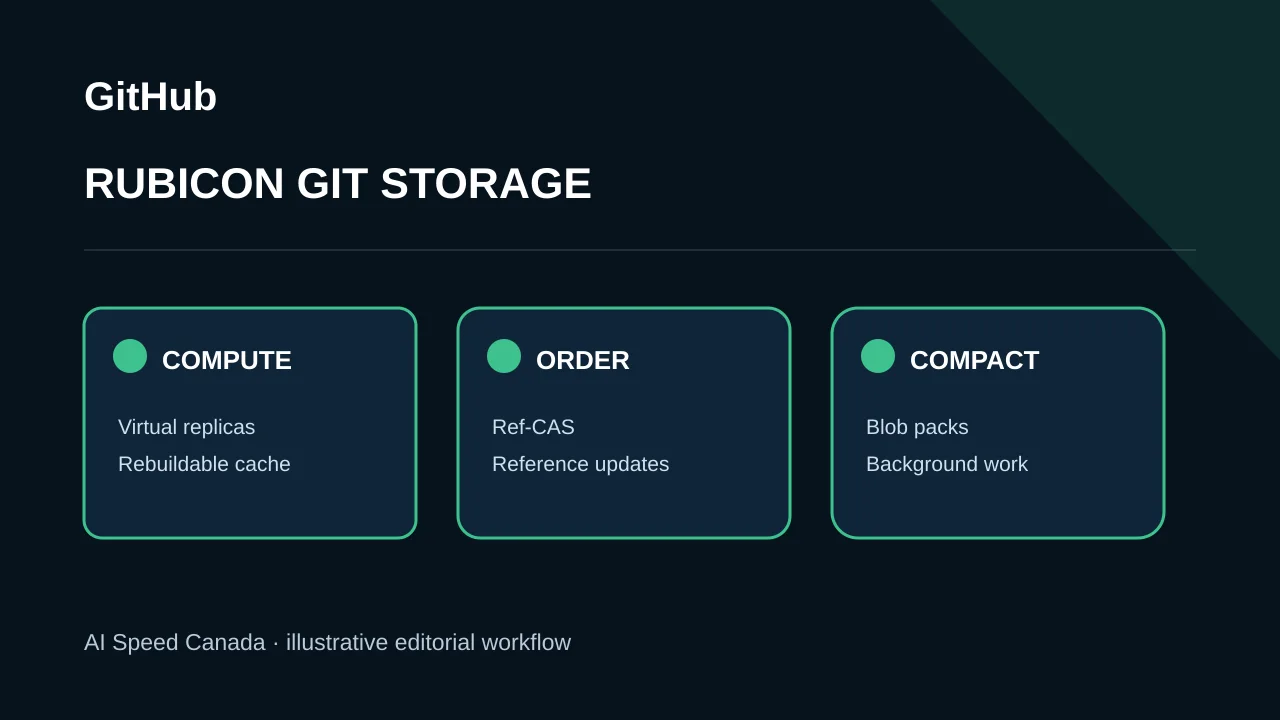
Git objects are immutable and identified by content, so many writers can upload packs without coordinating every byte. Rubicon stores packs in Azure Blob Storage and keeps references plus the pack manifest in a replicated log service called Ref-CAS.
A write uploads an indexed pack, then commits a transaction that adds it to the manifest and updates references. Separating object storage from ordered reference state reduces the coordination on each push, while still requiring correctness around conflicts and protections.
Related sources: GitHub: Inside the new Git storage architecture ↗
Virtual replicas are disposable compute with rebuildable caches
Spokes routes traffic to a small group of virtual replicas. Their local disks cache repository data; durable state remains in Blob Storage and Ref-CAS. More replicas can be added for busy repositories without making a particular machine authoritative.
This design can improve scaling and recovery, but the blog does not provide an independent availability study or every failure mode. Tenant isolation, fairness, cache warming and regional behavior remain operational concerns to measure during rollout.
Related sources: GitHub: Inside the new Git storage architecture ↗
Compaction moves away from request-serving nodes
Each push adds a pack. Dedicated compaction workers lease shards, combine packs, verify that objects are preserved and update the manifest. Garbage collection later removes unreachable objects. Request-serving replicas can therefore focus on reads and writes.
GitHub reports a flat latency curve as write load rises. That is internal evidence. Production evaluation should track push latency distributions, fetch amplification, failure recovery, repository protections and cost—not only a peak rate.
Related sources: GitHub: Inside the new Git storage architecture ↗
Canadian developers keep the Git interface but should watch data location and rollout
GitHub says ordinary push, fetch and branch behavior remains familiar. Canadian organizations should still review where repository data and logs are stored, contract terms, export paths and service dependencies when architecture or regional placement changes.
The practical next step is no migration based on a blog post. Watch preview eligibility, documented limits and measured performance on real repositories. Planned clone-free APIs, global replicas and agent event streams are future work, not current availability.
Sources and editorial method
We use the linked original statements and reports to distinguish documented facts from our analysis. Company announcements describe their authors’ plans and claims; they are not independent verification of future outcomes. This article is dated and will be revised if material evidence changes. Read our editorial standards and corrections process.
- GitHub: Inside the new Git storage architecture ↗ — Official November 5 architecture report; internal tests, Rubicon design, limited-preview status and future plans.